
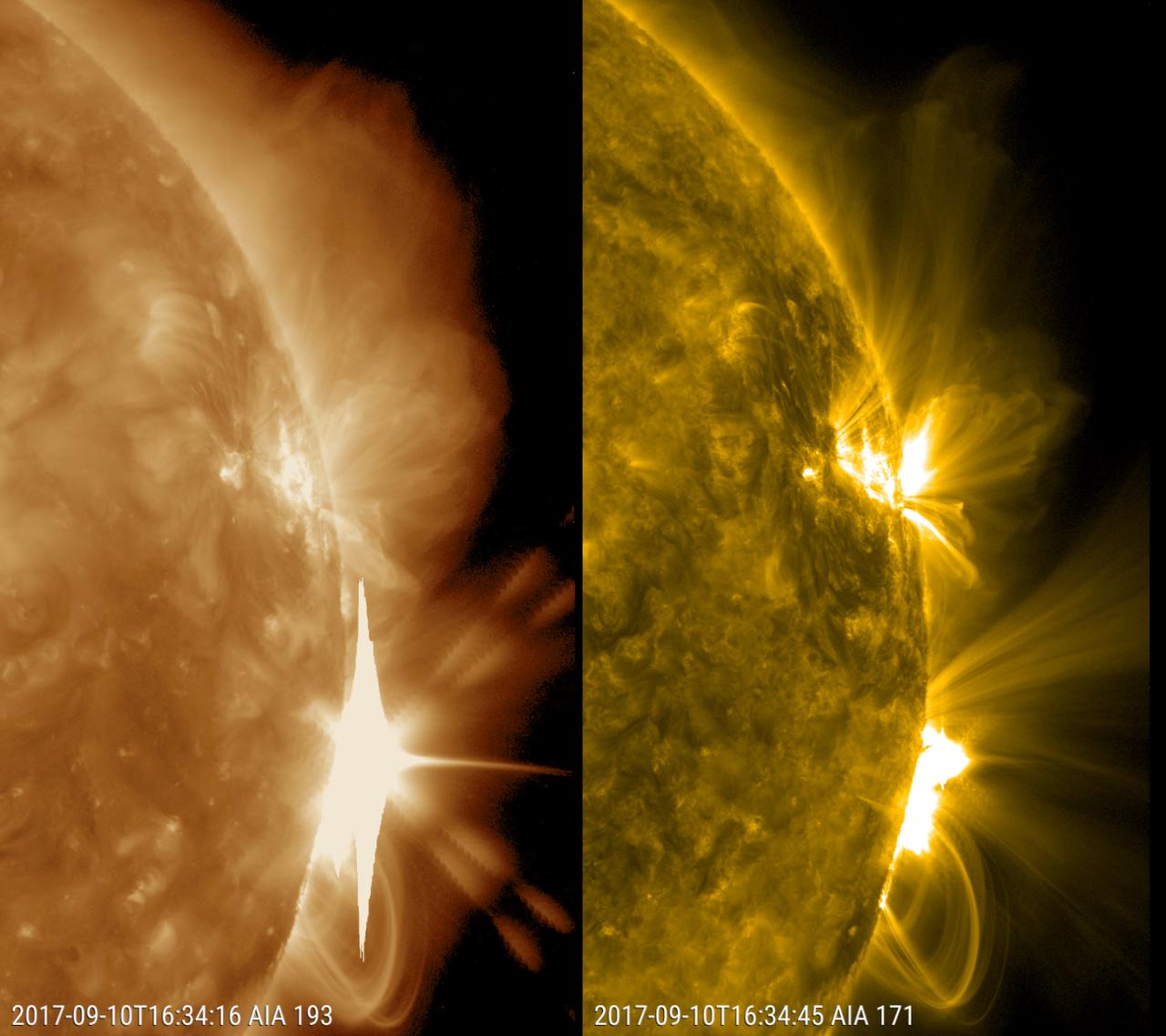
The sun has produced a genuinely messy sunspot this week, and it's making forecasters' jobs harder at the worst possible moment. Sunspot region AR4513 fired an M6.9-class solar flare on August 25, 2026 — the strongest in a burst of five M-class flares from the same region — and NOAA's Space Weather Prediction Center has responded by posting a G2 geomagnetic storm watch. The complication: coronal mass ejections (CMEs) are now racing toward Earth with arrival timing uncertain enough that nobody can yet say whether the resulting aurora will show up before, during, or after the deep partial lunar eclipse expected the night of August 27-28.
That's an unusually specific kind of frustration for skywatchers. A lunar eclipse is calendar-certain — it will happen on schedule regardless of what the sun does. An aurora display triggered by a CME is not; it depends on solar wind conditions that remain genuinely unpredictable until the ejected plasma is nearly on Earth's doorstep.
What's actually happening on the sun
According to NOAA's live Solar Region Summary, AR4513 sits at solar coordinates N04W04 — close to disk center, meaning it's currently facing Earth almost head-on — and carries a Beta-Gamma-Delta magnetic classification, McIntosh class Ekc. That classification matters more than the jargon suggests. Beta-Gamma-Delta regions are the most magnetically tangled sunspots the classification system recognizes: they contain umbrae of opposite polarity crowded together within a single penumbra, a configuration that stores enormous magnetic energy and releases it unpredictably. NOAA counts 13 large sunspots and 21 total spots within the region, spanning an area of 310 millionths of the visible solar hemisphere — genuinely large by sunspot standards. Spaceweather.com, which tracks solar activity independently, pegged the day's sunspot number at 83 and confirmed the region's beta-gamma-delta configuration, the G2 watch, and CME arrival timing that stretches across August 27-28. EarthSky's solar activity desk corroborated the broader picture: five M-class flares from AR4513, capped by the M6.9 event, with forecasters flagging a possible Earth-directed CME component given the region's near-central position on the disk.
Why the timing is such a moving target
CME arrival forecasting is one of the tougher problems in space weather prediction, and this event illustrates why. Unlike light, which reaches Earth from the sun in about eight minutes, a CME is a slow-moving cloud of magnetized plasma that typically takes one to three days to cross the roughly 93 million miles between the sun and Earth. Forecasters model that transit time using measurements of the CME's initial speed and direction, but small errors in those inputs compound over the multi-day journey — and multiple CMEs launched close together can interact, speeding up, slowing down, or merging in ways that shift the arrival window by many hours.
Space.com's August 26 report on the event noted that NOAA has issued its geomagnetic storm watch specifically because CMEs are inbound, with northern lights possible on August 27-28 — the same nights as the eclipse. But "possible" is doing real work in that sentence. Spaceweather.com's own coverage flagged that NASA and NOAA forecasting models don't fully agree on when the CME material will actually arrive — NASA's modeling points to arrival just before the lunar eclipse, NOAA's to just after — which is precisely why the overlap with the eclipse remains an open question rather than a promise.
What a G2 storm would actually look like
NOAA's geomagnetic storm scale runs from G1 (minor) to G5 (extreme). A G2 event is classified as "moderate" — strong enough to push the aurora oval well south of its usual high-latitude range, potentially making the northern lights visible across the northern tier of the continental United States and comparable latitudes elsewhere, but not the kind of extreme storm that threatens satellite operations or power grids the way a G4 or G5 event can. For skywatchers, a G2 watch is a genuine reason to check conditions after dark, not a guarantee of a dramatic show — actual visibility depends on local cloud cover, light pollution, and precisely when the storm's effects peak relative to nightfall at a given location.
Why It Matters
AR4513's activity is a useful reminder that solar weather and calendar astronomy run on fundamentally different clocks. The August 27-28 partial lunar eclipse will happen exactly when orbital mechanics say it will, full stop. Whether it's accompanied by aurora is a separate question that depends on a magnetically unstable sunspot's continued behavior and on CME transit physics that even professional forecasters can't pin down precisely until the plasma is nearly here. That's not a flaw in the science — geomagnetic storm forecasting has improved substantially, but a multi-day, roughly 93-million-mile plasma transit is inherently harder to time than an eclipse governed by centuries of orbital data. For anyone planning to watch the sky this week, the practical takeaway is to treat the eclipse as the sure thing and the aurora as a bonus worth checking for, not banking on. Events like this also matter beyond the view: strong flares and CMEs from Beta-Gamma-Delta regions are the same class of activity that can degrade GPS accuracy, disrupt high-frequency radio communications, and — in more severe cases — stress power grid infrastructure, which is why NOAA tracks regions like AR4513 continuously rather than just when they produce a headline-grabbing flare.
