
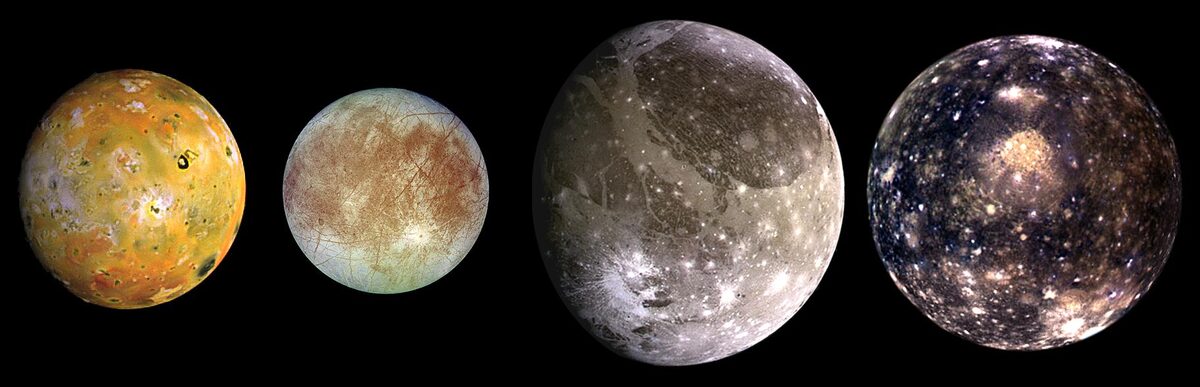
Jupiter's four big moons spend most of their time politely avoiding one another as seen from Earth. Every so often, though, the geometry changes and they begin to overlap: one moon slides in front of another, or drops into another's shadow and fades. According to David Dickinson's Sep 17, 2026 piece at Universe Today, one of those seasons is underway now, and the planet is prominent in the pre-dawn sky in time to watch it.
Why the moons only line up now and then
The reason these "mutual events" come in seasons comes down to tilt. Per Universe Today, the moons' orbits are inclined by less than one degree to Jupiter's equatorial plane, and that equatorial plane is itself tilted just over three degrees to Jupiter's orbit around the Sun. Universe Today notes that, like eclipses on Earth, mutual events would be a continual state of affairs if those orbits were not tipped slightly. Because they are, the moons and their shadows only line up during seasons.
Those seasons are centered on once every five years, which is about half the time it takes Jupiter to orbit the Sun. The current one runs from late 2026 into early 2027, and Universe Today says events involving the four moons are becoming more frequent.
Universe Today lists the possibilities: occultations, where one moon passes in front of another, and eclipses, where the shadow of one moon crosses the disk of another. Each can be total, annular or partial. It also notes that Callisto resumed casting a shadow on Jupiter on May 20, 2025, and that this continues until Aug 5, 2028. The middle of the formal eclipse season falls around mid-October 2026.
Where and when to look
Timing your observing around Jupiter's position matters as much as the events themselves. Jupiter passed solar conjunction on July 29 and is now prominent in the pre-dawn sky, Universe Today says. EarthSky's September sky guide describes the planet lying in the east shortly before sunrise in early September. By mid-month, it says, Jupiter is joined by Regulus, the brightest star in Leo the Lion, and by the end of September their gap narrows as the pair climb higher above the eastern horizon.
That gives observers a handy landmark: find the bright planet near Regulus in the east before dawn, and you have found the target.
Two more dates from Universe Today are worth pencilling in. Jupiter reaches quadrature, 90 degrees west of the Sun, on Nov 18, and opposition on Feb 11, 2027. Universe Today ties both to how the moons' shadows fall: Jupiter's shadow is cast off to one side around quadrature and falls nearly straight behind the planet near opposition, and the shadows of the moons follow the same pattern.
What a small telescope can show
None of these events is a big visual spectacle. Universe Today points out that observing and imaging them can be challenging because the moons themselves are so small: the largest, Ganymede, presents a disk only 1.3 arcseconds across. Nobody should expect a dramatic, planet-sized eclipse. Even so, the piece says a small telescope will reveal a moon in total eclipse behind the shadow of another, slowly fading from view and then returning. Occultations, it adds, look more like mergers, as the two moons seem to merge and then separate again. That is the kind of event to aim for: subtle, but a direct view of one world's shadow falling on a neighbour.
The moons involved are the four that Galileo is credited with finding in 1610. NASA's Jupiter moons page notes that Simon Marius observed them around the same time, and that the names in use today are the ones Marius proposed in 1614. Ganymede is the largest moon in the solar system, bigger than Mercury and Pluto, and Callisto is Jupiter's second largest moon. Io is the most volcanically active world in the solar system, and Europa is about 90 percent the size of Earth's Moon. NASA lists 115 moons for Jupiter as recognised by the IAU as of August 2026, but only these four are in play for the mutual event season.
Find the predictions before you go out
Do not rely on a summary article for exact times. Universe Today names resources for predicting the phenomena: the IMCCE ephemeris site (spelled "ICMME" in the piece) and the SETI PDS Rings node, plus planetarium programs such as Stellarium, which it calls serviceable for predicting and simulating the events. Check one of those tools before you plan a night around a particular event. Event times depend on where you are, and so does whether Jupiter is above your horizon when they happen.
The rare one: a triple shadow transit
Io, Europa and Ganymede sit in a 1-2-4 orbital resonance, which means Io makes two orbits around Jupiter for each one of Europa's. That makes a rare configuration possible: a triple shadow transit. Universe Today says the last such instance was on Jan 24, 2015, and the next is on March 20, 2032. That falls well outside this season, so anyone hoping to see one will have to wait.
Why It Matters
The mutual events are more than a sky show. Observing them helps pin down where the moons actually are, and a peer-reviewed example shows how precisely that can be done.
A 2023 paper on arXiv (Catani et al.) reports on the 2021 Brazilian campaign to observe Jovian mutual phenomena. The data correspond to eight events between Galilean satellites, plus a rare eclipse of the inner satellite Thebe, for nine events in total. The team simulated the light curves with a geometric model built on the DE440 and JUP365 ephemerides, used the complete version of the Oren-Nayar reflectance model, and fitted the simulations to the observations with Monte Carlo methods and chi-squared statistics. The average uncertainty on the relative positions of the Galilean satellites came out at 5 milliarcseconds, or about 15 kilometres.
The authors say their results contribute to the ephemeris database, which is fundamental to improving satellite orbits and reducing their uncertainties. The 2021 paper is background rather than a 2026 result, but it shows why careful observation of a season like this one has scientific value beyond simply watching.
For a backyard observer with a small telescope, the practical message is simpler. The season's midpoint falls in mid-October, Jupiter is up before dawn, and Universe Today describes these seasons as coming roughly once every five years. Check a predictions tool, find Jupiter near Regulus, and watch the moons.
Sources
- Catching 2026 Jovian Moon Mutual Eclipse Season (Universe Today, David Dickinson, Sep 17, 2026)
- The 2021 mutual phenomena involving the Galilean satellites of Jupiter and the inner satellite Thebe (Catani et al., arXiv:2310.00807, 2023)
- Visible planets and night sky guide for September (EarthSky, Sep 19, 2026)
- Jupiter Moons (NASA Science)
