
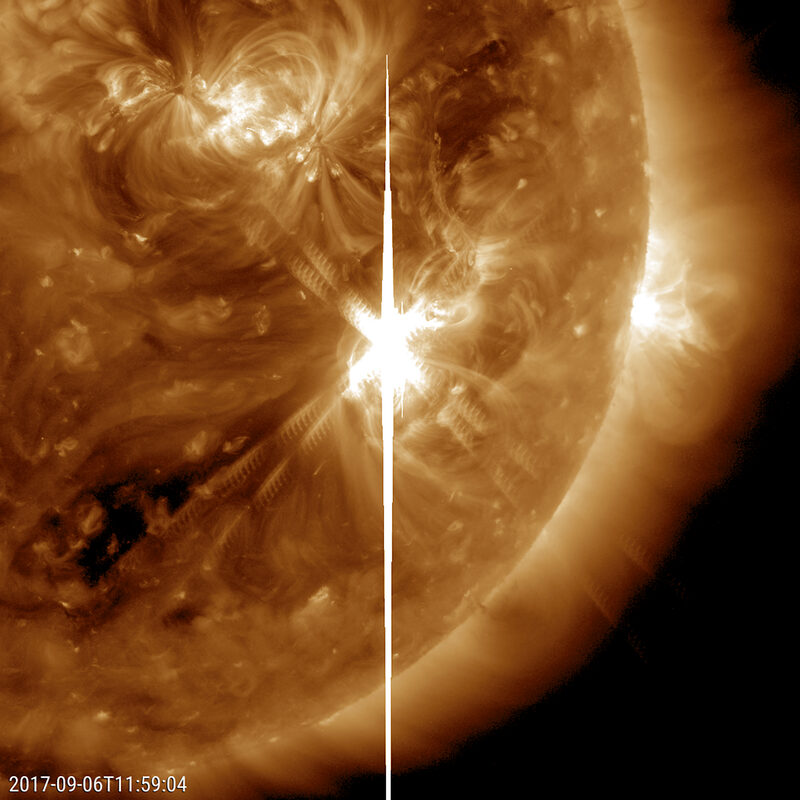
Active region AR4485 has spent the past few days putting on a going-away show. The sunspot cluster — flagged by the National Oceanic and Atmospheric Administration's Space Weather Prediction Center (NOAA/SWPC) as a region complex enough to drive continued flare risk, and independently described by EarthSky as "the period's most complex and active region" — produced an M1.19-class flare on July 12, according to full-disk and close-up imagery posted to the Cloudy Nights astronomy forum that day. By the afternoon of July 12, NOAA logged the region's largest flare of the 24-hour period: a C2.6 at 13:58 UTC, as AR4485 continued its slow rotation toward the sun's western limb.
Amateur solar imagers caught the M1.19-class flare in real time. A post to the Cloudy Nights astronomy forum on July 12 documented it with full-disk and close-up imagery plus a 40-minute animation. NOAA's own discussion for the period doesn't itemize that specific flare by classification or timestamp, but it independently confirms AR4485 as the day's most active region, citing the C2.6 at 13:58 UTC as the strongest flare of its 24-hour summary — while EarthSky's separate tracking puts the day's strongest flare, also a C2.6, at 13:46 UTC, a minor discrepancy between the two trackers' timing.
A Busy Region on Its Way Out
According to EarthSky's tracking, AR4485 wasn't a one-flare wonder. The region fired at least six of eight flares tracked across the disk that day — four C-class and four B-class — with the strongest of the bunch, the C2.6, peaking at 13:46 UTC. NOAA classifies AR4485's magnetic configuration as "beta-gamma," a designation reserved for sunspot groups complex enough to store energy for stronger eruptions. That complexity is why forecasters aren't ready to write the region off just because it's heading off-disk: SWPC's discussion notes a chance for additional M-class flares even as AR4485 slides toward the limb.
That exit is imminent. NOAA forecasters expect solar activity to remain low through July 13, with Region 4485 expected to have rotated far enough behind the sun's western limb by July 14 to minimize most flare-activity impacts on the visible disk. Solar rotation being what it is, a region that disappears over the limb can, in principle, reappear roughly two weeks later on the other side, though NOAA's discussion makes no forecast that far out. In the meantime, NOAA reports that a new active region, numbered 4489, has breached the eastern limb, giving space weather watchers a fresh spot to track as AR4485 makes its exit.
The CME Question: A Glancing Blow, Not a Direct Hit
Flares themselves are bursts of electromagnetic radiation that arrive at Earth at light speed, capable of causing brief radio effects on the sunlit side of the planet, but they do not by themselves cause geomagnetic storming. The bigger driver of aurora activity is the coronal mass ejection (CME) — a slower-moving cloud of magnetized solar plasma — and NOAA is tracking one tied to the July 10 activity. Forecasters say a portion of that July 10 CME may reach Earth late on July 13 into the early hours of July 14, though they caution that confidence in both the timing and intensity of the impact is low. EarthSky's tracking independently corroborates the broader picture, noting that as many as four separate CMEs are being monitored for potential glancing blows on Earth's magnetosphere over the coming days.
NOAA's forecast calls for geomagnetic conditions to reach G1 (Minor) storm levels, with a chance of unsettled-to-active conditions spanning July 13 and 14. EarthSky's aurora outlook aligns with that timeline, predicting G1-minor storm conditions possible on July 13 at high latitudes, with Kp 3-4 unsettled-to-active conditions persisting into July 14 before the geomagnetic field settles back to quiet-to-unsettled levels (Kp 1-3) by July 15. NOAA's own forecast likewise anticipates a return to quiet-to-unsettled conditions by the 15th.
One additional data point from NOAA's discussion underscores that the space environment near Earth has already been stirred up: energetic electron flux above 2 MeV — a measure of high-speed particles trapped in Earth's radiation belts — peaked at 3,729 particle flux units at 12:20 UTC on July 12, a level NOAA characterizes as "high." Elevated electron flux doesn't produce aurora on its own, but it's a marker of a magnetosphere that's been recently disturbed, consistent with the flare and CME activity from AR4485 over the preceding days.
Who Might See Something
Given the modest G1 forecast, this isn't shaping up to be a storm that lights up mid-latitude skies. EarthSky's outlook narrows the likely viewing zone to classic high-latitude aurora territory: northern Scotland, southern Alaska, and Iceland are named as locations where a G1-level storm could push the aurora oval far enough south (or, in the Southern Hemisphere's mirror case, far enough north) to be visible. Observers in those regions with clear, dark skies late on July 13 or into July 14 have the best shot, though the low-confidence timing NOAA flagged means the window could shift.
Why It Matters
AR4485's M1.19-class flare and the CME activity trailing it are a useful reminder that space weather doesn't announce itself with the same lead time as terrestrial forecasts. Flares hit with essentially no warning — the event Cloudy Nights documented on July 12 was already fading by the time most casual observers would have seen any alert — while CME arrival times carry real uncertainty even from the professionals tracking them, as NOAA's own "low confidence" language on the July 13-14 window makes clear. For most people, a G1 storm is a non-event: it poses no danger and only rarely disrupts infrastructure, unlike stronger storms further up NOAA's G-scale that can stress power grids and satellite operations. But it's exactly the kind of modest, well-forecast event that gives skywatchers at high latitudes a legitimate shot at aurora on a random Monday night, and it's a low-stakes preview of the kind of monitoring NOAA and independent trackers perform continuously as the sun works through its current activity cycle. Regions like AR4485 — complex, beta-gamma, capable of M-class flares — are exactly why that monitoring doesn't stop just because a sunspot rotates out of view.
