
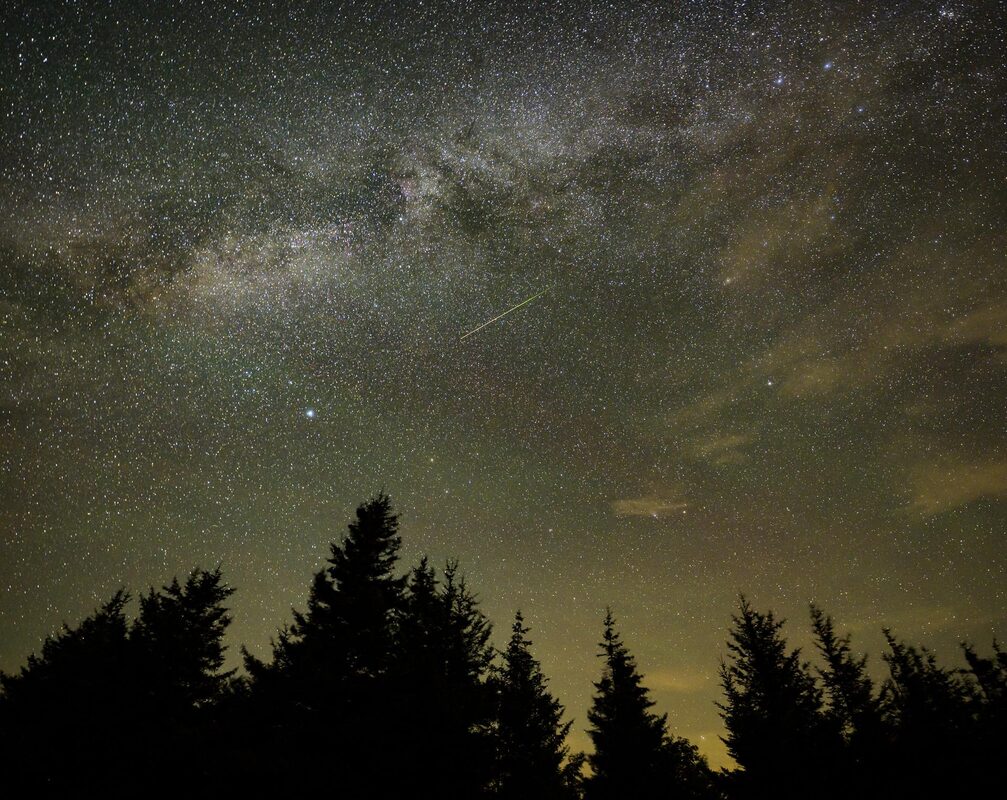
August 2026 is a stacked month for skywatchers, bookended by two eclipses and anchored by what may be the best Perseid meteor shower in years. The headline: the Moon spends the whole month cooperating. It's new for the Perseids' peak, which means a genuinely dark sky for the year's most reliable shower, and then swings all the way to full three weeks later for a deep partial lunar eclipse. Add an evening apparition of Venus at its brightest and best, and there is a reason to go outside on almost any clear night this month.
The Perseids peak August 12-13 under a moonless sky
The Perseid meteor shower, debris from comet 109P/Swift-Tuttle, is active from mid-July through late August, but the payoff is the peak night. The American Meteor Society's 2026 calendar puts the peak on the night of August 12-13, with a zenithal hourly rate (the theoretical best-case count under a perfectly dark sky with the radiant overhead) of about 100 meteors per hour. EarthSky and in-the-sky.org both put the sharpest activity in the pre-dawn hours of August 13.
What makes 2026 special is timing: New Moon falls on August 12, the same day the shower peaks, so there is no moonlight at all to wash out faint meteors. That is not guaranteed every year — some Perseid peaks land under a bright Moon that cuts visible rates by more than half. This year, real-world counts from a dark rural site should run well above what most people are used to seeing. The Perseid radiant sits in the constellation Perseus, in the northeast; classic advice applies — look about 30-40 degrees away from the radiant itself, give your eyes 20-30 minutes to adapt to the dark, and watch after midnight when Perseus climbs higher.
An eclipsed Sun opens the month — and it's not for U.S. eyes
That same New Moon on August 12 is also what produces a total solar eclipse — new moon is a prerequisite for any solar eclipse, since the Moon has to pass directly between Earth and the Sun. NASA's eclipse page confirms the path of totality crosses the Arctic, Greenland, Iceland, and northern Spain, with a partial eclipse reaching parts of the northern United States, from Alaska to North Carolina. We've published a full viewing guide with exact times, safety rules, and weather odds if you're within range or traveling for it. For most of North America, though, this is a Perseids month, not an eclipse month.
Venus at its evening best
Venus reaches greatest eastern elongation — its widest apparent separation from the Sun as seen from Earth — at 06:00 UTC on August 15, according to EarthSky and in-the-sky.org. At roughly 46 degrees from the Sun and shining at magnitude -4.4, this is Venus at its highest and most prominent in the evening sky all year: look west after sunset and it will be unmistakable, outshining every star. Because Venus is near dichotomy (half-illuminated, like a mini quarter Moon) around this same period, it's also a rewarding target for a small telescope.
Mercury's best morning show, and Jupiter shifts to dawn
Mercury reaches greatest elongation west on August 2, putting it as high as it gets in the pre-dawn sky for observers with a clear, low eastern horizon — in-the-sky.org notes it stays well-placed for viewing into the first days of the month. Jupiter, which has spent the first half of 2026 in the evening sky, crosses into the morning sky in mid-to-late August; it will be a modest, low target for early risers this month rather than the dominant evening presence it was earlier in the year, and it has a close conjunction with Mercury low in the dawn twilight around August 15.
The Sturgeon Moon and a near-total partial lunar eclipse (Aug 27-28)
The month closes with its second eclipse. The full Sturgeon Moon — named for the giant lake sturgeon once abundant in the Great Lakes and Lake Champlain during this part of summer — reaches peak fullness on August 28 at roughly 04:18 UTC (about 12:18 a.m. Eastern). That same night brings a partial lunar eclipse, with greatest eclipse at 04:13 UTC. Per EarthSky's eclipse coverage, Earth's dark umbral shadow will cover about 93% of the Moon's disk at maximum — deep enough that the shaded portion should glow a dim coppery red, similar to a total lunar eclipse, while a bright sliver along the northeastern limb stays in direct sunlight. The event is visible across the Americas, Europe, Africa, and the eastern Pacific, meaning most of the United States gets a good view overnight into the early hours of August 28 — no eclipse glasses needed for this one; lunar eclipses are safe to watch with the naked eye the entire time.
Why It Matters
Most months offer one good reason to look up. August 2026 offers four, and they are connected by the same piece of orbital mechanics: eclipses only happen at new Moon (solar) or full Moon (lunar), and this month's New Moon happens to land exactly on the Perseids' peak night, clearing the sky for meteors at the same time it blacks out the Sun for a lucky sliver of the Arctic and Europe. Three weeks later the Moon swings to full and very nearly repeats the trick in reverse, sliding deep into Earth's shadow. None of this is coincidence so much as a reminder of how the calendar of celestial events is really just the geometry of three bodies — Sun, Earth, and Moon — playing out on a predictable clock. For casual observers, the practical takeaway is simpler: this is one of the more rewarding months of 2026 to spend a few minutes outside after dark, and the Perseids' moonless peak alone is worth setting an alarm for.
