
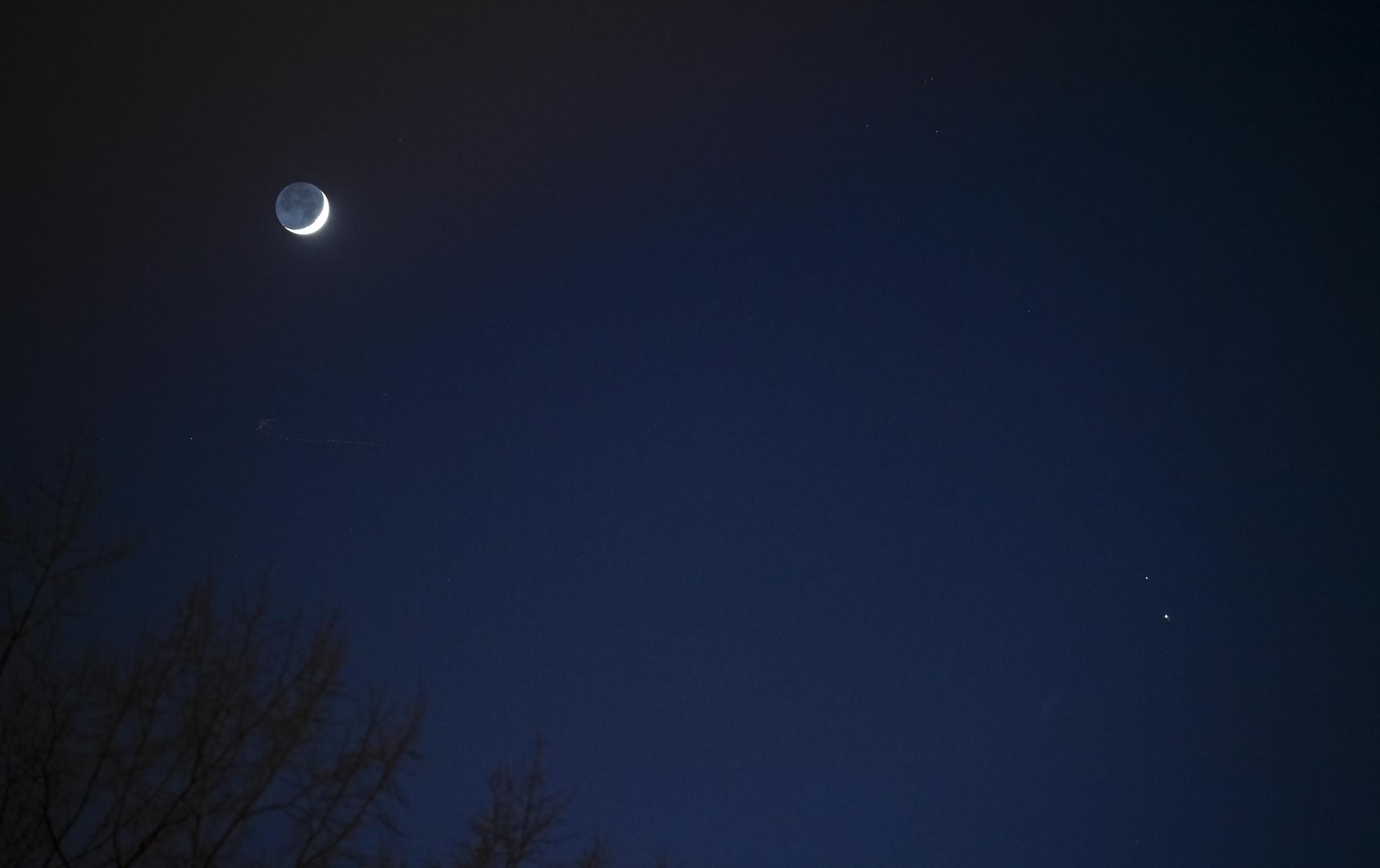
Set an early alarm. On the mornings of July 11 and 12, 2026, a waning crescent Moon will glide through the eastern sky before sunrise, passing close enough to Mars, Saturn, and Uranus to act as a natural signpost for all three. NASA's monthly "What's Up" skywatching guide flagged the lineup, and independent coverage from NewsBytes and Fox Weather corroborates the timing and the recommendation to get outside before dawn.
None of this requires special equipment to start — the Moon itself is the whole point. Find it low in the east in the hour or two before sunrise, and the rest of the lineup falls into place nearby.
What You'll Actually See
According to NASA's guide, Mars will appear as "a small reddish point of light" close to the Moon — dim by the standards of a planet that can blaze orange-red at opposition, but identifiable once you know where to look. Saturn will be the easier catch of the two naked-eye planets: brighter, steadier, and less easily mistaken for a star. Uranus rounds out the trio, but it's the one planet in the group that naked-eye viewers won't pick up. NASA and NewsBytes both note it requires binoculars or a telescope to resolve, even with the Moon as a guide.
NewsBytes describes the event as a "planetary parade" and echoes NASA's practical advice: this specific grouping — Moon, Mars, Saturn, and Uranus within the same patch of predawn sky — isn't a common occurrence, which is the whole reason to bother waking up for it.
The Rest of July's Sky Calendar
The July 11-12 lineup doesn't happen in isolation. Fox Weather's broader roundup of the month places it inside a busier stretch of orbital coincidences:
- July 4: A Mars-Uranus conjunction brought the two planets to within 0.1 degrees of each other — the closest they'll appear until 2053, per Fox Weather.
- July 6: Earth reached aphelion, its farthest point from the Sun for the year.
- July 7: A Moon-Saturn conjunction preceded the mid-month lineup by several days.
- July 11-12: The Moon-Mars-Saturn-Uranus predawn grouping covered above.
- July 14: New Moon, per NASA — which strips out lunar glare and opens a dark-sky window for fainter targets.
- July 17: A Moon-Venus conjunction, per Fox Weather.
That July 14 New Moon is worth circling separately. NASA's guide notes it creates favorable conditions for spotting Comet 10P/Tempel 2 in the constellation Capricornus, as well as for general Milky Way viewing away from city lights. NASA also flags that Saturn's rings will appear unusually thin in late July — a seasonal viewing angle effect rather than anything happening to the rings themselves — and lists the month's remaining Moon phases: Last Quarter on the 7th, First Quarter on the 21st, and Full Moon on the 29th.
How to Watch It
No special gear is needed to catch the Moon, Mars, and Saturn — this is a naked-eye event for three of the four objects. A clear view of the eastern horizon matters more than optics, since everything will sit relatively low in the sky in the pre-sunrise window. For Uranus, binoculars are the minimum; a telescope makes it easier still, since the planet's pale blue-green disc is faint enough to get lost against the brightening dawn sky.
Timing is the other variable. "Predawn" is doing real work in every source describing this event — get out too late and rising twilight will wash out the fainter members of the group, particularly Mars and Uranus, before Saturn or the Moon are affected.
Why It Matters
Planetary conjunctions and lunar pairings don't change the physics of the solar system — the planets are simply continuing along their ordinary orbits, and what shifts is the line-of-sight geometry as seen from Earth. But that's exactly what makes events like this useful as a public entry point into astronomy: no telescope, no dark-sky preserve, no specialized knowledge required to start. The Moon supplies an obvious, unmistakable reference point, and from there a first-time observer can walk away having correctly identified Mars and Saturn with their own eyes — and, with a pair of binoculars, having spotted Uranus, a planet most people never consciously look for. NASA runs "What's Up" as a monthly guide precisely because these low-barrier events, more than any single spectacular meteor shower or eclipse, are what turn casual sky-glancing into sustained interest in observational astronomy.
