
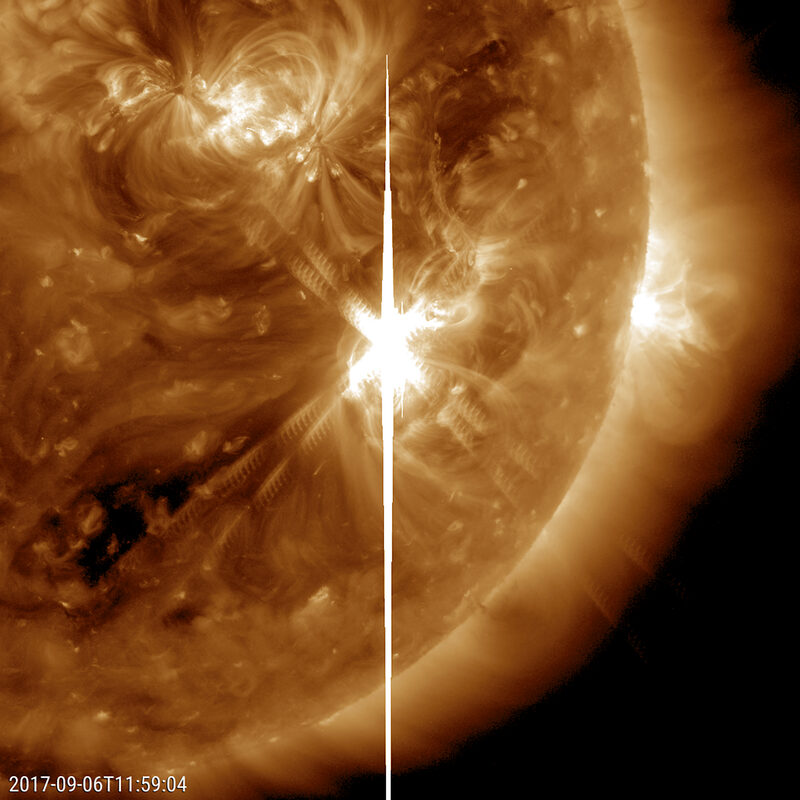
The sun has been busy. On July 7, 2026, an active region designated AR4482 let loose an M4.0 solar flare that peaked at 14:19 UTC, strong enough to blot out a swath of HF radio and navigation signals over the mid-Atlantic in a brief, minor radio blackout. A few hours later, in a separate event, a large filament of magnetized plasma tore free from the sun's northeast limb in a dramatic eruption that didn't even need a flare to make headlines. Now, space weather forecasters say the fallout from that active week is about to arrive at Earth — and it's arriving with company.
NOAA's Space Weather Prediction Center (SWPC) flagged the M4.0 flare's effects in its forecast issued July 7 at 17:50 UTC, logging an active R1 (Minor) radio blackout impact from the event. By July 9, the picture had grown more complicated: a high-speed stream of solar wind pouring out of a coronal hole and a separate, fast coronal mass ejection (CME) that erupted July 5 are both converging on Earth's magnetosphere around the same window. EarthSky, citing NOAA forecasters, describes the coming days, July 9 through 11, as likely to bring "unsettled to active" geomagnetic conditions, with a real if modest chance of minor G1-level geomagnetic storming.
What Actually Happened on the Sun
AR4482 isn't a quiet sunspot. According to SpaceWeather.com's July 9 update, the sun's whole-disk sunspot number stands at 81, and 2026 has seen just three spotless days (2% of the year) to date — a sign of just how active the current solar cycle remains. NOAA forecasters cited by the site put the odds of another M-class flare from AR4482 at 40% over the next 24 hours, with a 10% chance of a full X-class flare, the most powerful category the sun produces. That combination — a flare-productive region plus a CME and a fast solar wind stream both inbound — is exactly the kind of setup space weather watchers pay attention to.
The two July 7 events were distinct in character. The M4.0 flare was a classic flare: a sudden burst of X-ray and radio-wavelength radiation that reached Earth at the speed of light and caused the immediate, short-lived R1 radio blackout over the Atlantic. The filament eruption that followed around 21:00 UTC was different — plasma held aloft by the sun's magnetic field broke loose and blasted outward without an accompanying flare. According to EarthSky, initial analysis of that eruption found its associated CME was directed well away from Earth, a reminder that a filament eruption can launch a CME without ever registering as a flare event — even when, as in this case, the resulting plasma cloud misses our planet entirely.
Why Two Different Solar Wind Sources Matter
Geomagnetic activity at Earth isn't caused by flares themselves — flares are a light show, not a wind. What actually disturbs Earth's magnetic field is charged particles and magnetized plasma physically arriving from the sun, which is why the coronal-hole high-speed stream and the July 5 CME matter more for aurora-watchers than the July 7 flare did. A coronal hole is a region where the sun's magnetic field opens up into space, letting solar wind stream out faster and more steadily than usual; when that stream sweeps past Earth, it can rattle the magnetosphere for days. A CME, by contrast, arrives as a discrete cloud of plasma and magnetic field that can deliver a sharper, shorter jolt. Having both converge on Earth around the same window is what's pushing forecasters toward a G1 storm watch rather than a shrug.
Why It Matters
For most people, the practical upshot of this week's solar activity is aurora. A G1-level geomagnetic storm is the mildest rung on NOAA's five-step storm scale, but it's often enough to push the aurora's visible boundary down from its usual polar perch into the northern tier of the United States and comparable mid-to-high latitude regions elsewhere — think the northern Plains, the Great Lakes, and northern New England on a good night, along with similar latitudes across Europe and Asia. It's not a guarantee, and G1 storms don't typically produce the sweeping, naked-eye displays that stronger storms do, but they're well within range of a camera with a long exposure or a clear, dark sky.
The radio blackout tied to the M4.0 flare is a reminder of the other side of space weather: it isn't just a photography opportunity. R1-level blackouts are minor and short-lived, degrading HF radio communication and GPS-dependent navigation in the sunlit hemisphere for a limited window, but they illustrate the same physics that, at higher magnitudes, can disrupt satellite operations, airline communications on polar routes, and power grid equipment. With AR4482 still active and NOAA giving it real odds of firing off an X-class flare in the near term, this week is a live example of how solar activity translates into concrete, if modest, effects back on Earth.
What to Watch For
SWPC's forecast window runs through July 11, so the geomagnetic response to the incoming CME and solar wind stream should play out over the next several nights. Skywatchers at mid-to-high latitudes hoping for aurora should keep an eye on updated NOAA forecasts as the CME's arrival time and strength become clearer — CME impacts can shift by many hours as new solar wind measurements come in from spacecraft positioned upstream of Earth. Meanwhile, AR4482 remains on the sun's Earth-facing disk, and with its flare productivity showing no sign of slowing, more activity out of this particular sunspot region looks likely before it rotates out of view.
Separately, SpaceWeather.com also logged two other notable near-Earth events this week: asteroid 2026 NP passed within 0.2 lunar distances of Earth on July 6, and 14 fireballs were detected in Earth's atmosphere on July 8 — both reminders that the space environment around Earth stays busy even when the sun isn't the one making news.
