
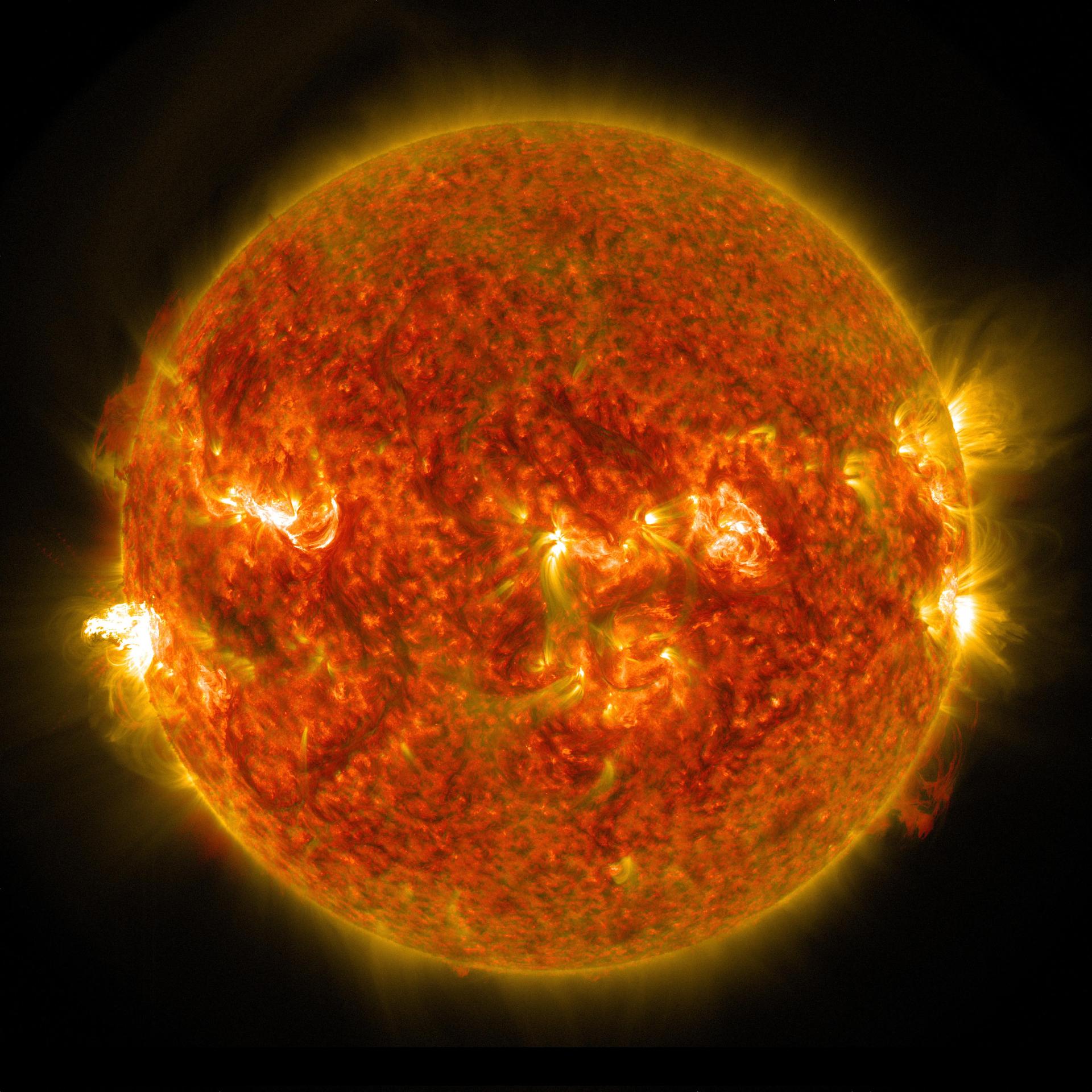
The Sun spent the last week of July reminding everyone who is actually in charge of space weather. On July 26, 2026, sunspot region 4494 let go of an M3.2 flare, the strongest of a cluster of eruptions that also included C-class flares from two neighboring regions. None of it has so far disturbed the ground beneath our feet, but the setup on the solar disk is the kind that keeps forecasters watching the clock.
Here is what happened, what it means, and why you might want to keep an eye on the northern horizon this Buck Moon week.
Three regions, one busy day
According to NOAA's Space Weather Prediction Center, whose Solar and Geophysical Activity Summary was issued at 0245 UTC on July 27, three active regions were responsible for the day's fireworks. Region 4494 produced the headline event: an M3.2 flare. Region 4495, sitting close to disk center at S03W02, added a C4.2. Region 4496 rounded out the trio with a C2.0.
Flares are graded on a logarithmic ladder — A, B, C, M, X — where each letter marks a tenfold jump in peak X-ray brightness. An M-class flare is a mid-tier event: energetic enough to matter, an order of magnitude short of the X-class monsters that make headlines. An M3.2 is squarely in that middle band. The C-class flares from 4495 and 4496 are a notch quieter still, the sort of low-level crackle that a busy Sun produces almost as background noise.
Spaceweather.com timestamped the main event at 1528 UT on July 26, and noted the activity had not stopped by the following morning: region 4494 fired a smaller C1 flare at 0703 UT on July 27. The disk-wide sunspot number stood at 99 — a healthy count that reflects a Sun still carrying plenty of magnetic complexity across its face.
What makes 4494 worth watching
Not all sunspots are created equal, and 4494 has the magnetic pedigree that flare forecasters pay attention to. Spaceweather.com describes it as having a "beta-delta" magnetic configuration — a mixed-polarity field in which opposite magnetic polarities are crammed together inside a single sunspot's penumbra.
That matters because flares are, at bottom, a magnetic phenomenon. When oppositely directed field lines are forced into close quarters, they can reconnect and release stored energy explosively. A delta configuration is shorthand for exactly that kind of tangled, high-tension geometry. In the language of the daily reports, 4494 is "harboring energy for M-class flares" — which is precisely what it demonstrated.
Because of that structure, the next couple of days carry real, if modest, odds of more. Spaceweather.com puts the chance of another M-class flare at 45% over the next 24 to 48 hours, and the chance of a top-tier X-class flare at 10%. Those are meaningful numbers — not a near-certainty, but not something to wave off either.
Meanwhile, the ground stays calm
A flare on the Sun and a disturbance at Earth are two different things, and right now only the first is happening. The geomagnetic field has stayed at quiet levels. NOAA reported three-hour planetary K-indices running between 1 and 2, with a planetary A-index of 6 (Afr/Ap values of 008/006). Spaceweather.com independently pegged the planetary K-index at 2 — quiet. No proton events were recorded, and NOAA issued no geomagnetic warnings.
The solar wind conditions back that up. Spaceweather.com reported wind speed near 377.9 km/s, a low density of 2.9 protons per cubic centimeter, and an interplanetary magnetic field around 4.7 nT with a Bz component of +1.2 nT. That last number is the one aurora watchers care about most: a northward-tilted (positive) Bz tends to keep the door to Earth's magnetosphere closed, blunting the geomagnetic response. There were also no significant Earth-facing coronal holes to feed a high-speed stream our way.
In other words: the Sun is active, but at the moment it is firing radiation, not aiming a geomagnetic punch at us. Flares deliver their X-rays at the speed of light and can briefly disturb the dayside upper atmosphere — the kind of thing that nicks high-frequency radio and precise navigation on the sunlit side of the planet — but a quiet magnetic field and calm solar wind mean no auroral storm is underway.
Why It Matters
Space weather is the connective tissue between an abstract astronomical event and the technology we lean on. Even without a geomagnetic storm, an M-class flare can cause a short-lived radio blackout on the daylit side of Earth, degrading high-frequency communications used by aviation, maritime operators and amateur radio. The larger point is that 4494's beta-delta field is still loaded. A 45% M-flare probability and a 10% X-flare probability over the next day or two mean this is a region to keep tabs on rather than file away.
For skywatchers, the calm-but-primed situation is worth understanding because it can change fast. Should 4494 launch a larger, Earth-directed eruption with a coronal mass ejection attached — something today's quiet numbers do not show — the aurora conversation would shift within a day or two. Knowing the difference between "the Sun flared" and "a storm is hitting Earth" is what separates a genuine aurora alert from a false alarm. Right now we are firmly in the former camp.
A backyard hook for Buck Moon week
The timing lines up with a bright week overhead. Per EarthSky's night-sky guide, the Moon is passing near the stars of the Teapot asterism in Sagittarius, with the full "Buck Moon" of July reaching its peak on July 29 (14:36 UTC) after rising the evening of July 28. That is a double-edged deal for observers. The near-full Moon is a lovely naked-eye target in its own right, easy to find riding low through the rich star fields of the southern summer sky. But its glare will also wash out any faint aurora, so even if the geomagnetic field did stir, this is not the ideal week for chasing dim northern lights.
The practical move for the next few nights: enjoy the Buck Moon and the Teapot as your naked-eye headline act, and treat the Sun as the wild card. If you have access to a properly filtered solar telescope, region 4494 is the feature to look for on the disk during the day — a magnetically complex spot doing exactly what such spots do. And keep NOAA's alerts page bookmarked. The current quiet is real, but with a delta-class region rotating across the Earth-facing side of the Sun, "quiet" is a status, not a promise.
