
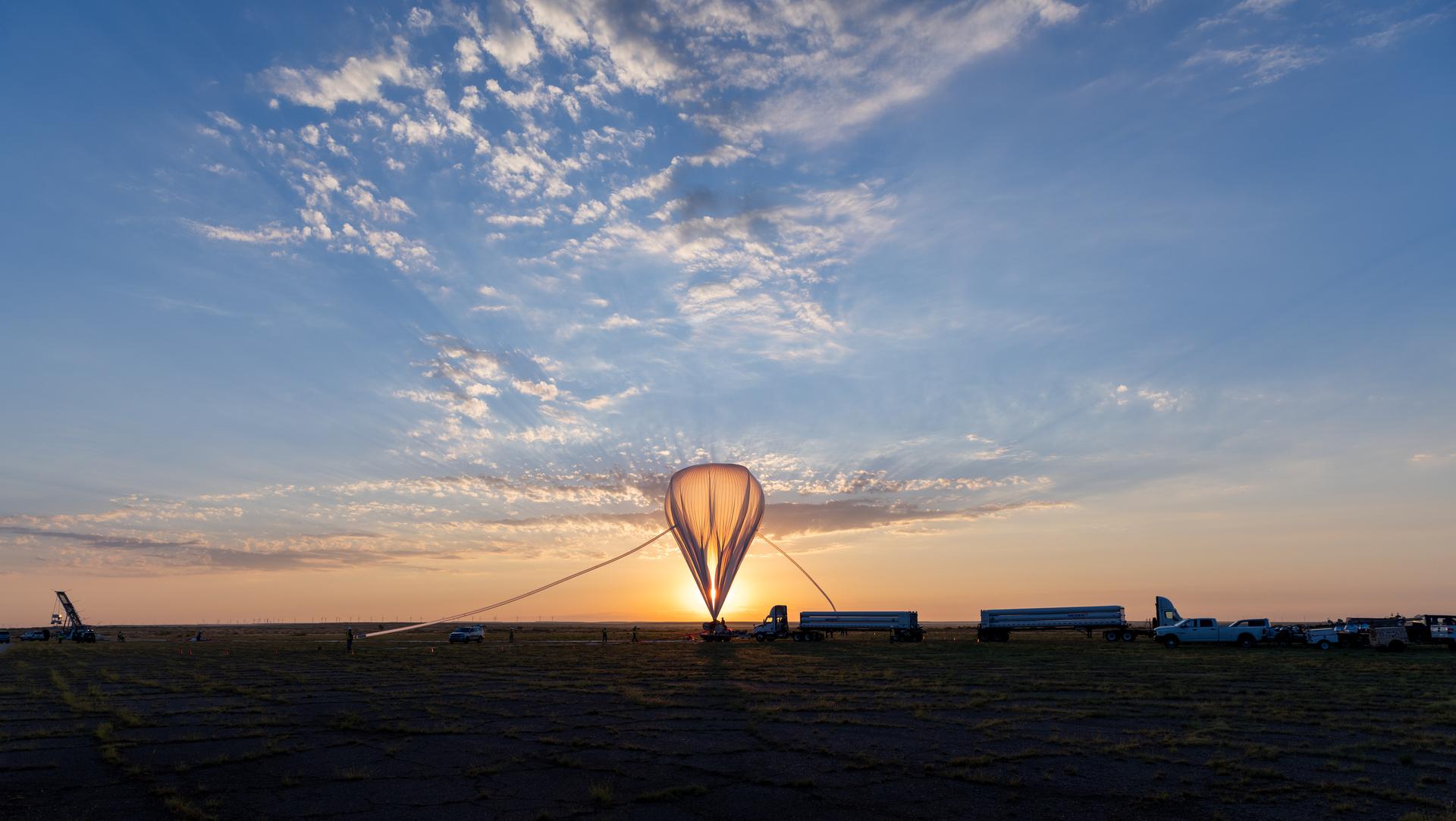
On August 12, 2026, the Moon's shadow will race across the top of the world, sweeping over Greenland, Iceland, and northern Russia before angling south across a sliver of the Atlantic to touch Spain and Portugal. NASA has now confirmed how it will broadcast the event — and, more quietly, how it will use it as a rare atmospheric experiment. While cameras on the ground and a high-altitude WB-57 aircraft capture the Sun's corona, five university teams funded through NASA's Nationwide Eclipse Ballooning Project will be several kilometers below, releasing roughly 86 balloons into the path of totality to watch what happens to the sky itself when the Sun briefly disappears.
The Coverage Plan
NASA's broadcast begins at 1:15 p.m. ET on August 12, streaming live at nasa.gov/live. Totality first arrives in Iceland at 1:45 p.m. ET, then reaches Spain at 2:28 p.m. ET as the shadow's path curves southeast across the ocean. Beyond the public feed, NASA has two science efforts riding on the eclipse. A NASA-funded science team will chase the Moon's shadow with the WB-57, a high-altitude research aircraft, to investigate solar corona dynamics during totality. And on the ground in Iceland and Spain, the Nationwide Eclipse Ballooning Project will be running a very different kind of investigation, one aimed not at the Sun but at the air the eclipse passes through.
Eighty-Six Balloons, One Shadow
The ballooning project is led by Dr. Angela Des Jardins at Montana State University, who serves as principal investigator, and it draws on five university teams split by discipline and location. Engineering teams — a joint University of Bridgeport/University of Hartford team, the University of North Florida, and Montana State's own team — will fly out of Spain. Atmospheric science teams from the University of Idaho and the University of Kentucky will launch from Iceland, near Reykjavik, according to a report from Icelandic Review confirming their presence in the country.
Together the teams plan to launch 86 balloons: 6 latex balloons carrying engineering payloads of up to 6 kg each from the Spain teams, and 80 small radiosondes from the Iceland teams. The launches are part of a continuous 30-hour campaign, running from 00:00 UTC on August 12 through 06:00 UTC on August 13, bracketing the eclipse itself, which spans roughly 16:40 to 18:50 UTC on August 12. The extended campaign window matters: launching balloons only during totality would capture a single moment, but running for 30 hours straight lets the teams build a before-and-after picture, comparing the atmosphere's ordinary daily rhythm against whatever happens when the Sun's disk is blotted out in the middle of the afternoon.
Scientifically, the balloons are targeting two layers of the atmosphere: the planetary boundary layer, the churning zone closest to the ground where heat, moisture, and wind mix most directly with the surface, and the tropopause, the boundary several miles up where the churning weather layer gives way to the stable stratosphere. Both layers respond to solar heating, and a total eclipse is one of the few events on Earth that can switch that heating off and back on again within a couple of hours, offering a natural experiment that would be nearly impossible to engineer any other way.
The project is funded through NASA's Science Activation and Space Grant programs under award #80NSSC22M0003 — support that also underwrites its role as a hands-on training ground, since each team recruits several student interns for summer 2026 to carry out the balloon launches, tracking, and data collection.
Why It Matters
Total solar eclipses are rare enough, and brief enough, that scientists rarely get more than a few minutes at a time to study how the atmosphere reacts when solar heating suddenly stops. A 30-hour campaign bracketing the event, rather than a short burst timed to totality alone, gives researchers a genuine baseline to measure against — turning a spectacle millions will watch through eclipse glasses into a dataset on how the boundary layer and tropopause respond to a fast, temporary loss of sunlight. That kind of data feeds directly into models of how the lower atmosphere behaves under rapid changes in solar input, questions with relevance well beyond eclipse science. It is also, notably, a student-run operation: the same event that NASA is streaming to a global audience from 1:15 p.m. ET is, on the ground, being measured by undergraduate and graduate teams from five universities using balloons they help launch themselves.
