
Brown dwarfs don't fit neatly into either category. They form the way stars do, from collapsing clouds of gas, but they never gather enough mass to sustain hydrogen fusion in their cores. Their atmospheres look more like those of the solar system's giant planets: chemically rich and cloudy. Zafar Rustamkulov of IPAC at Caltech in Pasadena, who led a new study of them, puts it this way: "They're kind of goth."
That study, published in The Astrophysical Journal and announced by NASA on Oct. 8, 2026, uses observations from NASA's SPHEREx telescope. The team measured 37 nearby brown dwarfs in 102 colors and found water, carbon dioxide, carbon monoxide and methane in their spectra. The sample is useful, but the more interesting result is a mismatch. The best available atmosphere models still struggle to fully reproduce what SPHEREx sees.
A survey telescope does detailed work
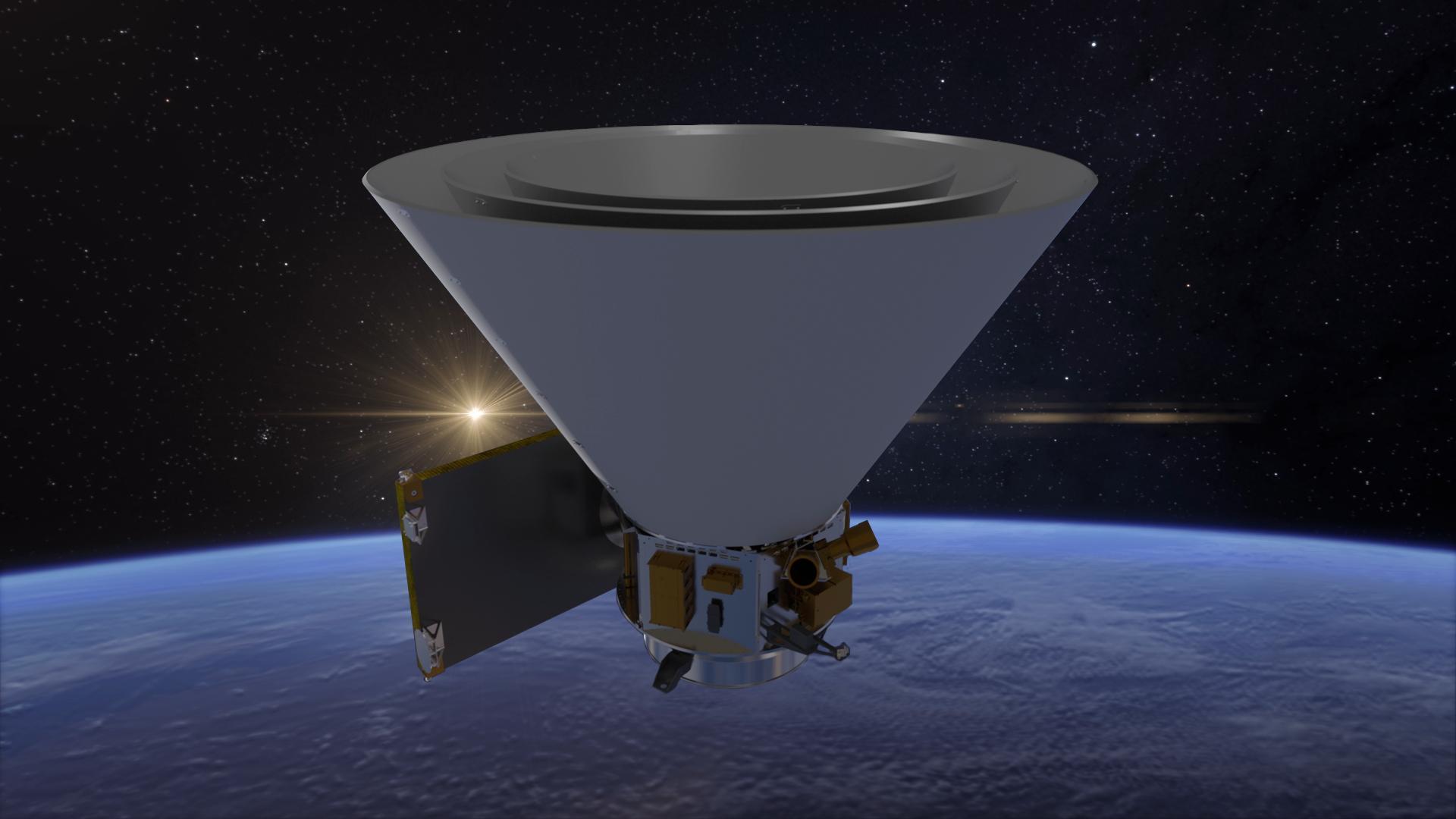
SPHEREx launched in March 2025. It is managed by NASA's Jet Propulsion Laboratory and takes about 3,600 unique images a day to stitch into maps of the entire sky. Spotting brown dwarfs is something of a side project for it. Because it records each part of the sky at many wavelengths, though, it builds up a low-resolution spectrum for every object it sees, nearby brown dwarfs included.
That matters because, according to NASA, only a few dozen brown dwarfs had been studied in detail with space-based telescopes before this work. The preprint of the study (arXiv:2607.00543) says the SPHEREx all-sky survey has measured spectra running from 0.75 to 5 microns at a spectral resolution of roughly R~40 to 100 for thousands of nearby brown dwarfs. The 37 in this paper are a first selection. "Our paper concentrated on just three dozen, but we have thousands more that we are in the process of analyzing," said co-author J. Davy Kirkpatrick, according to NASA's release.
The 37 field dwarfs cover a wide range. By spectral type they run from L0 to Y4. NASA gives their temperatures as about 4,000 degrees Fahrenheit down to about -10 F (roughly 2,200 to -20 Celsius). The paper describes the same range as approximately 2,500 to 250 Kelvin.
What the spectra show
Across that temperature range, SPHEREx picked up the molecules expected in cool, substellar atmospheres: water, carbon dioxide, carbon monoxide and methane. "We're seeing the signatures of these molecules and how they change from object to object across the entire temperature regime," Kirkpatrick said. According to the preprint, the survey's wide spectral coverage and high signal-to-noise let it capture several broad molecular absorption features, and upwards of 80 percent of the total bolometric luminosity of most brown dwarfs.
That kind of uniform dataset is what model testing needs. Rustamkulov and his 23 co-authors fit the spectra with five published model grids: Sonora Diamondback, Sonora Elf Owl, BT-Settl, ATMO2020 and ATMO2020++, and compared how well each did as a function of wavelength, spectral type, and treatment of clouds and chemistry. In the paper's words, the models "continue to struggle."
Where the models miss
According to the preprint, the models have the most trouble with two parts of the spectrum at once:
- The J, H and K peaks. These are near-infrared peaks in the spectrum, and the models have difficulty fitting them.
- The 4 micron opacity window. The models struggle to fit this region at the same time as the peaks.
The problems are worst in objects at the L/T transition, the stage where brown dwarfs change from the warmer, cloudier L types to the cooler, methane-rich T types. NASA describes this as a dynamic stage of life when the exotic clouds thin out. "The state-of-the-art models are capturing the general chemical trend, but when it comes to these cloudy transitions, the models are struggling to match the data," Rustamkulov said. The authors report that the largest deviations appear around the chemistry-sensitive carbon dioxide and carbon monoxide features.
The fits do show one preference. The observed sample "strongly" prefers Elf Owl models with weak vertical mixing, with an eddy diffusion coefficient (kzz) of 104 cm2/s, over strong-mixing versions. Vertical mixing describes how gas moves between layers of an atmosphere, so the data lean toward the weak-mixing end of what the models offer.
That preference doesn't settle the physics. Despite these offsets, the paper says, the models broadly capture the trends across the L/T transition, but the large deviations at the CO and CO2 features remain, so the weak-mixing grid is a better fit, not a complete description. The result is still a useful constraint, and it comes from dozens of objects measured in the same way rather than a handful observed with different instruments. The authors say the spectra, along with future SPHEREx data, will help guide improvements to the models.
Why It Matters
Brown dwarfs sit between stars and planets. They form like stars, and NASA notes they share characteristics with Jupiter and Saturn, though unlike most planets they drift in darkness, heated entirely from within. Much of what astronomers understand about their makeup, storminess and evolution comes from theoretical models, which is why NASA says astronomers want to observe more of them. If the models can't reproduce the near-infrared peaks or the carbon features of nearby, isolated brown dwarfs, there's reason to be careful about what they say elsewhere.
Scale is the other factor. Before this work, the number of brown dwarfs studied in detail from space was in the dozens. SPHEREx observes them as a side effect of its survey and has already measured spectra for thousands. A sample that size could show whether the patterns in these first 37 objects hold across the population. As Rustamkulov noted, "No two brown dwarfs are alike. Even at the same temperature, their spectra look quite distinct."
For now, the result is a clear set of model problems tied to specific wavelengths: the J/H/K peaks, the 4 micron window and the CO and CO2 features. The obvious next step is to apply the same comparison to the thousands of brown dwarfs still waiting in the SPHEREx data.
