
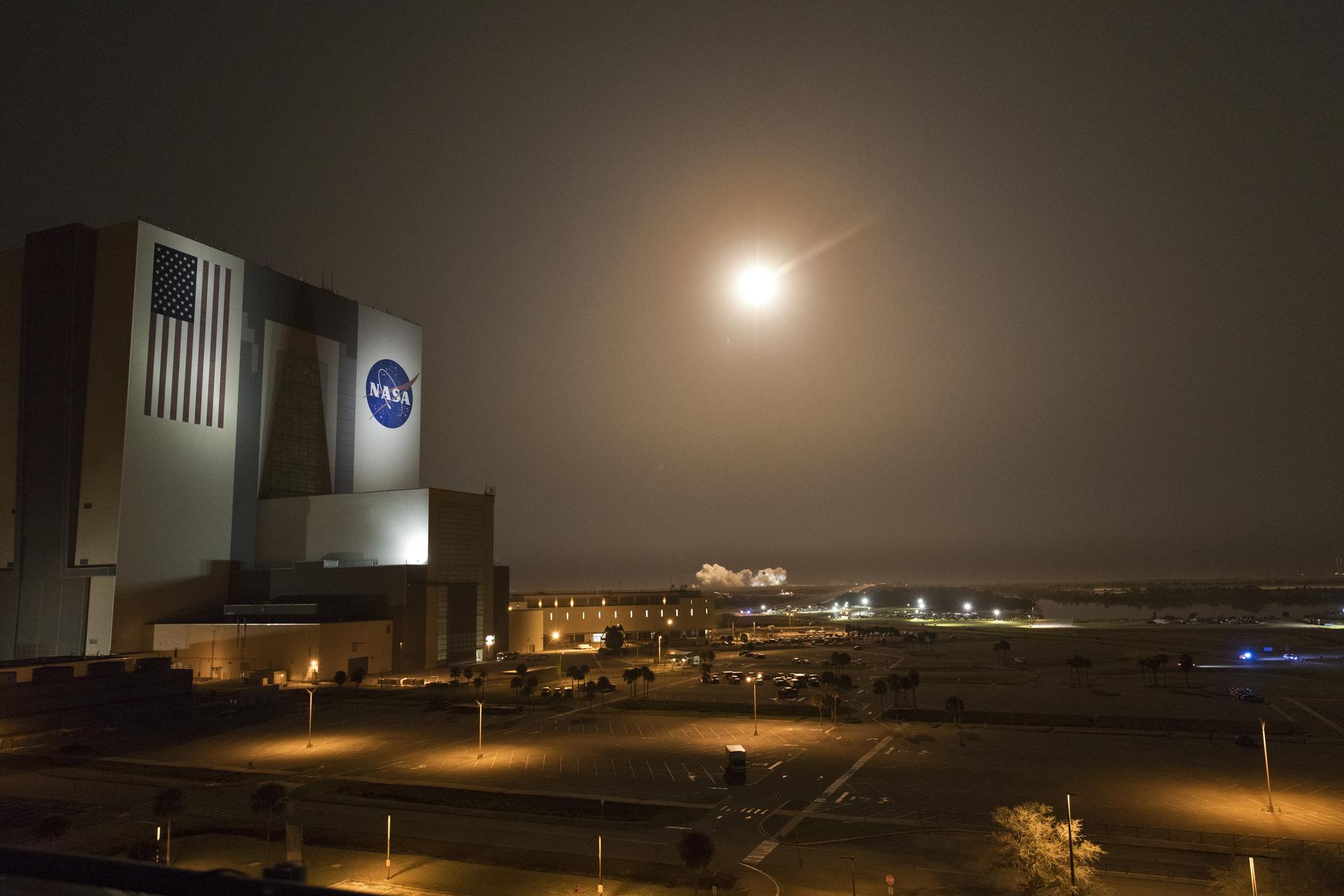
Just after midnight on July 7, a Falcon 9 rocket lit up the California coast, climbing off Space Launch Complex 4E at Vandenberg Space Force Base at 12:12 a.m. PDT. Over the next two and a half hours, it methodically released 81 satellites into sun-synchronous orbit — one of the densest single-rocket payload counts SpaceX has flown — on behalf of a sprawling international customer base. Integrator Exolaunch alone manifested 49 of the satellites on behalf of 20 international customers. The mission, Transporter-17, is the latest installment in SpaceX's dedicated rideshare program, which has turned orbital access into something closer to a scheduled bus route than a bespoke, single-customer affair.
Vandenberg, home to Space Launch Delta 30, has become the default departure point for these polar and sun-synchronous rideshare flights, and Transporter-17 was no exception. But the manifest this time carried an unusually high concentration of headline-grabbing payloads, from wildfire-hunting satellites to a Navy technology demonstrator to an experiment testing whether spacecraft parts can be manufactured in orbit rather than launched fully built.
A Crowded Ride to Orbit
Rideshare missions like Transporter-17 work by bundling dozens of small and medium-sized satellites onto a single Falcon 9, splitting the cost of the ride among many customers instead of any one operator footing the bill for a dedicated launch. Integration specialist SEOPS handled the buildup for 10 of the customer spacecraft on this flight, coordinating hardware from five different nations — France, India, the Netherlands, Spain, and the United States — ahead of the launch, a logistical exercise that increasingly looks like the real bottleneck in rideshare launches, rather than the rocket itself.
Among the largest single satellites on board was South Korea's CAS500-4, an Earth-observation spacecraft weighing around 500 kilograms — the fourth member of a planned five-satellite CAS500 constellation that will help the South Korean government monitor crops and forests, among other tasks. Finland's Iceye, known for its synthetic aperture radar imaging satellites that can see through clouds and darkness, added four more spacecraft to its fleet. And the United Arab Emirates flew Leonav-1, the country's first low-Earth-orbit satellite dedicated to positioning, navigation, and timing — the kind of infrastructure that underpins everything from mapping apps to precision agriculture.
Watching for Fire from Space
The most closely watched payloads, though, were three satellites built by Muon Space for the Earth Fire Alliance, a nonprofit coalition focused on early wildfire detection. Known as FireSat, the constellation is designed to spot blazes as small as 5x5 meters — small enough to catch a fire in its earliest, most containable minutes rather than after it has already grown into a front-page emergency. Fast detection matters enormously in fire response: the difference between catching a fire at a few square meters versus a few acres often determines whether it's a minor incident or a multi-week disaster requiring evacuations.
Three satellites is only a partial constellation, but each additional FireSat launch shortens the revisit time over fire-prone regions, edging the system closer to the kind of near-continuous monitoring its designers envision.
Military and Manufacturing
Not every payload on Transporter-17 was about watching Earth. The U.S. Naval Research Laboratory flew SPEAR-1, a technology demonstration mission, adding a military research component to a manifest otherwise dominated by commercial and scientific spacecraft. And Orbital Matter's Replicator-2 tested in-space 3D printing — an early step toward a future where satellites and structures could be partly manufactured in orbit rather than built entirely on the ground and launched intact, potentially easing the size and shape constraints that come with fitting hardware inside a rocket fairing.
The Booster That Keeps Going
Powering all 81 satellites uphill was booster B1097, flying for the 11th time. Its resume by now reads like a cross-section of SpaceX's business: it has previously launched the Twilight mission, the NROL-172 national security payload, the Sentinel-6B ocean-monitoring satellite, and seven separate batches of Starlink satellites. After stage separation, B1097 flew itself back down to the droneship Of Course I Still Love You stationed in the Pacific, notching that vessel's 208th successful landing and SpaceX's 634th booster landing overall — numbers that, at this point, are less remarkable for any single flight than for how routine they've become.
Why It Matters
Transporter-17 is a snapshot of how much orbital infrastructure now gets built through shared rides rather than dedicated launches. A single Falcon 9 flight carried military research, Earth-observation infrastructure, navigation infrastructure for a nation building out its space capability for the first time, and — most consequentially — an expansion of a wildfire early-warning system that could shrink response times during increasingly severe fire seasons. None of these payloads individually would have justified a rocket of their own; together, they filled one. That's the quiet economic engine behind SpaceX's rideshare program: it lowers the price of entry to orbit enough that a wildfire nonprofit, a national navy, a startup testing space manufacturing, and a first-time satellite nation can all fly on the same ride, on the same night, for a fraction of what a dedicated launch would cost any one of them.
Sources
- Fire detectors, military tech demos, 3D printers among SpaceX rideshare payloads launching on midnight Falcon 9 flight - Spaceflight Now
- Watch SpaceX Falcon 9 rocket launch 81 satellites early on July 7 - Space.com
- SEOPS Completes Multi-National Integration of 10 Payloads for SpaceX Transporter-17 Mission - SatNews
- Vandenberg Weekly Round-Up - Vandenberg Space Force Base
