
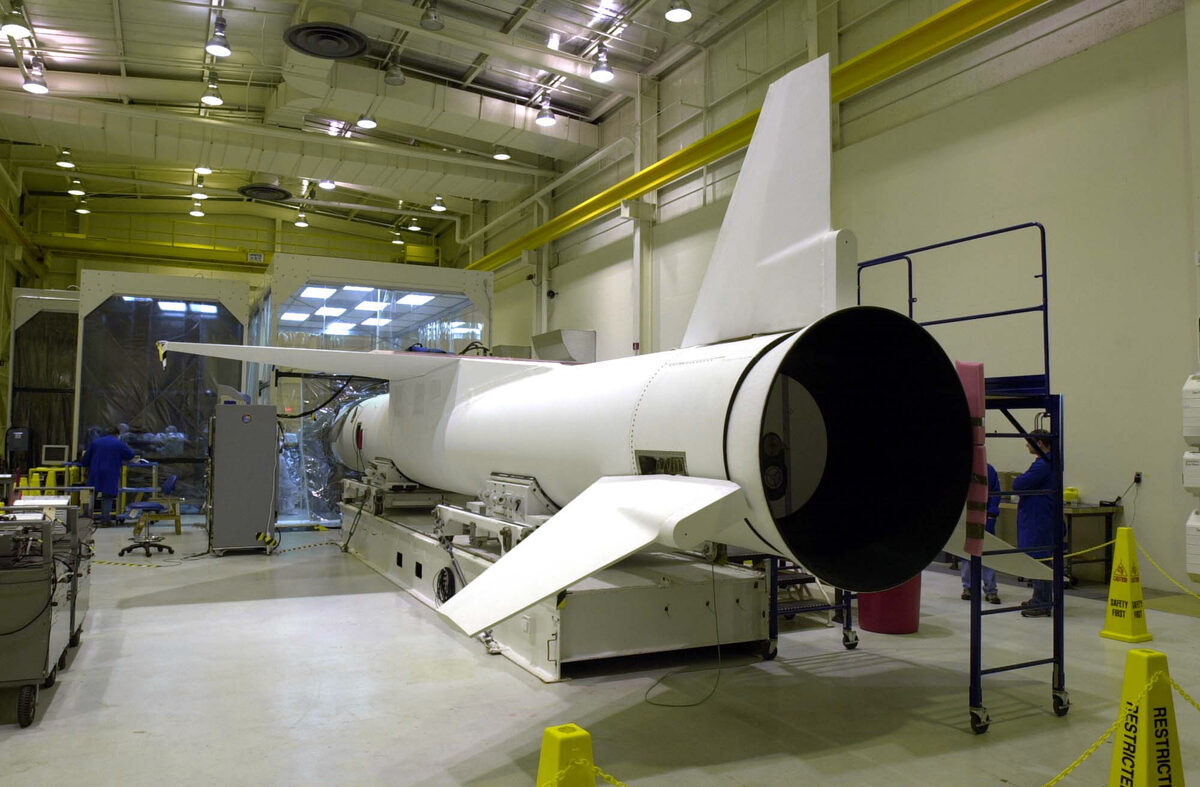
At 8:36 p.m. Marshall Islands Time on July 3 (4:36 a.m. EDT), a Northrop Grumman Pegasus XL rocket dropped from the belly of the Stargazer L-1011 aircraft roughly 41,000 feet over Kwajalein Atoll, lit its first-stage motor, and carried a 425-kilogram satellite into orbit. The payload was not a new telescope or a communications relay. It was a tow truck.
The spacecraft, built by startup Katalyst Space and named LINK, is headed for a rendezvous with the Neil Gehrels Swift Observatory — NASA's veteran gamma-ray burst hunter, in orbit since 2004 — with one job: grapple it, haul it to a higher orbit, and buy it years of additional life before it would otherwise burn up in the atmosphere.
It's a mission that didn't exist ten months ago. NASA only contracted Katalyst in September 2025, giving the company roughly a year to design, build, test, and launch a spacecraft capable of docking with a satellite that was never built to be docked with. Katalyst principal investigator Kieran Wilson called it, without much room for hyperbole, "an absolutely unprecedented development timeline."
Why Swift Needed Saving
Swift orbits at a relatively low altitude, and low orbits decay — atmospheric drag, even from the wisps of atmosphere that exist at hundreds of kilometers up, slowly bleeds off a spacecraft's energy until it falls. That's normally a slow, predictable process engineers plan around for years.
What changed is the Sun. A recent uptick in solar activity heats and expands Earth's upper atmosphere, thickening the drag Swift experiences at its roughly 360-kilometer orbit. According to NASA and SpaceNews, the result was an observatory losing altitude faster than expected, putting it in danger of an uncontrolled reentry late in 2026 or early 2027 if nothing were done. For a spacecraft that has spent more than two decades doing science — Swift's rapid-response instruments have chased down gamma-ray bursts, tidal disruption events, and other fast-fading cosmic explosions since launch — an unplanned, unguided fall back to Earth would be an ignominious and premature end.
So NASA went shopping for a tow.
The Spacecraft, the Rocket, and the Plan
LINK's mission profile, as described by Katalyst and reported by SpaceNews, breaks down into three phases. First, LINK has to find Swift, close the distance, and match orbits with it — no small feat, since Swift has no docking port, no grapple fixture, and no other hardware designed to make this easy. Katalyst has built LINK to capture the observatory using robotic arms designed to grapple locations already present on Swift's exterior, though the team still plans to inspect the spacecraft up close to confirm those spots will work.
Second comes roughly three months of reboost: LINK fires its thrusters in a sustained, gradual push to raise Swift from its decaying ~360 km orbit up to somewhere between 550 and 600 kilometers — high enough that atmospheric drag stops being an existential threat for a long while.
Third, once the job is done, LINK detaches from Swift and uses its remaining propellant to lower itself and speed up its own deorbit, taking care of its own disposal rather than leaving another piece of hardware cluttering the orbital environment.
Getting LINK off the ground took one of the more unusual rockets left in the American launch fleet. Pegasus XL doesn't launch from a pad — it launches from underneath an airplane. Stargazer, a modified L-1011 airliner, carries the winged rocket up to high altitude and releases it, at which point Pegasus ignites and climbs the rest of the way to orbit on its own. Northrop Grumman's Wes Collier, the company's VP of Launch Systems, touted that speed and readiness in describing the flight: "Ready for launch in under eight months, Pegasus is the go-to choice for missions that need to get off the ground now."
This flight was the 46th Pegasus launch in the vehicle's history — and, according to SpaceNews, likely its last. After 36 years in service since its 1990 debut as the world's first privately developed space launch vehicle, a rocket that once represented cutting-edge flexible launch capability appears to be closing out its career on a mission to save one of NASA's own satellites.
Why It Matters
If LINK successfully grapples Swift, it will be the first time a commercial spacecraft has docked with — and physically manipulated the orbit of — a government satellite that was never designed with servicing in mind. That distinction matters well beyond Swift's own fate. In-space servicing has been a long-promised, rarely-delivered capability: the idea that instead of writing off aging satellites as they run low on fuel or drift into decaying orbits, a servicer vehicle can show up, refuel or reboost them, and extend their working lives.
NASA Astrophysics Division Director Shawn Domagal-Goldman's involvement in green-lighting the mission signals how the calculus has shifted. Swift is not a flagship-class telescope with a multibillion-dollar price tag, but it's a productive, still-scientifically-relevant asset, and the agency judged that paying a commercial company to save it was worth doing — and worth doing fast, on a timeline that would have been unthinkable for a traditional NASA-built spacecraft.
That timeline is itself the other headline. A ten-month path from contract award to launch, for a first-of-its-kind rendezvous-and-capture mission, is aggressive by any standard in the industry. If Katalyst pulls this off, it becomes a proof point that commercial servicing companies can move at a pace that matches urgent, unplanned problems — not just scheduled, years-in-advance satellite refueling contracts. That has implications for the Pentagon, which has its own aging orbital assets, and for the growing population of commercial satellites that could someday need a similar rescue rather than a costly replacement.
There's also a quieter symbolism to the mission's launch vehicle. Pegasus flying its likely final mission to keep another aging spacecraft alive is a fitting bookend for a rocket that spent 36 years proving unconventional approaches to spaceflight could work. Whether LINK can finish the job it just started over the Pacific — closing in on Swift, grappling a satellite that was never meant to be grappled, and pushing it to safety — will determine whether this becomes a template for servicing missions, or a one-off rescue that came down to the wire.
