
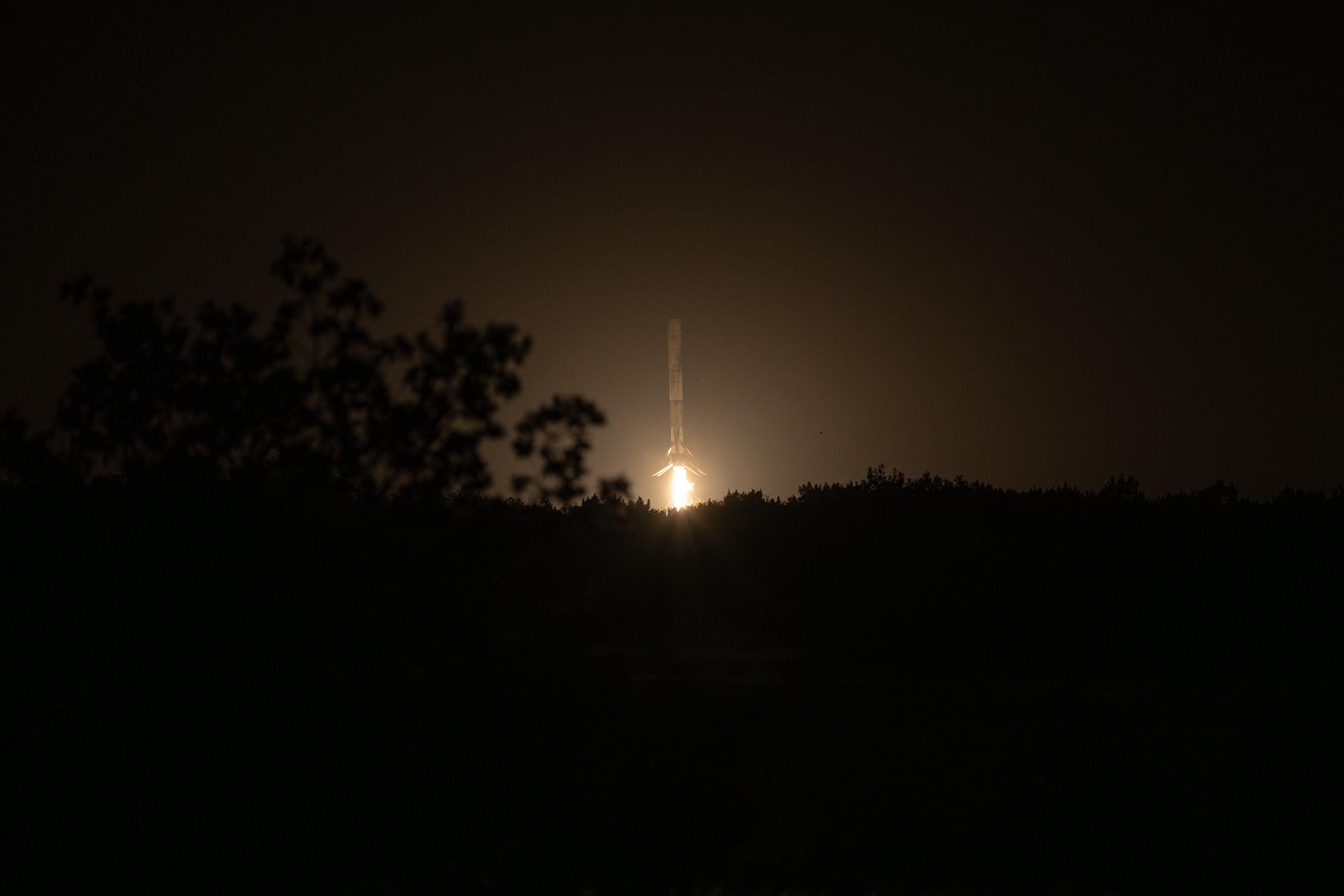
At 6:50 a.m. EDT on July 5, a Falcon 9 lifted off from Space Launch Complex 40 at Cape Canaveral carrying the now-routine cargo of 29 Starlink v2 Mini satellites. Nothing about that part of the mission was unusual — SpaceX flies these Starlink batches on a near-weekly cadence. What was unusual rode along on the first-stage booster itself: two test-bed pods built by a Washington, D.C. startup called Besxar Space Industries, there to find out whether a semiconductor wafer can survive being launched into space and slammed back down to Earth without falling apart.
The booster, tail number B1090, followed its normal trajectory before separating and beginning its return to Earth, as first-stage boosters do routinely after every Falcon 9 launch. Bolted to it were Besxar's two "Clipper Class" pods, riding out the entire suborbital arc — a trip that lasted 8 minutes and 19 seconds and topped out around 115 kilometers in altitude, according to live coverage from Spaceflight Now. That's not orbital spaceflight, but it's enough to expose whatever is inside those pods to the full mechanical violence of a rocket launch: the shaking of ascent, the near-vacuum and cold of the upper atmosphere, and then the heat and deceleration loads of reentry as the booster falls back for its landing.
For Besxar, that violence is the whole point. The company isn't trying to get its hardware to orbit and back intact for its own sake — it's trying to prove that chips can be manufactured in space at all, and the first hurdle is showing that a wafer can take a beating and come out the other side usable.
An Egg Drop for Silicon
Think of it as an egg-drop contest, except the "egg" is a semiconductor wafer and the "drop" is an actual orbital-class rocket launch. Besxar's pitch is that space itself — its hard vacuum and freedom from gravity-driven convection — is a better environment for growing certain semiconductor materials and crystals than anything achievable in a cleanroom on Earth. But before a company can justify building an actual in-space fab, it has to answer a much more basic question: can the wafers, and the fragile production hardware around them, physically survive the trip up and back?
That's what the July 5 flight was designed to test. Rather than waiting for a costly dedicated orbital mission, Besxar hitched its pods to a part of the rocket that already flies constantly and comes back down by design — the Falcon 9 booster. According to Payload Space's reporting on the company's emergence from stealth, Besxar has lined up 24 reusable "Fabship" payload flights across 12 Falcon 9 launches, using the boosters as a repeatable, low-cost test bed rather than building one-off missions from scratch.
Who's Behind It
Besxar Space Industries was founded in 2023 by Ashley Pilipiszyn, an early employee at OpenAI who saw a growing mismatch between how semiconductors are manufactured and what newer, more demanding technologies need. The company stayed under wraps until October 29, 2025, when it emerged from stealth with its SpaceX launch agreement already in hand — per Payload Space, billed as the first reusable payload to fly aboard a SpaceX rocket in this fashion: not a satellite that stays in orbit, and not a capsule that comes back once, but a recurring test-bed arrangement riding the same reused boosters SpaceX already flies dozens of times a year.
Besxar's stated target market is high-performance chips for AI data centers. Pilipiszyn has pointed to a mismatch between existing semiconductors and workloads that demand near-constant, "24/7 throttling" — arguing the industry needs next-generation materials that can hold up under that kind of sustained load, which is the gap Besxar is betting space-grown substrates can fill.
The NASA Angle
Besxar isn't inventing the idea that space is good for making chips — it's stepping into a lane NASA has already tried to pave. The agency's In-Space Production Applications (InSPA) program is explicitly built to accelerate the development of in-space manufacturing, and NASA names semiconductors and uniform crystals grown aboard the ISS National Lab as priority targets. That focus isn't incidental: NASA ties the program directly to the goals of the CHIPS and Science Act, the 2022 law aimed at rebuilding domestic semiconductor capacity and supply chains.
The theory behind space-grown semiconductors is that microgravity removes the convection currents and sedimentation effects that occur when crystals grow in Earth's gravity, potentially allowing more uniform, higher-quality crystal structures — the kind of substrate improvements that matter for high-performance computing. Whether that theoretical advantage translates into a commercially viable manufacturing process is still an open question, and NASA's InSPA framework exists in part to help answer it by giving companies like Besxar a policy tailwind and, potentially, a customer.
Why It Matters
The July 5 flight didn't manufacture anything — it tested survivability, which is a necessary but unglamorous first step. Before anyone builds an orbital chip fab, they need proof that the wafers and equipment involved can take the mechanical and thermal punishment of getting to space and back without shattering, delaminating, or otherwise ruining the very product they're supposed to produce. Piggybacking on an already-reusable Falcon 9 booster is a clever way to get repeated test flights cheaply — 12 launches' worth, by Besxar's own count — rather than paying for dedicated missions each time.
It also matters because of who's involved. SpaceX agreeing to sell a startup 24 payload flights across a dozen of its launches — rather than treating each one as a one-off charter — signals that the launch industry sees a real, recurring business in hosting in-space manufacturing experiments, even if the manufacturing itself is still firmly in the experimental stage. And NASA's InSPA program gives this kind of effort a policy home, tying a niche orbital manufacturing bet to the much larger national push to expand semiconductor production onshore — or, in this case, straight up.
None of that guarantees space-grown chips become commercially real. Surviving a suborbital hop is a long way from running a production line in orbit at any meaningful scale or cost. But Besxar's approach — cheap, repeated, real-world tests riding hardware that already flies — is a pragmatic way to find out fast whether the idea has legs, without betting the company on a single expensive mission.
