
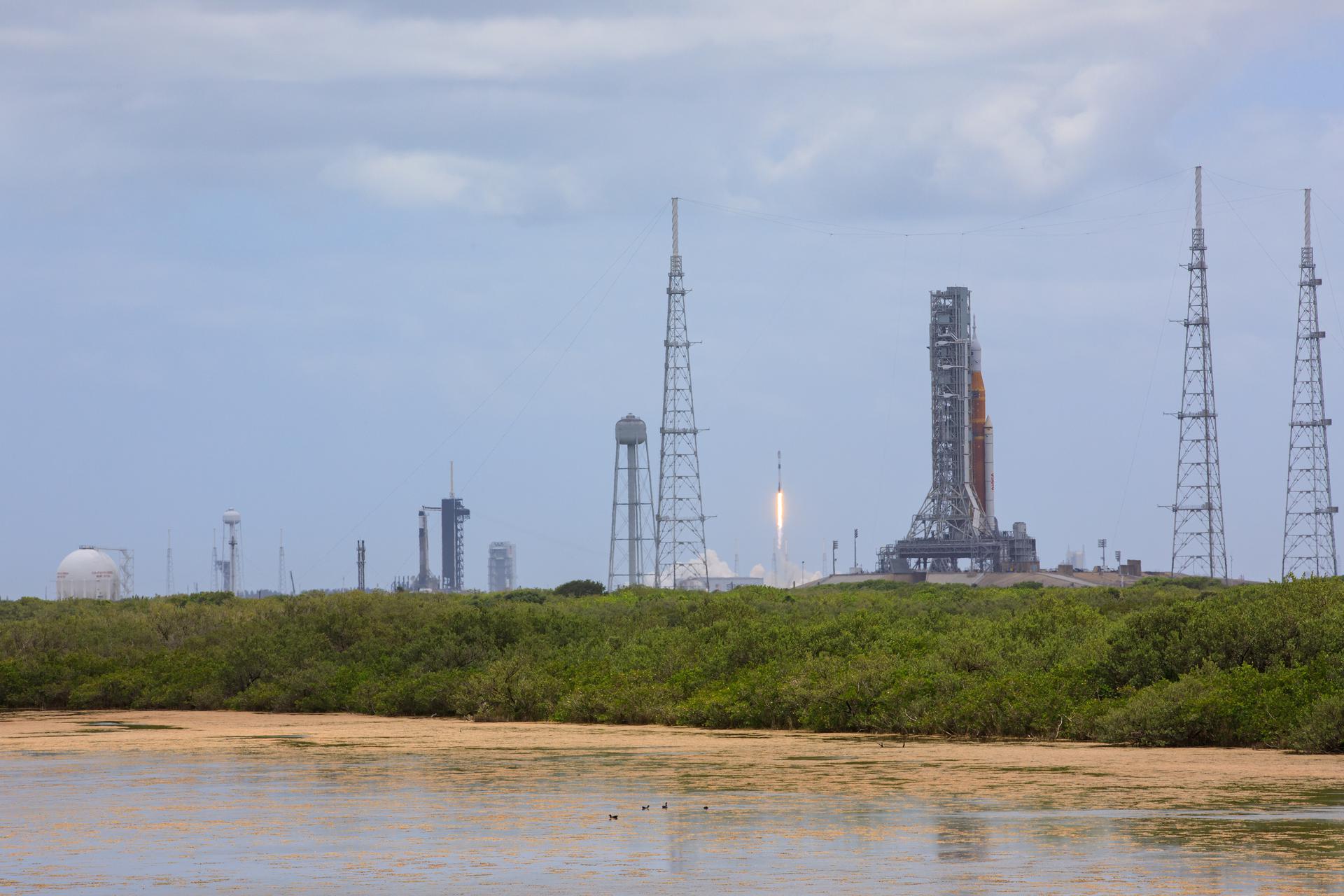
In the pre-dawn hours of Sept. 2, a Falcon 9 first stage that has now flown more times than almost any rocket in history lit its nine Merlin engines at Vandenberg Space Force Base, hauled 27 more Starlink internet satellites toward orbit, and then flew itself back down to a floating landing pad in the Pacific Ocean. For most launch providers, this would be the story: a successful mission, a batch of satellites, a rocket recovered. For SpaceX, it was Tuesday.
The Falcon 9 lifted off at 1:42 a.m. PDT (0842 UTC), within a launch window that ran from 12:46 to 4:46 a.m. Sept. 2, according to Santa Maria Times. Aboard were 27 Starlink V2 Mini satellites, the workhorse spacecraft SpaceX uses to thicken its broadband constellation in low Earth orbit. Deployment was confirmed just over an hour after liftoff, according to spaceflightnow.com.
The satellites themselves were almost a footnote to the booster carrying them. Designated B1063, the first stage completed its 35th flight — a number that, as recently as a few years ago, would have sounded like a typo. Falcon 9 boosters were originally rated for around 10 flights before SpaceX began pushing that ceiling higher through refurbishment improvements and, eventually, minimal-touch turnarounds between missions.
B1063 is no ordinary tail number. Santa Maria Times reported that its flight history includes the Sentinel-6 Michael Freilich ocean-monitoring satellite, the DART planetary-defense demonstration that intentionally slammed into the asteroid moonlet Dimorphos, and multiple National Reconnaissance Office (NROL) missions — a résumé spanning climate science, planetary defense, and national security. That same flight log also shows 25 prior Starlink missions, meaning this booster has spent most of its career doing exactly what it did Tuesday: quietly adding satellites to SpaceX's broadband constellation between its higher-profile assignments.
After stage separation, B1063 flipped, reignited a subset of its engines for boostback and reentry burns, and touched down on the droneship "Of Course I Still Love You," stationed in the Pacific Ocean off the coast of Baja California, according to spaceflightnow.com. As has become routine for West Coast landings, the booster's return produced sonic booms audible to residents in Santa Barbara, San Luis Obispo, and Ventura counties, according to Santa Maria Times.
Why It Matters
The headline number here isn't 27 satellites — SpaceX has flown missions like this dozens of times this year alone. It's 35. Every additional flight a booster survives pushes the economics of orbital launch further away from the expendable-rocket era and toward something closer to commercial aviation, where the vehicle is an asset flown repeatedly rather than a consumable built once and discarded.
That shift has consequences beyond SpaceX's balance sheet. A launch cadence high enough to fly the same booster 35 times is also a cadence high enough to reshape the pace at which any nation or company can put mass into orbit. This mission was SpaceX's 104th orbital launch of 2026 and its 79th Starlink deployment of the year alone, according to spaceflightnow.com — a tempo that, a decade ago, no launch provider anywhere in the world sustained across an entire year, let alone by early September.
B1063's own flight log doubles as a snapshot of what that reusable capacity has been used for: a climate-monitoring satellite, a first-of-its-kind planetary defense test, classified national security payloads, and — 26 times now, counting Tuesday's flight — the steady buildout of a private satellite internet network. The same piece of hardware that helped validate humanity's first attempt to deflect an asteroid has spent most of its 35 flights adding to a constellation that now numbers in the thousands. That range — from one-off science and defense missions to routine commercial infrastructure — is itself the argument for reusability: it only makes sense to build a rocket this capable if it's going to fly enough times, on a wide enough range of jobs, to earn out.
None of this happens without the regulatory scaffolding to allow it. SpaceX flies Falcon 9 under FAA Commercial Space Transportation vehicle operator licenses that are specific to each launch site rather than a single blanket authorization — License No. LLO 19-110, cited among this article's sources, covers Falcon 9 and Falcon Heavy flights from Launch Complex 39A at Kennedy Space Center on the East Coast; Vandenberg's West Coast Falcon 9 missions, including this one, operate under their own separate FAA license. It's that site-by-site licensing framework, not a single Vandenberg-specific document, that authorizes the droneship and pad landings that make boosters like B1063 possible to reuse in the first place. Doing the math on 2026's pace — 104 orbital launches across roughly 35 weeks — works out to nearly three missions a week on average, a cadence that regulatory streamlining has had to keep up with as much as hardware has.
Sources
- SpaceX to launch Starlink mission from West Coast — Spaceflight Now
- Starlink mission set to launch early Wednesday morning from Vandenberg SFB — Santa Maria Times
- FAA Commercial Space Transportation Vehicle Operator License No. LLO 19-110 (SpaceX Falcon 9/Falcon Heavy) — Federal Aviation Administration
