
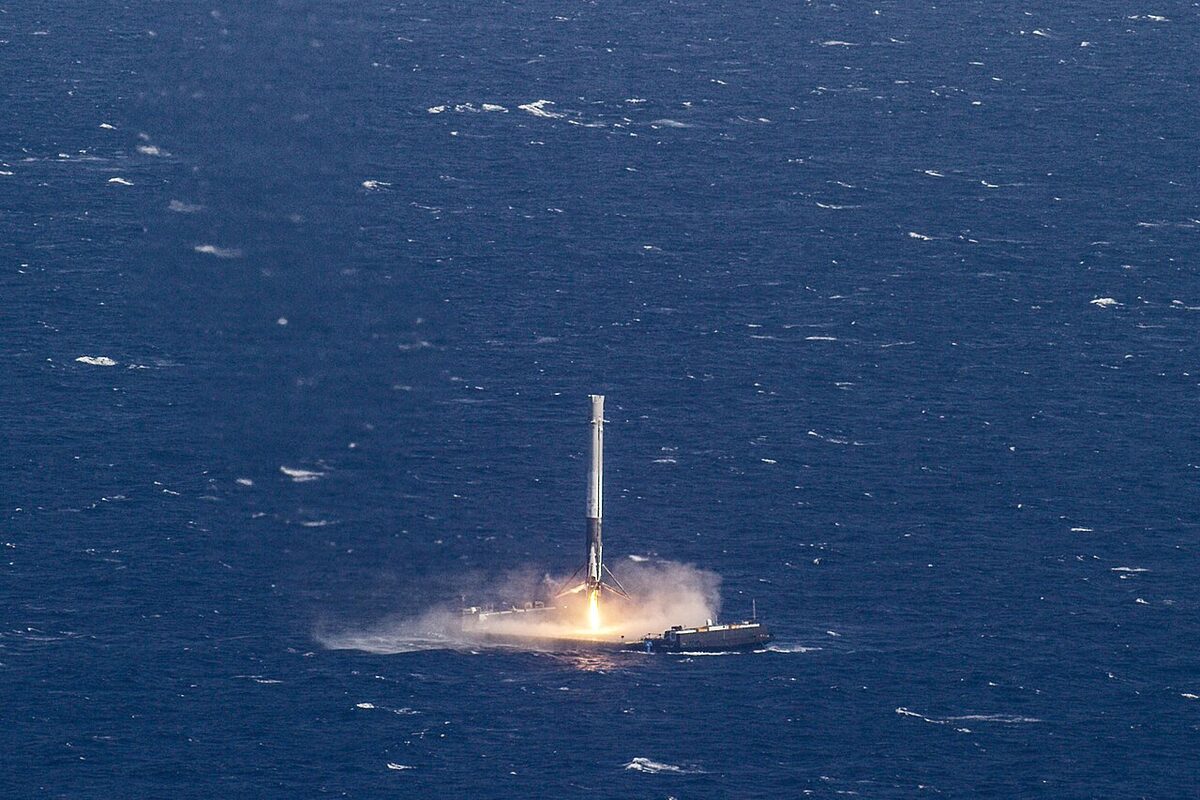
On June 8, a Falcon 9 rocket lifted off from Cape Canaveral carrying a batch of Starlink satellites, arced downrange, and dropped its first stage onto a droneship in the Atlantic. The payload was routine; the booster was not. That first stage, designated B1067, had just completed its 35th flight — a new record for how many times a single orbital-class rocket stage has flown and been recovered. It first launched back in 2021. Since then it has gone to space and come home thirty-five times, and the remarkable thing is how unremarkable that has come to feel.
The fantasy that became the floor
For most of the space age, rockets were thrown away. Every launch consumed a vehicle that cost tens or hundreds of millions of dollars to build, used once and discarded — the equivalent of scrapping an airliner after a single flight. The idea of flying a booster repeatedly was widely dismissed as uneconomic: surely the cost of recovering and refurbishing a stage would exceed the cost of building a fresh one. SpaceX's Falcon 9 demonstrated, flight after flight, that the skeptics had the arithmetic wrong. Reuse spreads the largest single cost of a rocket — the first stage — across dozens of missions, and the refurbishment between flights has compressed from a major overhaul into inspections and turnarounds measured in days rather than months.
The cadence tells the story better than any single record. The June 8 launch was SpaceX's 66th Falcon 9 flight of 2026 alone, and roughly the 660th mission in the rocket's history. No other launch vehicle in the world flies anything close to that often. That tempo is only possible because the company is not building a new booster for each flight; it is cycling a fleet of proven stages through the pad, the way an airline cycles aircraft through a schedule.
The recovery that makes this possible has itself become routine theater. After boosting its payload toward orbit, the first stage flips around, reignites a subset of its engines to slow its plunge, deploys grid fins to steer through the atmosphere, and settles upright on its landing legs — either back at the Cape or, as on the June 8 flight, on an autonomous droneship waiting downrange in the Atlantic. Between flights the stage is inspected, refurbished where needed, and flown again. What was once a white-knuckle experiment, watched live by millions hoping the booster wouldn't topple, is now so dependable that the landing barely rates a mention.
What the reuse pays for
The clearest beneficiary of cheap, high-frequency launch is the payload that has ridden up most often on these boosters: Starlink, SpaceX's own satellite internet constellation, which now numbers more than 10,500 active spacecraft in low Earth orbit. A megaconstellation on that scale is only viable if launching satellites is cheap and routine, and reuse is what makes it so — the business case and the booster are two sides of the same bet. The newest Starlink satellites add direct-to-cell capability, beaming connectivity straight to ordinary phones in dead zones through partner carriers, an ambition that would be financially absurd without a rocket that flies dozens of times a year.
It is worth being clear-eyed about what the record does and doesn't mean. A booster on its 35th flight is a triumph of operations and inspection, not a guarantee — each additional flight is still a calculated risk, and SpaceX retires or expends stages when the math says to. Reuse has also concentrated an uncomfortable share of the world's launch capacity in a single company and a single rocket, which is precisely why competitors from Blue Origin to Rocket Lab are racing to field reusable vehicles of their own. But the underlying shift is no longer in doubt. The disposable rocket, the default of the entire space age, has become the exception. A first stage flying for the 35th time is the clearest possible proof that the cost of reaching orbit has been permanently reset — and that the rest of the industry is now playing catch-up to a standard SpaceX set one landing at a time.
