
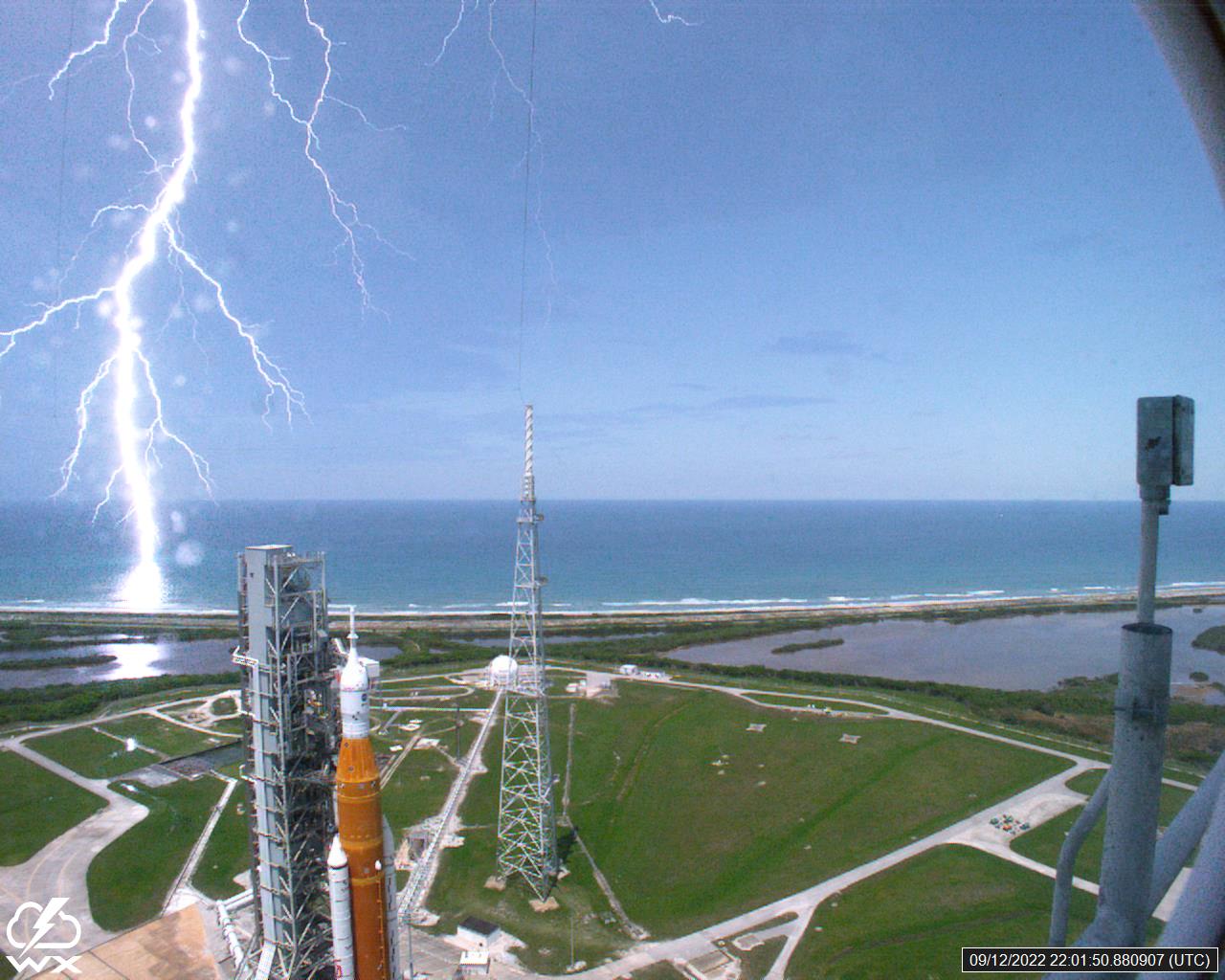
The clip is short and shaky, the way most amateur launch video is. A Long March 3B/E climbs away from Xichang in the evening haze. Then, roughly 30 seconds into the flight, a lightning bolt reaches down and finds it.
The rocket kept going.
The launch happened on July 23, 2026, at 8:00 a.m. Eastern — 8:00 p.m. Beijing time — from the Xichang Satellite Launch Center in Sichuan Province, in southwest China. The payload was Tianlian II-06, a data relay satellite developed by the China Academy of Space Technology. SpaceNews reports the rocket delivered it successfully to geostationary transfer orbit; Xinhua, China's official news agency, says only that the satellite "entered its planned orbit." Xinhua logged the flight as the 658th mission of the Long March carrier rocket series. The independent launch database NextSpaceflight lists the same vehicle configuration, site and date, records the mission as a launch success to geostationary transfer orbit, and notes in its own launch log that the vehicle "was struck by lightning at around T+35 seconds, with no adverse effects resulted."
None of the reporting suggests the strike caused a mission anomaly. The satellite got where it was going. But the footage is the kind of thing that makes launch engineers put their coffee down, and one observer's reaction — a space enthusiast known as Cosmic Penguin, quoted by SpaceNews — captured the mood well enough: "Damn this one is even more crazier than Apollo 12 and that Soyuz-2 that got hit launching at Plesetsk several years ago – the lightning strike actually clearly hit the ground here!"
What Tianlian II-06 Actually Does
Strip away the pyrotechnics and this was an infrastructure launch, and a fairly important one. Xinhua describes Tianlian II-06 as providing data relay and TT&C — telemetry, tracking and command — services for crewed spacecraft including spaceships and space stations, for medium- and low-Earth-orbit resource satellites, and TT&C support for spacecraft launches. SpaceNews frames the same role more plainly: communications relay and tracking and control support for crewed spacecraft, the Tiangong space station and other missions.
NextSpaceflight's record adds the architecture. Tianlian 2 is a geostationary relay satellite built on the DFH-4 bus, intended to support real-time communications between orbiting satellites and ground control stations — and, in the database's words, to "replace the current network of ground-based space tracking and telemetry stations and space tracking ships." It is the second generation of that relay network. For a program running a permanently crewed station, that is not a nice-to-have. It is the difference between continuous contact and a series of brief, scheduled windows as a spacecraft passes over ground sites.
Which makes the lightning strike a slightly sharper story than a fun piece of viral video. This was a rocket carrying a piece of crewed-spaceflight support infrastructure, and it was flying through weather that produced a discharge half a minute after liftoff.
The Apollo 12 Comparison Is Earned
The reference the observer reached for is the right one, and NASA's own account of it is worth reading closely.
On November 14, 1969, Apollo 12 was struck by lightning 36.5 seconds after lift-off, at roughly 6,000 feet — an electrical discharge between clouds and the ground. A second strike followed at 52 seconds, which NASA's record says caused "an electrical disturbance."
The fix has passed into flight-control legend. Flight controller John Aaron recognized that normal readings could be restored by putting the Signal Conditioning Electronics system on its auxiliary setting — the "SCE to AUX" call — which meant it would operate even under low-voltage conditions. The crew flew on, and NASA's account notes they made it safely to the Moon and back home to Earth.
The important part, from the perspective of a July 2026 launch in Sichuan, is what the intervening decades did to launch weather rules. SpaceNews points to a later and more consequential case: the 1987 Atlas-Centaur 67 flight, which ended in failure after a lightning strike and prompted the tightening of the modern Lightning Launch Commit Criteria — the rule set that routinely scrubs American flights on days that look, to the naked eye, perfectly launchable.
We have no window into what weather rules were in force at Xichang on July 23, and neither SpaceNews nor Xinhua addresses the question. What can be said is narrower and still interesting: a vehicle flew, and a bolt found it about 30 seconds in.
The Same Day, a Second Flight
About eleven and a half hours later, at 7:33 p.m. Eastern, China launched again. A solid-fueled Kinetica-1 lifted off from the Dongfeng Commercial Aerospace Innovation Test Zone at the Jiuquan spaceport in northwest China on a commercial rideshare mission, carrying five satellites: Chenguang-1, Gande-1 01, Xiguang-2 03, Jitianxing A-04 and Yinglong Fengguang-1. All five reached orbit.
SpaceNews counts the pair as China's 50th and 51st orbital launch attempts of 2026, against a national target of more than 100 launches in a calendar year for the first time. Either way, the cadence is the story: a national relay-satellite mission and a commercial smallsat rideshare, from two different spaceports, inside a single day.
Why It Matters
Two things are true at once here, and they pull in opposite directions.
The first is that the Long March 3B did exactly what a well-built launch vehicle should do when the atmosphere hits it: nothing much. Apollo 12 survived two strikes with 1969 electronics and a quick-thinking controller. Tianlian II-06 reached its transfer orbit with no adverse effects reported at all. That is a real engineering result, and it deserves to be read as one.
The second is that surviving a lightning strike is not the same as being right to fly into one. The Lightning Launch Commit Criteria regime was tightened because a rocket was lost to a strike in 1987, and "the vehicle probably tolerates it" stopped being an acceptable answer when the alternative is waiting a few hours. Margin that gets spent on weather is margin unavailable for everything else that can go wrong on ascent — and this particular rocket was lofting a node in the network that keeps crews on Tiangong in contact with the ground.
As launch rates climb — 51 orbital attempts from China alone by late July, on the way to a target north of 100 — schedule pressure and weather rules will keep colliding. The video from Xichang is a spectacular piece of footage. It is also a data point about where one launch program's risk tolerance currently sits, and the useful conversation is about that, not about the lightning.
Sources
- Lightning strikes Long March 3B after liftoff, Kinetica-1 launches 5 satellites — SpaceNews (Andrew Jones, July 24, 2026)
- China launches new data relay satellite — Xinhua (July 23, 2026)
- Lightning Strikes Twice (Apollo 12) — NASA Science
- Tianlian-2-06 | Long March 3B/E — NextSpaceflight launch record
