
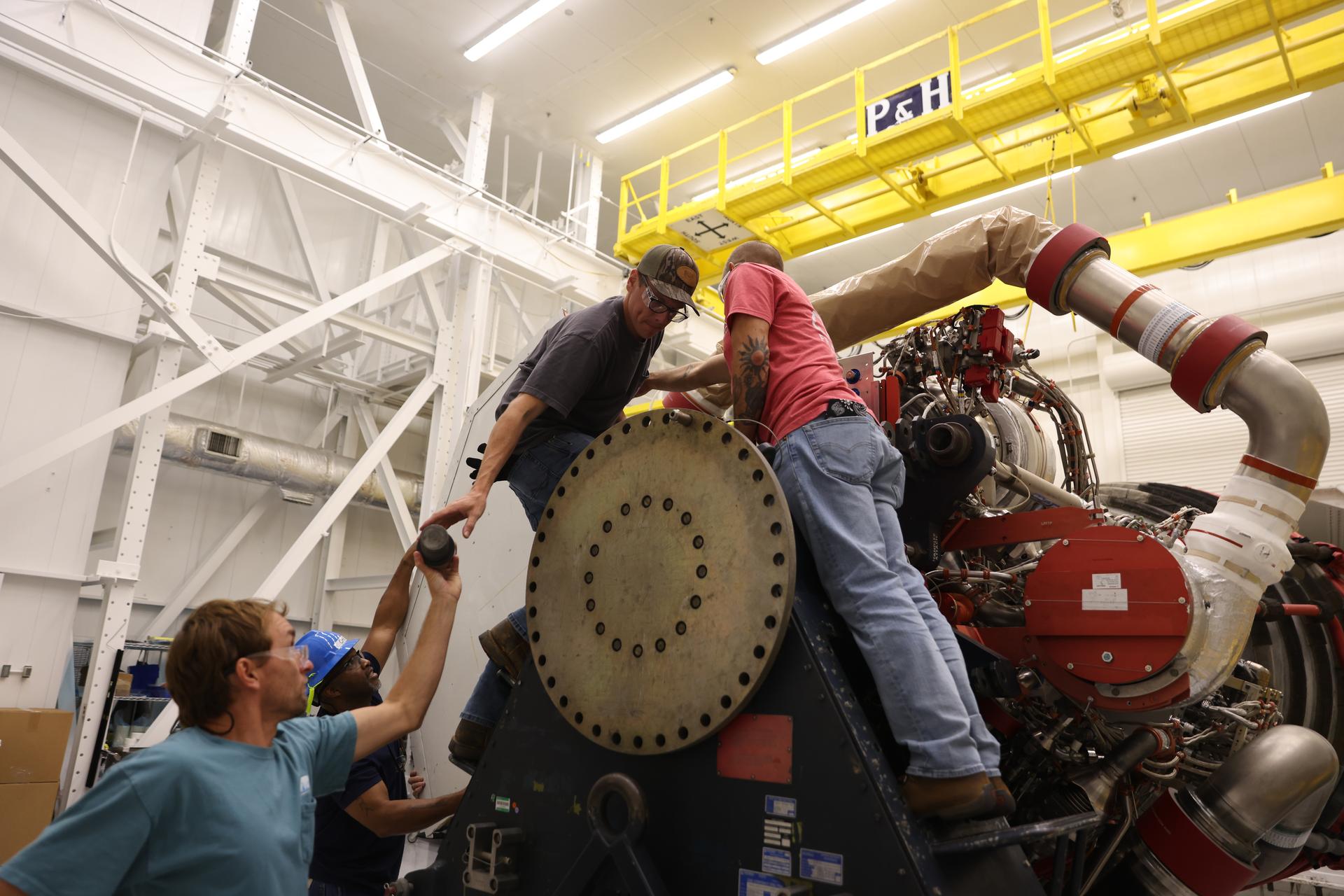
Four rocket engines were delivered to NASA's Michoud Assembly Facility in New Orleans on July 22, and between them they carry a service record that nothing built after them will ever match: 36 space shuttle flights, including International Space Station assembly missions and astronaut John Glenn's return to space.
L3Harris announced that day that it had delivered the four RS-25 engines that will power the Space Launch System core stage for Artemis III, the third SLS flight. According to SatNews, which covered the handover the same day, the shipment represents the final deployment of upgraded Space Shuttle main engine hardware in the initial Artemis propulsion phase. The engines that follow them are new-build.
What Actually Got Delivered
The RS-25 is the engine NASA never quite let go of. Four of them sit at the base of the SLS core stage, and per NASA's own SLS reference material, the quartet operates for just over eight minutes, producing more than 2 million pounds of thrust while burning liquid hydrogen and liquid oxygen. The stage they bolt into is 212 feet tall and holds more than 733,000 gallons of super-chilled liquid propellant — a number that reads better as a mental image than a statistic. Eight minutes. Three-quarters of a million gallons. Then it's empty.
The four engines heading into the Artemis III stage are not museum pieces bolted on as-is. L3Harris describes three categories of upgrade: modern electronics, new insulation to protect against the SLS thermal environment, and operation at higher thrust levels than during the shuttle era. SatNews puts finer detail on the same work — modernized, radiation-hardened digital engine control units with enhanced processing speeds and diagnostic telemetry, and upgraded thermal protection insulation around the powerhead and nozzle assemblies.
That combination is worth sitting with. The controller is the engine's brain, and hardening it against radiation is the kind of upgrade that matters less on an eight-minute ascent than it does as a general modernization of avionics designed decades ago. The thermal insulation on the powerhead and nozzle answers a genuinely different flight environment: SatNews describes the upgraded insulation as sized for high acoustic and thermal environments, which is not the environment these engines were originally qualified in. And the uprated thrust is the part that quietly explains why "shuttle heritage" is not the same as "shuttle hardware" — these engines are being asked to run harder than they ever did in their first careers.
The Handoff to New Engines
This is the interesting structural fact buried in a routine delivery announcement. L3Harris says subsequent Artemis missions will use newly constructed engines incorporating modern manufacturing techniques and enhancements designed to reduce costs while maintaining performance and reliability. SatNews names the first destination for that hardware: L3Harris is concurrently producing newly manufactured RS-25s using additive manufacturing for Artemis V, following hot-fire acceptance testing at NASA's Stennis Space Center.
So the ledger runs like this. The shuttle program's leftover engines, refurbished and pushed past their old operating limits, carry Artemis III. After that, the line is production hardware — additive-manufactured components, deliberate cost reduction, a manufacturing process designed around the fact that SLS expends its engines rather than flying them home.
That last point is the uncomfortable one that no press release will say out loud. The RS-25 flew, came home, and flew again — that is what 36 shuttle flights across these four engines means. On SLS, they fall into the ocean. The engineering pedigree that made the shuttle main engine remarkable is being spent one launch at a time. The additive-manufacturing push for Artemis V is, in large part, an admission that an engine you throw away needs to cost less to build than an engine you planned to recover.
Where the Stage Goes Next
The immediate path is straightforward. Per SatNews, Boeing and NASA technicians will mechanically install and align the engines onto the 212-foot core stage at Michoud; after structural integration and engine gimbal system checkout, the assembled core stage travels by barge to Kennedy Space Center for stack integration. L3Harris notes this is the first time engines will be integrated vertically with the core stage, which it says simplifies installation and accelerates the process — a change in how the engines are mated to the stage rather than a change to the engines themselves.
Michoud has done this before, recently. NASA's SLS materials note that the Artemis II core stage was the first fully assembled Moon rocket stage for a crewed mission to roll out of Michoud since the Apollo program. The facility is now running the same play a second time.
At the Kennedy end, Artemis III hardware has been accumulating. NASA's SLS page carries a June 4, 2026 update headlined "Final Artemis III SLS Booster Segments En Route to NASA Kennedy," and a July 13, 2026 update headlined "NASA's Artemis III Flight Hardware Stacks Up at Kennedy" — nine days before the engines reached New Orleans. Stacking is underway in Florida. The engines are only now going onto the stage in Louisiana. That sequencing is normal, but it does mean the core stage remains the long pole.
The Claim Worth Watching
Kristin Houston, L3Harris' President of Space Propulsion & Power Systems, framed the delivery this way: "This delivery keeps Artemis III on track for launch in 2027 and supports NASA's transition to an annual launch cadence that will enable regular missions to the Moon."
Two things are packed into that sentence. The first is a 2027 launch date, asserted by the engine supplier rather than by NASA. The second is annual cadence — a rate SLS has not yet demonstrated, and one that depends on considerably more than engine deliveries.
There's a third item, and L3Harris' own release supplies it: Artemis III will test integrated operations between the Orion spacecraft and commercial lunar landers in low Earth orbit. That is a meaningful description, and it does not sit comfortably beside SatNews' description of Artemis III as NASA's planned crewed lunar landing mission. A mission scoped as an Orion-and-lander integration test in low Earth orbit is a different mission from a landing. The engines being delivered are the same either way. What they are being delivered for is characterized differently in two accounts published on the same day.
Why It Matters
Two transitions are happening in the same shipment, and only one of them is being advertised.
The advertised one is industrial. After Artemis III, the RS-25 stops being a refurbishment program and becomes a manufacturing program. Additive manufacturing and cost-reduction changes are what make an expendable version of a recoverable engine defensible at all, and Artemis V is where that thesis gets tested with hardware nobody ever flew before. If the new-build engines perform like the heritage ones, SLS gets a supply chain instead of an inventory. If they don't, the program discovers that late.
The unadvertised one is programmatic. These four engines, with 36 shuttle flights behind them, are being installed for a mission that L3Harris itself describes as an integrated-operations test between Orion and commercial landers in low Earth orbit — while the supplier's quote promises a 2027 launch and an annual cadence. The hardware is arriving on a schedule that looks credible. What that hardware is being asked to accomplish is the part still in motion, and the engines cannot resolve it.
The finite stock of shuttle engines was always going to run out. It ran out on a Wednesday, in New Orleans, in a press release.
