
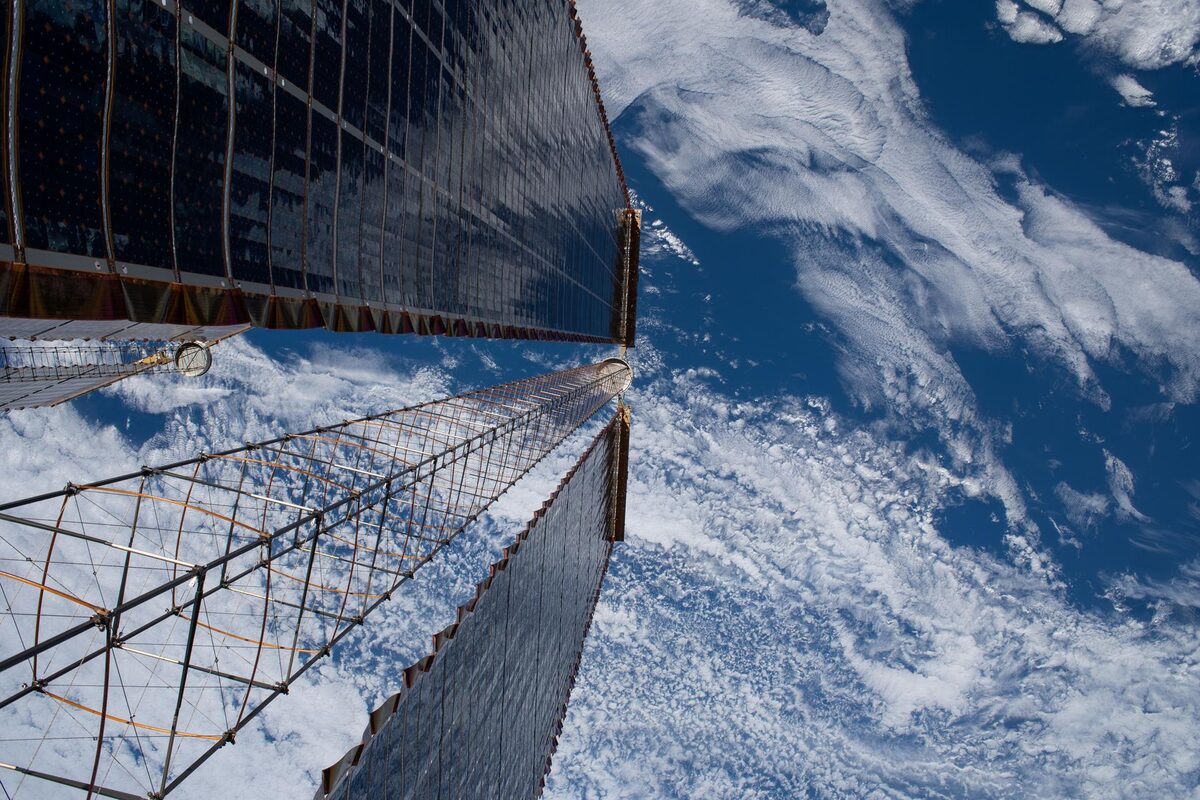
Round numbers make good headlines, but the job itself was routine: bolt a new solar array onto the International Space Station and unroll it. On Oct. 29, NASA astronaut Anil Menon and Canadian Space Agency astronaut Joshua Kutryk did that during a 7-hour, 11-minute spacewalk. They installed and deployed the station's seventh ISS Roll-Out Solar Array, or IROSA, on the 2A electrical power channel. The outing was also the 100th US spacewalk from the ISS.
The two Expedition 75 crew members ended the spacewalk at 3:08 p.m. EDT (1908 GMT) when they returned to the Quest airlock, Space.com reported. It was Menon's fourth spacewalk and Kutryk's first.
What came up in Dragon's trunk
The hardware is compact for what it does. Rolled up, the iROSA measured about 10 by 2 by 4 feet and weighed 750 pounds (340 kg), according to Space.com. It reached the station earlier in October in the unpressurized trunk of a SpaceX Dragon on the company's 35th ISS resupply mission.
Moving a 340-kilogram package along the truss takes coordination. The two astronauts split the work. Menon rode the end of Canadarm2, the station's robotic arm, and carried the array out to the port side. Kutryk made his way to the worksite along the station's backbone truss at the worksite. The Canadian Space Agency's preview of the spacewalk described the same setup, with Canadarm2 acting as a mobile base for one of the spacewalkers.
The design explains the name. The array goes up as a compact roll and unfurls once it is mounted. That is how a blanket this size fits in a Dragon trunk. After installing it on the 2A channel, the pair deployed it, and the seventh new array began generating power.
Seven down, one to go
The upgrade isn't finished yet. NASA said Menon and Kutryk also completed get-ahead tasks for the next spacewalk, planned for Thursday, Nov. 5. On that outing, crew members will install the eighth and final IROSA on the 3B power channel.
Once all eight arrays are in place, NASA says the station's power capacity will rise by up to 30%, from 160 kilowatts to about 215 kilowatts. The CSA cited the same "up to 30%" figure for the new array combined with the ones installed before it.
NASA's announcement includes one detail that is easy to miss. The agency said the extra power supports station operations, including a safe, controlled deorbit. Space.com added that the station's eight original arrays are showing degraded output after exceeding their 15-year design life, and that the deorbit is currently scheduled for 2030.
Counting spacewalks
The milestone number depends on who is counting. Spacewalk 100 is the US tally of spacewalks from the ISS. NASA also gave a broader figure: this was the 285th spacewalk in support of station assembly, maintenance and upgrades. Either way, the station has needed a lot of work done outside to keep running and to keep being improved.
The Canadian side had its own milestone. Space.com noted it was the first spacewalk by a Canadian since David Saint-Jacques went outside in April 2019. With this outing, the CSA said, Kutryk joins a short list of Canadian spacewalkers: Chris Hadfield, Steve MacLean, Dave Williams and Saint-Jacques. The agency treated it as a public event and organized viewing at the Montreal Science Centre and the Canada Aviation and Space Museum.
Canada's equipment also had a hand in the work. Canadarm2 carried Menon and the array out to the installation site. So a Canadian astronaut on his first spacewalk worked alongside Canadarm2 to install the hardware.
Why It Matters
The station runs on electricity, and the new arrays raise its generating capacity from 160 kW to about 215 kW. NASA's own explanation shows the work is about more than science output: the agency tied the upgrade directly to operations that include a safe, controlled deorbit.
The spacewalk also shows how the upgrade is being done. This array arrived in the trunk of a commercial cargo spacecraft, was carried into position with a robotic arm and was installed by two astronauts on a spacewalk of more than seven hours. Each array is a step toward the full power increase. Seven are done. The Nov. 5 spacewalk on the 3B channel is planned to complete the set.
Finally, the outing marked something for Canada. A first spacewalk for Kutryk, and the first by any Canadian in more than seven years, puts a Canadian astronaut directly into hands-on station work, alongside Canadarm2, which the CSA lists as part of the operation.
