
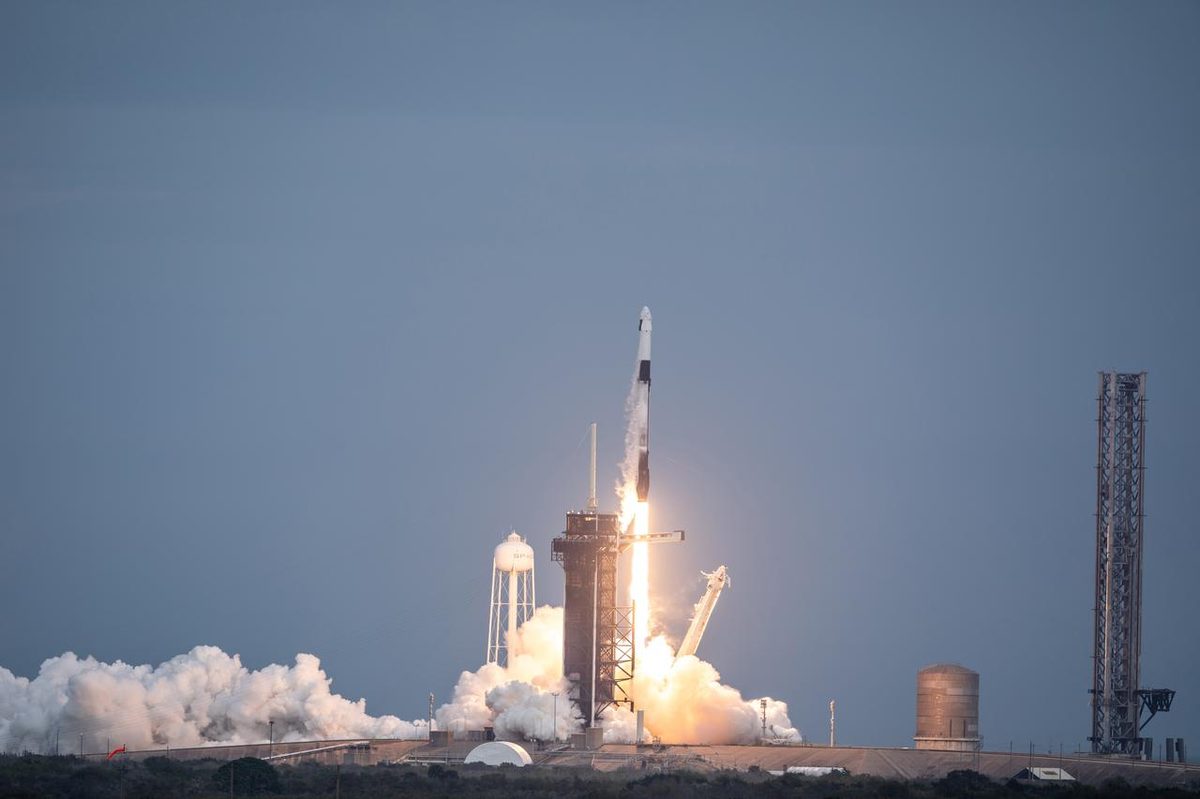
The Kármán line has a price list now. It is not posted anywhere publicly, and the figures are usually disclosed only when a deal is announced or a passenger talks to the press, but the rough contours of the market are legible enough: a suborbital hop with Blue Origin's New Shepard runs somewhere in the range of $450,000 to $600,000 per seat. A SpaceX Crew Dragon mission flown commercially — meaning through Axiom Space, which charters the vehicle and sells individual berths — costs each passenger in the vicinity of $55 million, inclusive of six months of training, logistics, and a brief stay at the International Space Station. Virgin Galactic, which completed its commercial debut in 2023 before grounding its VSS Unity spaceplane and transitioning to the next-generation Delta class vehicle, has returned to flight with pricing reported around $600,000 per seat. These are not entry-level figures. They are, however, no longer exclusively the province of centibillionaires.
The shift has been gradual but real. The earliest passengers — Dennis Tito, who paid an estimated $20 million to ride a Soyuz to the ISS in 2001, followed by a thin trickle of ultra-wealthy adventurers over the next two decades — were outliers in every sense. They were buying access that did not yet have a market structure around it, and they were doing so through a Russian space agency that had a very specific reason to sell: it needed hard currency after the Soviet program's financial collapse. When SpaceX flew Inspiration4 in September 2021, carrying four passengers on a purely private mission with no government agency in the loop, it was genuinely different. The vehicle was American, the mission was privately financed, and the customers were not heads of state or tech moguls negotiating one-off deals. They were people who could afford an amount that was very large by most standards but not by the standards of a Forbes 400 list.
Who the customers actually are
The current buyer profile for orbital missions clusters around the high net worth tier just below the superrich — founders, executives, and investors with assets in the $100 million to $500 million range who treat a Crew Dragon seat the way a previous generation might have treated a private Antarctic expedition. The Axiom missions have followed this pattern consistently. Axiom Mission 1, which flew in April 2022, carried Michael Lopez-Alegria as commander alongside three paying customers: Larry Connor, an Ohio real estate developer; Mark Pathy, a Canadian shipping and investment executive; and Eytan Stibbe, an Israeli investor and former fighter pilot. None of them would appear on a list of the world's wealthiest people. All of them were rich enough that $55 million represented a meaningful but not catastrophic allocation of capital.
Subsequent Axiom missions have deepened this pattern while adding a new dimension: national participation. Axiom Mission 2 in May 2023 included two Saudi Arabian passengers, Rayyanah Barnawi and Ali Alqarni, whose seats were paid for at least in part by the Saudi government as part of a broader push to develop domestic space capability and national prestige. Axiom Mission 3 in January 2024 had a similar flavor, with passengers from Italy and Sweden alongside a U.S. commander. The orbital market, in other words, is not just a consumer luxury product — it is also a procurement category for governments that want to send their citizens to space without operating their own launch vehicles. For smaller nations with ambitions but not infrastructure, buying Axiom seats is the fastest path to having an astronaut.
Suborbital is a different market, serving a different appetite. New Shepard's flights last roughly eleven minutes, including about three to four minutes of weightlessness and a window view of Earth's curvature above the atmosphere's thin blue line. That is not the same experience as two weeks on the ISS, and the pricing reflects it. Blue Origin has flown dozens of passengers since its first crewed launch in July 2021, drawing from a pool of entrepreneurs, investors, and a handful of celebrities — though the company does not publicly release its manifest. The demographic skews toward people who want the experience of spaceflight without the six-month training commitment that orbital missions require. New Shepard's capsule is passive; passengers receive a day of training and then ride. That accessibility has made it a viable product for a wider pool of buyers than anything orbital.
What the competition is doing to price
The question that orbital market observers have been asking since Axiom flew its first mission is whether competition will eventually compress prices. The short answer, as of mid-2026, is: not yet, and probably not soon. The constraint is not demand — there are more people willing to spend $55 million on a Crew Dragon seat than there are Crew Dragon seats available. The constraint is supply. SpaceX has a full manifest of NASA crew rotation missions to the ISS, Commercial Crew obligations that take priority, and Starship development consuming significant engineering bandwidth. Axiom can only sell what SpaceX can fly, and SpaceX is not flying commercial missions as a primary business line.
Starship changes the calculus in theory, though the timeline has slipped enough times that forward projections carry wide uncertainty bands. SpaceX has described Starship as eventually enabling large-scale space tourism — the dearMoon mission, which was announced in 2018 with Yusaku Maezawa as the anchor passenger and a crew of artists flying around the Moon, has been rescheduled multiple times and remains technically contracted but practically uncertain. If Starship reaches operational status for crewed flights, the economics shift dramatically: a vehicle that can carry a hundred people in principle is a vehicle that can, in time, spread its fixed costs across a much larger manifest. That is how prices come down. But Starship is not there yet.
In the suborbital segment, Virgin Galactic's return with the Delta-class vehicle — designed from the outset as a higher-cadence aircraft-launched system compared to the single Unity — introduces meaningful competitive pressure on Blue Origin. Both companies are selling the same fundamental product: a few minutes above the atmosphere, the astronaut wings designation, the story you tell for the rest of your life. Differentiation comes down to vehicle experience, brand, and the community each company cultivates around its passenger alumni. Virgin Galactic has leaned into the experiential and social dimensions; Blue Origin emphasizes the technical rigor of its rocket-propelled capsule. Both approaches are finding buyers.
The second-order effects
What is quietly more interesting than the price-per-seat figures is what the commercial passenger economy is doing to the broader aerospace industry. Axiom Space has used its ISS missions not just to generate revenue but to build the operational and regulatory credibility it needs to eventually fly passengers to its own station — the Axiom Station modules are under construction, with the first expected to attach to the ISS before the end of the decade. The company's business model depends on demonstrating that commercial crews can operate professionally in orbit, and each successful mission is effectively a proof-of-concept for that longer arc.
Meanwhile, the concept of "payload" in commercial spaceflight has expanded beyond human beings. Several passengers on recent Axiom missions have carried private research experiments — pharmaceutical crystallization studies, materials science samples, biological cell cultures — that their companies or sponsors could not easily fly through traditional NASA channels. The ISS has always been a research platform, but the commercial crew pathway has opened access to it for organizations that would never have navigated the NASA proposal process. In this sense, the market for space tourism is beginning to overlap with the market for microgravity research services, and the economics of the two reinforce each other.
The customer buying a $55 million seat today is still exceptional by any ordinary measure. But the infrastructure being built around them — the training facilities, the mission operations companies, the insurance products, the regulatory frameworks — is infrastructure that will exist when the price is $5 million, and eventually when it is $500,000. Markets develop through the premium tier first. Space tourism is not yet a mass-market product. It is, unmistakably, becoming a real one.
