
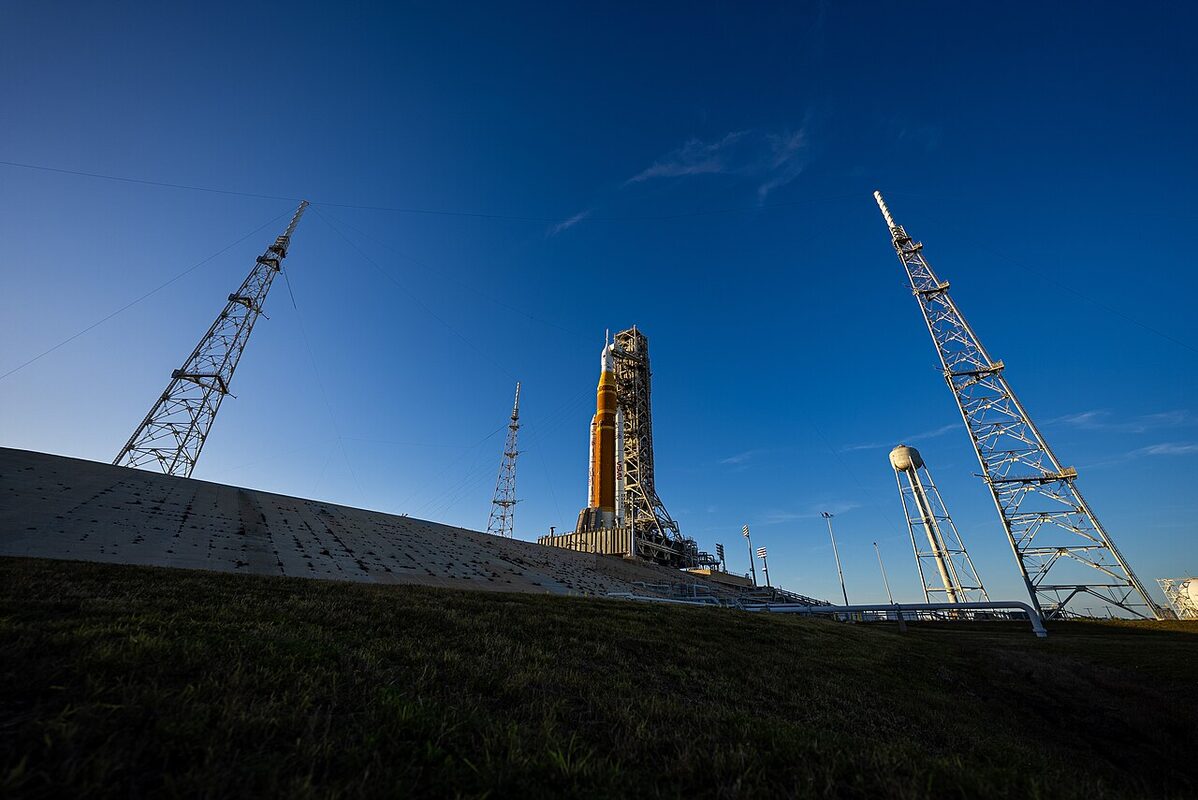
The marquee event of 2026 is already in the books: Artemis II flew its nearly ten-day lunar loop in April, carrying four astronauts farther from Earth than any crew since Apollo and splashing down within three miles of its targeted landing site. But the year's launch manifest is far from spent. Between now and December, NASA's next flagship observatory ships to the Cape, a small fleet of commercial landers takes aim at the Moon, Japan mounts the first round-trip mission to a Martian moon, and India flies the dress rehearsal for its first crewed spaceflight. Here is what is still scheduled to leave the pad in 2026 — with honest caveats about which dates will hold.
The Flagship: Roman Space Telescope, August 30
NASA's Nancy Grace Roman Space Telescope now has a firm date: August 30, 2026, on a Falcon Heavy from Kennedy Space Center, bound for the Sun–Earth L2 point. The date is notable for moving in the rare direction — up. Roman was built out roughly eight months ahead of its original schedule, finished observatory construction last November, and ships from Goddard to Florida this month. With a field of view a hundred times Hubble's at the same resolution, Roman's five-year survey mission is built to settle questions about dark energy that Hubble and Webb can only nibble at. After years of watching the project survive repeated cancellation attempts in budget proposals, the astronomy community gets its answer to whether Roman flies — this summer.
The Moon Rush Resumes
Four commercial and national landers are still chasing 2026 windows, every one of them carrying the standard caveat: lander schedules slip.
China's Chang'e 7 is the heavyweight — an orbiter, lander, rover, and a hopping probe designed to leap into permanently shadowed craters near Shackleton at the lunar south pole, hunting water ice with 18 science payloads. The spacecraft arrived at the Wenchang launch site in April for a Long March 5 launch in the second half of the year. Astrobotic's Griffin-1, the company's return after the Peregrine failure, is targeting no earlier than July on a Falcon Heavy, hauling Astrolab's thousand-pound FLIP rover to the south pole. Intuitive Machines' IM-3 — after two landings that ended on their sides — aims for the Reiner Gamma magnetic anomaly in the second half of the year with NASA magnetometers and plasma instruments. And Firefly's Blue Ghost Mission 2, stacked on the company's Elytra Dark transfer vehicle, would deploy ESA's Lunar Pathfinder relay satellite and then attempt something no commercial lander has tried: a far-side touchdown, with the UAE's Rashid Rover 2 aboard, late in the year.
The wild card is Blue Origin's Blue Moon MK1 cargo-lander demo, which finished thermal-vacuum testing but rides on New Glenn — and New Glenn is grounded. The rocket's fourth flight ended before it began on May 28, when a static-fire test at Launch Complex 36 destroyed the transporter-erector in a pad explosion. Blue Origin says it will fly again before year's end; outside observers call that ambitious, and NASA is no longer waiting to find out — Administrator Jared Isaacman says the agency is decoupling the lander from the rocket and pushing for an alternative launcher to protect the Artemis schedule.
Crews and Capsules
SpaceX Crew-13 moved up to no earlier than mid-September — NASA astronauts Jessica Watkins and Luke Delaney, Canada's Joshua Kutryk, and Roscosmos' Sergey Teteryatnikov, riding to the station for Expedition 75. Boeing's Starliner-1, recast as an uncrewed cargo flight after the 2024 crewed test's troubles, sits at TBD on an Atlas V. Sierra Space's Dream Chaser — the winged cargo spaceplane a decade in the making — holds a no-earlier-than fourth-quarter slot on a Vulcan.
The most consequential crew-program milestone, though, belongs to India. Gaganyaan-1, the first uncrewed orbital test of ISRO's crew capsule, is officially slated for the second half of 2026 — a target that already slipped a year from the late-2025 date ISRO's chairman was projecting when he called the vehicle 90 percent complete last fall. It will carry Vyommitra, a half-humanoid robot, as a stand-in for the astronauts India intends to fly in 2027 — which would make it only the fourth nation to launch humans on its own vehicle.
Mars, by Way of Phobos
Japan's MMX — Martian Moons eXploration — ships to a November-or-December window on an H3 from Tanegashima, when the every-26-months Mars window opens. The mission profile is audacious: orbit Mars, land on Phobos, grab at least ten grams of its surface, fly by Deimos, and return the samples to Earth in 2031. If it works, JAXA will have returned material from a Martian moon before any agency returns material from Mars itself — and may settle whether Phobos is a captured asteroid or a chip off Mars from an ancient impact.
The Rockets Themselves
The launcher picture is messier than the payload manifest. ULA's Vulcan opened 2026 with a national-security flight, then ran into a Space Force pause on military missions after a February flight shed an anomalous debris plume from a solid booster; its September task is the first Amazon Leo constellation batch on Vulcan. Ariane 6 is projected to roughly double its 2025 cadence with six to eight flights, while sister rocket Vega-C lofts ESA's FLEX plant-fluorescence explorer together with Sentinel-3C in September. SpaceX's Starship program, twelve flights in, debuted its upgraded V3 vehicle in May and has the next one in test flow. And New Glenn's recovery timeline is the question mark hanging over every payload manifested on it.
Why It Matters
Strip away the dates and 2026's back half is a referendum on whether the new architecture of spaceflight actually delivers. Roman tests whether NASA can still field a flagship on schedule. The lander wave tests whether the commercial-lunar model can produce upright, operating spacecraft at a cadence instead of heroic one-offs. Gaganyaan-1 and MMX test how wide the circle of serious spacefaring nations has grown. Not all of these dates will hold — lander slips are a near-certainty, and New Glenn's year-end return is a bet, not a plan. But even the slips are informative: arrivals already locked for late 2026, like ESA's Hera reaching the Didymos asteroid system and BepiColombo finally settling into Mercury orbit, mean the season delivers regardless of what the pads do. We will update this guide as windows firm up or slide.
Sources
- NASA Sets Launch Date for Roman Space Telescope — SpacePolicyOnline
- Initial Artemis II Assessments — NASA
- Moon Rush: Private Lunar Landings in 2026 — Space.com
- New Glenn Return-to-Flight After Pad Explosion — Space.com
- Chang'e 7 Arrives at Spaceport — SpaceNews
- NASA Crew-13 Assignments — NASA
- Launch Schedule — Spaceflight Now
