
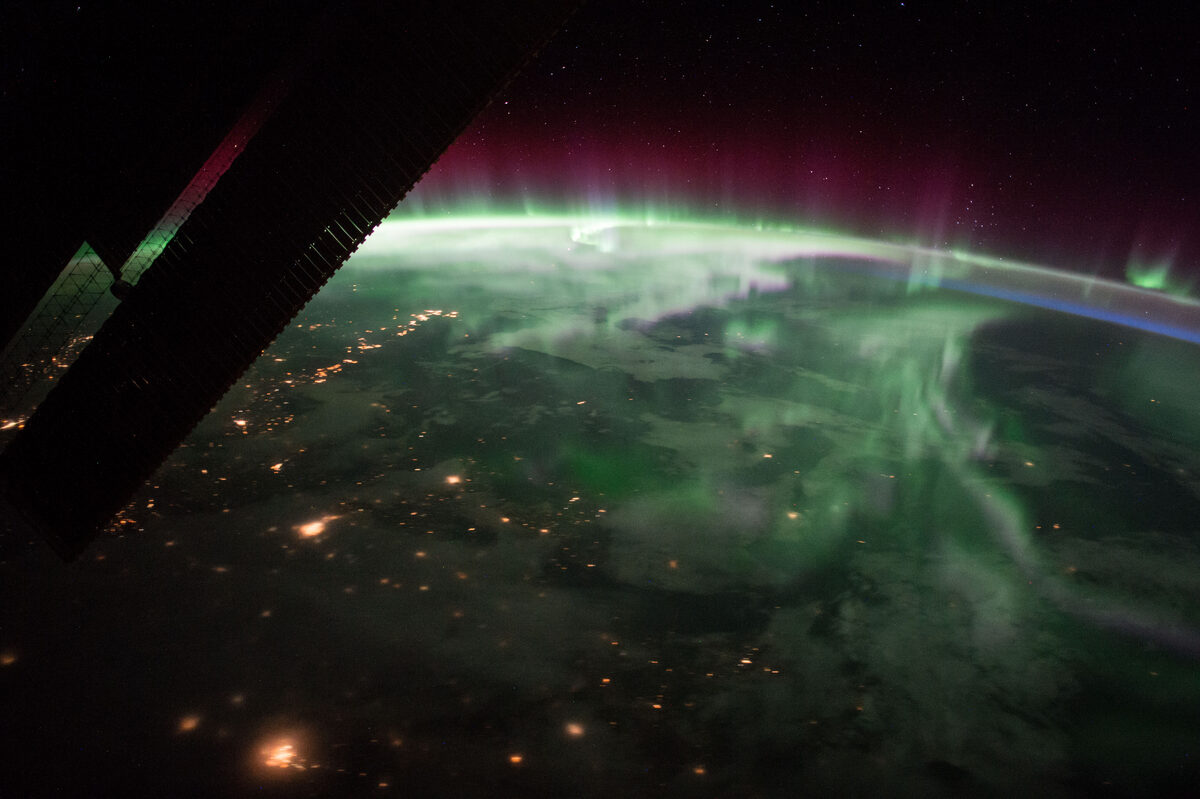
For as long as the Moon has orbited us, its two faces have quietly recorded different weather. Not rain and wind in any earthly sense, but the relentless drizzle of the solar wind - protons, alpha particles and heavier ions streaming off the Sun and slamming into the airless lunar surface. Now, thanks to a couple of grams of soil scooped from the Moon's far side, researchers have shown that Earth itself has been tampering with that record for billions of years, and that the difference is written into the noble gases locked inside the dirt.
The study, published in Nature Geoscience by Zhang and colleagues, leans on the material China's Chang'e-6 mission returned in 2024 - roughly 2 grams of regolith lifted from the South Pole-Aitken Basin, the enormous, ancient impact scar that dominates the lunar far side. It was the first sample ever brought back from the side of the Moon that never faces Earth, and that single fact is what makes the analysis possible: for the first time, scientists could directly compare far-side soil against near-side soil from the earlier Chang'e-5 mission and ask whether the two hemispheres were weathered by the same wind.
They were not.
Reading the Gas in the Grains
The evidence lives in noble gases - neon, krypton and xenon - implanted in the outer skins of individual soil grains. Solar wind ions arrive with enough energy to bury themselves a short distance into mineral surfaces, where they sit as a chemically inert archive. Because noble gases do not react with the minerals around them, the isotopic fingerprint and the depth to which they penetrate survive as a physical memory of how fast the wind was moving when it struck.
In the Chang'e-6 far-side samples, the team found low neon isotope ratios and a much stronger degree of neon fractionation than in the near-side material. The krypton and xenon are clearly solar-wind-derived, and crucially their release patterns - how the gases come off the grains as the samples are heated in the lab - indicate that the particles penetrated deeper into far-side soil than into the Chang'e-5 near-side soil. Deeper penetration points to a faster, more energetic wind hitting the far side essentially unimpeded.
The near side tells the opposite story. There, the wind arrives softened. The researchers interpret the near-side signature as a partially decelerated solar wind, slowed to something like 200 km/s - close to half the speed of the unshielded flow, which typically travels around 400 km/s - by the time it reaches the surface. The culprit is the one object big enough and magnetic enough to get in the way: Earth.
Standing in Earth's Shadow
Earth's magnetosphere is not a tidy bubble. On the side facing the Sun it is compressed, and on the night side it stretches into a long magnetotail that reaches well past the Moon's orbit. Every month, as the Moon swings to the far side of Earth from the Sun, its near side spends part of that time inside or near this tail, where the incoming solar wind has already been slowed, deflected and reshaped by its passage through Earth's magnetic field. The far side, pointing away from Earth, gets no such cover.
The numbers the team put on this are what make the result concrete. Their analysis suggests that about 25 percent of the total solar-wind exposure recorded at the Chang'e-5 near-side site had been influenced by this decelerated, magnetosphere-processed wind. At the Chang'e-6 far-side site, they found no comparable shielding effect at all - the soil there simply took the wind at close to full speed for its entire exposure history.
That asymmetry has been suspected on theoretical grounds and glimpsed by spacecraft measuring the environment in real time. What had been missing was a physical sample that integrated the effect over geological time. The regolith does exactly that, averaging billions of years of monthly passes through Earth's magnetic shadow into a single, measurable chemical difference between the hemispheres.
Why It Matters
The immediate appeal is a clean confirmation: Earth measurably alters the space weather that reaches the Moon, and the fingerprint is strong enough to survive in the soil. But the larger prize is what this makes possible going forward. If the degree of solar-wind deceleration on the near side depends on Earth's magnetosphere getting in the way, then near-side lunar soils become a kind of fossil record of that magnetosphere's behavior over time.
Earth's magnetic field is not static. Its strength has waxed and waned across the planet's history, it has reversed polarity many times, and the very existence of a strong early magnetosphere is tied to deep questions about how our planet stayed habitable - how it held onto water and atmosphere while a young, violent Sun tried to strip them away. We have almost no direct archive of that history. Rocks on Earth preserve fragments of the ancient field, but they are limited and endlessly reworked by plate tectonics and weathering.
The Moon offers something Earth cannot: a stable, tectonically dead surface that has been sitting in Earth's magnetic wake for eons, quietly logging the interaction. By comparing near-side and far-side samples of different ages, researchers may be able to reconstruct how the shielding effect - and by extension the magnetosphere producing it - has changed over billions of years. That turns a handful of grey dust into an instrument for reading our own planet's magnetic past.
A Payoff for Going to the Far Side
None of this would have been measurable without going to the far side specifically. The near-side story alone is ambiguous; you cannot tell how much the wind was slowed without a pristine sample of the unslowed wind to compare against. Chang'e-6's roughly 2 grams from the South Pole-Aitken Basin supplied exactly that control - the baseline of what the solar wind looks like when Earth is not in the picture.
It is a reminder that sample-return missions keep paying dividends in directions no one fully anticipated when the spacecraft launched. The soil was gathered to study the far side's geology and the Moon's own history. It turned out to also carry a record of Earth, faintly etched into the surfaces of its grains by billions of years of solar wind - some of it moving fast, some of it slowed by the shield that has protected us all along.
Sources
- Deeper solar wind penetration on the Moon's farside from noble gas records - Nature Geoscience (Zhang et al., 2026, DOI 10.1038/s41561-026-02042-w)
- Chang'e-6 samples reveal how Earth slows solar wind striking Moon's near side - EurekAlert!
- China's Chang'e-6 reveals why solar wind hits the Moon's two sides differently - ScienceDaily
