
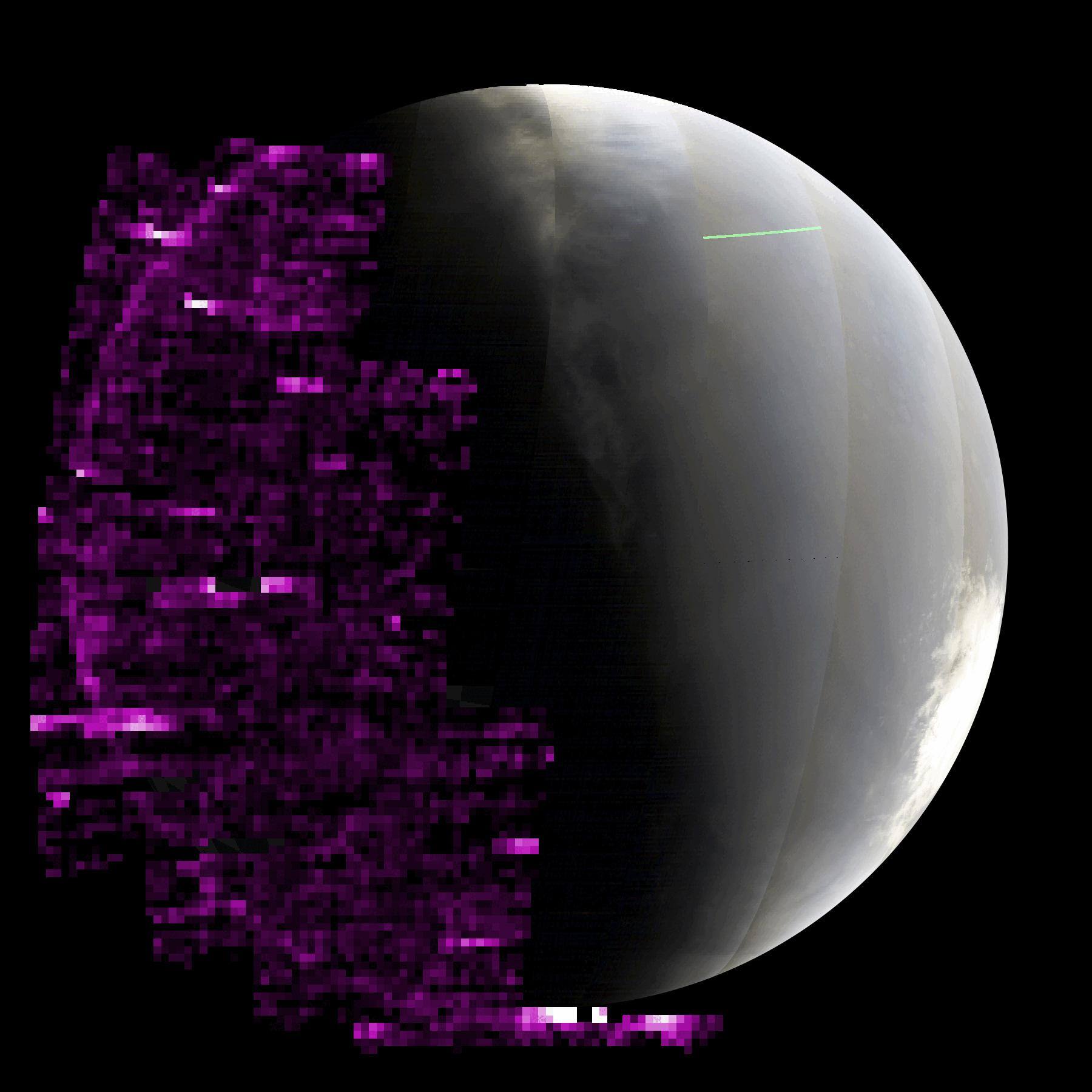
Mars should not have discrete auroras. That was never quite the stated position of planetary science, but it was the shape of the problem. Discrete aurora — the sharp, structured, localized kind, as opposed to a diffuse planet-wide glow — is what you get when a magnetic field grabs electrons, accelerates them along field lines, and slams them into an atmosphere. Earth has a global dipole to do that work, generated by our planet's churning core. Mars has no global magnetic field at all: the ancient one recorded in its crust roughly four billion years ago has long since disappeared. And yet Martian discrete auroras are real, repeatedly observed, and stubbornly localized over particular patches of magnetized crust.
On July 23, 2026, NASA announced that data from the retired MAVEN orbiter has closed the gap. Writing in Nature Communications, a team led by Shaosui Xu, an associate research physicist at UC Berkeley's Space Sciences Laboratory, argue that Mars runs a miniature version of the Dungey cycle — the same magnetic-reconnection-driven circulation of flux and plasma that lights up Earth's aurora. Not an analog. Not a loose resemblance. "We knew that magnetic reconnection was happening at Mars," Xu said, "but did not expect it to be like the Dungey cycle."
The engine, and why Mars was not supposed to have one
The Dungey cycle is the standard account of how a magnetized planet converts solar wind energy into aurora. When the Sun's magnetic field lines get close to Earth's magnetosphere, they can reconnect and inject energy and mass throughout the magnetosphere and magnetotail, ultimately firing electrons back into the atmosphere. The process drives electrical currents, accelerates the charged particles that create auroras, and controls the circulation of plasma in Earth's magnetosphere and ionosphere. It is a closed circulation of magnetic flux and plasma, running as long as the solar wind keeps blowing.
Running that cycle normally requires a global intrinsic magnetic field, which is precisely the thing Mars does not have. What it has instead is remnant crustal magnetism: intensely magnetized crust that formed around four billion years ago, when lava cooled in the presence of Mars' ancient global magnetic field — a field that has since disappeared, with intense solar wind stripping the planet's atmosphere. Those regions behave as what NASA describes as "numerous miniature magnetospheres," scattered around the planet rather than organized around a pole. MAVEN has observed highly localized auroras over these crustal fields, which NASA's release likens to Earth's auroras at the poles.
The open question was never whether the crustal fields mattered. It was the energy budget. Something had to be accelerating electrons hard enough to produce discrete emission, and nobody had pinned down what. Per NASA, the realization that a Dungey-like cycle operates within these crustal fields is what answered that question: the mechanism is the one we already knew, operating in miniature.
Three instruments, one argument
The case rests on in situ electron, ion, and magnetic field measurements MAVEN was positioned to make from orbit. The Magnetometer and the Solar Wind Electron Analyzer were used together to determine the magnetic configuration and to derive electrical currents. STATIC, the Suprathermal and Thermal Ion Composition instrument, measured plasma flows in the ionosphere. "We really pushed the limit of STATIC to get the data we needed," Xu said. "It was the final piece to the puzzle in understanding these localized auroras."
Magnetic topology, currents, and plasma circulation are the three things you need to identify a Dungey cycle rather than merely assert one. Reconnection is not directly photographable; it is inferred from the configuration that permits it, the currents it drives, and the flows it produces. Having all three from the same spacecraft, at the same place and time, is what turns a plausible story into a measurement.
What the combination reveals, in the authors' framing, is a miniature cycle of magnetic flux and plasma circulation resembling a scaled-down version of what happens at Earth. It also helps explain why Martian aurora is so unruly: with crustal fields distributed non-uniformly across the planet, Mars exhibits complex and highly variable auroral patterns tied to both planetary rotation and solar wind conditions.
How small is small
The scaling numbers are worth sitting with, because they are what make this interesting rather than merely tidy. At Earth, the Dungey cycle operates in the presence of a global intrinsic dipole field roughly 100 times stronger than the Martian fields in play, on spatial scales roughly 20 times larger. Mars is running the same circulation at a fraction of the field strength across a fraction of the volume, on magnetism that has been sitting inert in rock since the planet's first billion years.
That is a useful stress test for the physics. A mechanism that only works at one set of parameters is a description; a mechanism that survives two orders of magnitude in field strength is closer to a law. NASA makes the same point more soberly: the result shows a Dungey-like mechanism can happen on both large and small scales, which widens the search for where else in the solar system the process might be running. It also reframes what a magnetosphere has to be — not necessarily a planet-sized cavity carved by a dynamo, but any magnetic structure large enough to support the cycle, including one welded to the ground.
Why It Matters
Two reasons, one scientific and one operational — plus a third that is really about how missions end.
Scientifically, this closes a mechanism gap on a planet whose atmospheric history is the whole reason for studying its upper atmosphere in the first place. MAVEN was, per UC Berkeley's Space Sciences Laboratory, the first mission devoted to understanding the Martian upper atmosphere, and a central goal was determining the present-day loss rate of water and other gases to space so that rate could be extrapolated backward into Mars' atmospheric, climate and habitability history. Aurora is a visible symptom of the electrodynamic coupling between the solar wind and that atmosphere. Knowing the coupling runs through reconnection at crustal fields, rather than through some unidentified local accelerator, changes how you model energy delivery into the system. As MAVEN principal investigator Shannon Curry put it, the result "changes how we think of Martian auroras and is another important step toward understanding why Mars and Earth have evolved so differently despite being governed by the same underlying physics."
Operationally, discrete aurora marks where energetic particles are hitting the atmosphere. NASA frames the broader payoff as a better understanding of how the solar environment interacts with the Red Planet as a whole — something it calls essential for future robotic and crewed missions. The localization is the useful part. If electron precipitation concentrates over specific, mapped crustal regions under specific solar wind conditions, then it is something you can anticipate rather than merely budget for. That is the difference between a design margin and a flight rule.
Then there is the mission itself. MAVEN lost signal with ground stations on December 6, 2025. On June 3, NASA declared the mission concluded after finding the spacecraft unrecoverable. The orbiter operated from 2013 to 2025; its principal investigator is based at the University of Colorado Boulder's Laboratory for Atmospheric and Space Physics, which also manages science operations, while NASA Goddard manages the mission, Lockheed Martin Space built and operated the spacecraft, and JPL provides navigation and Deep Space Network support. Curry is a co-author on a paper published roughly seven weeks after her spacecraft was formally declared done. The orbiter is silent. The archive is not. First-order science is still coming out of data collected years ago by instruments nobody can point at anything anymore, which is a reasonable argument for treating archive and analysis funding with something closer to the seriousness we reserve for launches.
Sources
- NASA's MAVEN Illuminates New Understanding of Auroras at Mars — NASA Science, July 23, 2026
- Miniature Dungey-like cycle at Mars: a new twist on an old auroral paradigm — preprint, Research Square (DOI 10.21203/rs.3.rs-7915739/v1)
- MAVEN — UC Berkeley Space Sciences Laboratory project page
- NASA's MAVEN Sheds Light on Martian Auroras — Mirage News
