
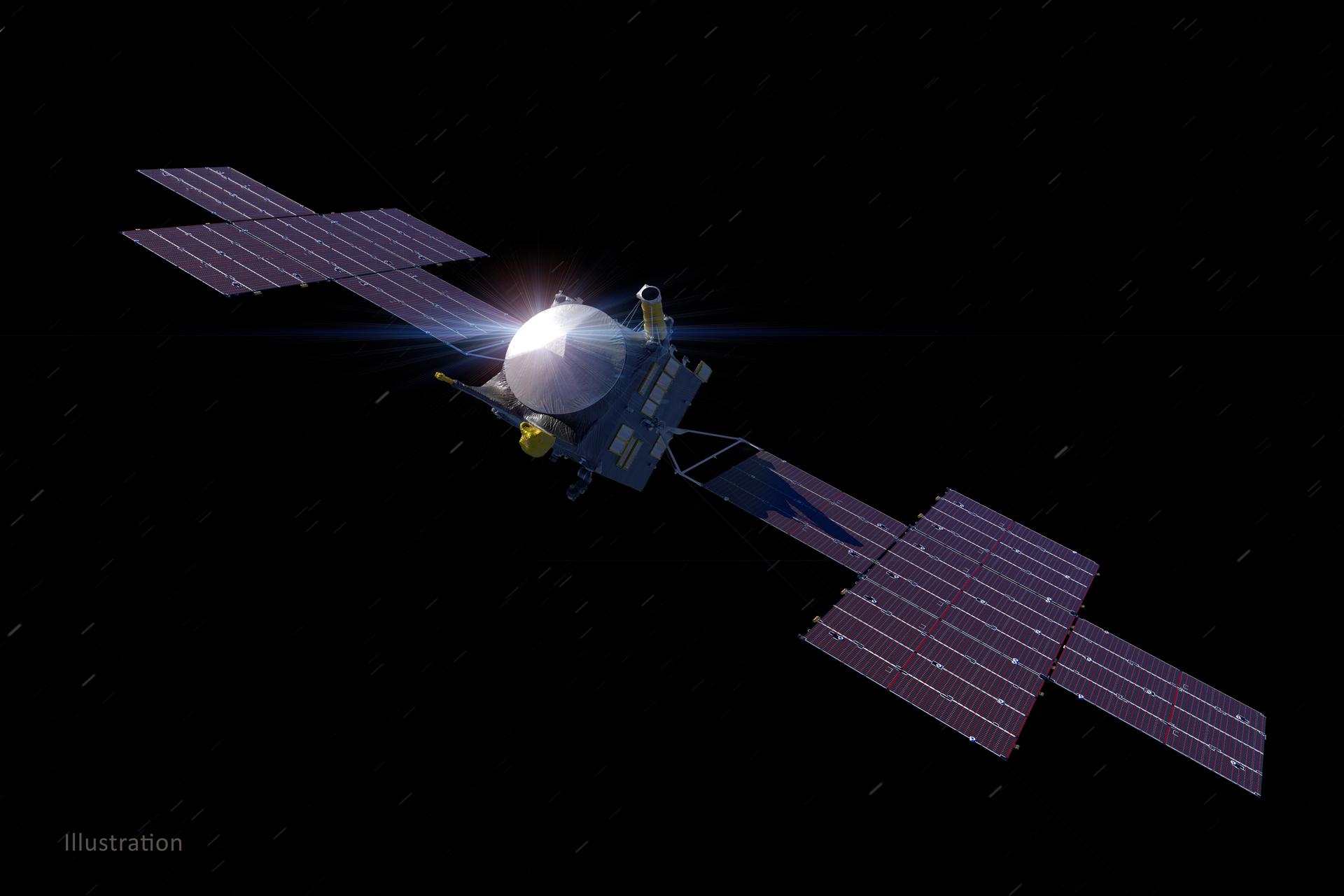
A gravity assist is, in the coldest engineering terms, a way to steal momentum from a planet. But when NASA's Psyche spacecraft swung past Mars on May 15, 2026, it did more than borrow speed. It used the encounter as a dress rehearsal — a chance to point its cameras and sensors at a real world and see whether the hardware built to study a distant metal asteroid actually works. On July 17, 2026, NASA and the Jet Propulsion Laboratory released the results: the science data and a time-lapse video assembled from the flyby. The verdict, in short, is that everything came to life.
What actually happened at Mars
Psyche passed within 2,864 miles (4,609 km) of Mars at closest approach. That flyby bent the spacecraft's trajectory and increased its velocity — all without burning a drop of propellant. That last detail is the entire point of a gravity assist. Fuel is the scarcest resource on any deep-space mission, and letting a planet's gravity do the work of a rocket burn is how spacecraft reach targets that would otherwise be out of budget. Psyche is bound for the metal-rich asteroid (16) Psyche, and it is now scheduled to arrive in the summer of 2029. Mars was the shortcut on the way.
The gravity assist was the headline maneuver, but for the science teams the flyby was something more useful: a live operational test. Instruments that have spent years in the lab and months in transit finally had a bright, complicated, nearby object to look at. Mars is not the mission's science target, but it is an excellent proving ground, and the release makes clear the checkout went well.
The instruments, and how they did
Three instrument systems got their workout during the encounter, and according to NASA all three returned good results.
The imager captured the kind of detail that only a close pass allows: windblown craters, the planet's south polar ice cap, and the large double-ringed Huygens crater. Those are not just pretty pictures. Confirming that the camera resolves fine surface structure and handles the geometry of a fast flyby is exactly the sort of validation you want years before the spacecraft has to image an asteroid it has never seen up close.
The magnetometer team also used the pass as a functional test, recording an intense uptick in the magnetic field corresponding to the bow shock region as the spacecraft passed Mars. Reading a planet's magnetic environment on the fly is a demanding exercise, and getting the instrument through a real encounter builds confidence for the science campaign to come.
Then there is the gamma-ray and neutron spectrometer, which is arguably the instrument with the most riding on this flyby. Its job at the asteroid will be to determine what (16) Psyche is actually made of by reading the gamma rays and neutrons that come off a body's surface. During the Mars pass, the spectrometer detected a count-rate enhancement close to what the team anticipated from neutrons escaping Mars — a genuine measurement rather than a bench simulation. That is the difference between believing an instrument works and watching it work.
The Lawrence Livermore angle
One piece of that spectrometer deserves its own spotlight. The gamma-ray sensor at the heart of the instrument was built by Lawrence Livermore National Laboratory, working in partnership with the Johns Hopkins Applied Physics Laboratory, and the Mars flyby delivered its first measurements of a planetary surface after roughly 2.6 years in deep space. According to Lawrence Livermore, the encounter was an invaluable dress rehearsal — a chance to test all aspects of the instrument's performance and its data pipeline ahead of the asteroid science operations to come.
This matters because a gamma-ray sensor is not a thing you can fully vet on the ground. Earth's atmosphere, and the shielding of a laboratory, change the radiation picture. A flyby of a planet — with its own gamma-ray and neutron environment — offers a controlled-enough, realistic-enough test to shake out whether the detector behaves as designed. Passing that test now, rather than discovering a problem at the asteroid with no way to fix it, is precisely the kind of risk that mission planners build these checkouts to retire.
The time-lapse
The most public-facing piece of the release is the time-lapse video, and it is worth understanding how it was made. NASA assembled it from images the spacecraft took starting in early May and throughout the flyby — a monthlong sequence around the May 15 closest approach. The video shows Mars beginning as a distant point, swelling until it fills the field of view during the close pass, with the south polar ice cap visible during the encounter.
It reads as a piece of outreach, and it is. But it is also evidence. Building a smooth month-long time-lapse out of a long run of frames requires that the imager and the spacecraft's pointing performed consistently across the whole approach-and-departure arc, not just at the single instant of closest approach. The video is the checkout result made visible.
Why It Matters
Psyche is headed to a world unlike anything a spacecraft has visited: a metal-rich asteroid that may be the exposed core of an early planetary building block, or something stranger. The science that justifies the mission — figuring out what that body is made of — depends entirely on instruments that have never operated at their real target. The Mars flyby was the last major opportunity to prove those instruments against a real planetary object before arrival in 2029.
That it also bent the spacecraft's path and added speed without burning propellant is the elegant part of the story. But the deeper significance is confidence. A camera that resolved Huygens crater, a spectrometer that read Mars' neutron environment, and a Lawrence Livermore gamma-ray sensor that took its first planetary-surface measurements are no longer unknowns. When Psyche reaches its metal world, the mission will be flying instruments that have already been proven to work in space — and that is the difference between hoping for good data and expecting it.
