
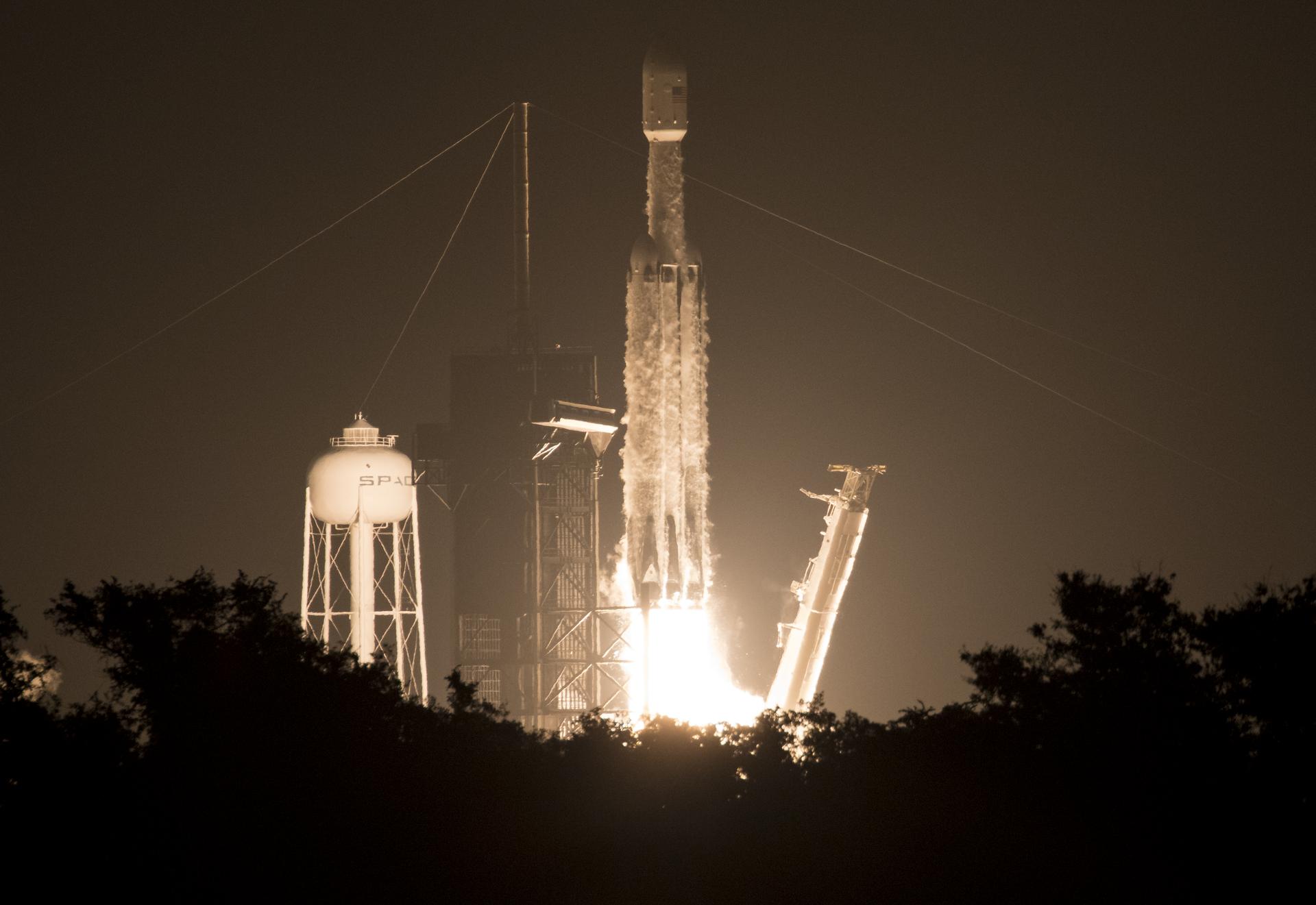
The U.S. Space Force did not announce a new rocket, a new orbit, or a new adversary this week. It announced a bigger number. On July 17, 2026, Space Systems Command raised the spending ceiling on the National Security Space Launch Phase 3 Lane 1 contract vehicle from $5.6 billion to $17 billion — an increase of $11.4 billion, more than tripling the pot available to seven commercial launch providers competing for military payloads through fiscal 2029.
Ceiling increases are the least glamorous documents in defense procurement. They are also, frequently, the most honest. A ceiling is the government's admission of how much it might have to spend on a thing it has already decided it needs. Tripling one two years into a five-year strategy is not a routine administrative refresh. It is the Space Force saying, in the only language contracting officers are permitted to use, that it badly underestimated how much launching it was going to do.
What Lane 1 actually is
NSSL Phase 3 splits military launch into two lanes, and the distinction matters more than the naming convention suggests. GAO describes Phase 3 as a dual-lane approach intended to lower government launch costs, ensure mission success and access to space, and facilitate competition.
Lane 2 is the traditional half. GAO characterizes it as assuring DOD's access to space with three commercial providers, which must meet all launch requirements for a specified number of the department's most critical payloads. Full certification, government engineering oversight, the works.
Lane 1 is the commercial-style half. In GAO's framing, it expands DOD's supply of newer commercial providers that can meet a subset of launch requirements — missions that do not demand the extensive certification procedures Lane 2 requires. Critically, Lane 1 functions as an on-ramp: it is the mechanism by which newer providers enter the national security launch market at all, a market that was historically a two-company affair.
That on-ramp is now visible in the vendor pool. The seven providers eligible for Lane 1 task orders are United Launch Alliance (a Boeing–Lockheed Martin joint venture), SpaceX, Blue Origin, Rocket Lab USA, Stoke Space Technologies, Impulse Space, and Relativity Space's Relativity Federal subsidiary. Two of those names — ULA and SpaceX — represent the old duopoly. The other five are companies that would not have been in the room under the previous structure.
Why the number moved
The stated driver is demand, and the specific figure is telling. The Space Force has identified 25 additional Lane 2 missions beyond the 54 originally planned across the five-year period. That is a roughly 46 percent increase in projected Lane 2 mission count against a plan set in 2024 — meaning launch needs have risen sharply in the two years since the Phase 3 strategy was drawn up.
There is an obvious question buried in that: why does a surge in Lane 2 missions justify tripling the Lane 1 ceiling? The lanes are not sealed compartments. A launch manifest that grows by a quarter of a hundred missions puts pressure on every part of the system — vehicles, pads, processing facilities, range time, and the contract vehicles that pay for all of it. Raising the Lane 1 ceiling gives Space Systems Command headroom to push work toward the faster, cheaper, less procedurally encumbered path rather than queueing everything behind full mission assurance. It is capacity insurance.
It is worth being precise about what a ceiling is and is not. Raising it to $17 billion does not obligate $17 billion. No provider has been handed money. What has changed is the maximum aggregate value of future task orders that can be issued under this vehicle before contracting officers have to go back and modify it again. Competition for those task orders runs through fiscal 2029.
The part nobody put in a press release
The ceiling notice reads very differently alongside a Government Accountability Office report published in June 2025, GAO-25-107228, whose title reads like a bureaucratic shrug and whose contents describe a system straining at the seams: National Security Space Launch: Increased Commercial Use of Ranges Underscores Need for Improved Cost Recovery.
The headline finding is a volume number. Commercial launches at federal launch sites have more than quadrupled since 2021. GAO's auditors visited all three federally owned launch ranges, infrastructure built as government assets to serve government missions. Those ranges are now heavily occupied hosting private launches, many of which happen to be flying government payloads under commercial-style contracts like, for instance, NSSL Phase 3 Lane 1. GAO notes DOD's launch infrastructure is strained by the increased rate of launches.
That volume costs money to support, and GAO found the Defense Department is not reliably collecting it. Recent legislation allows DOD to be reimbursed for indirect costs within certain limitations, but in the report's words, DOD "does not have clear cost collection and reimbursement guidance for support services at launch ranges, potentially missing opportunities to recoup millions of dollars." GAO also found DOD has struggled to accurately bill companies for direct costs. Range safety, tracking, security, roads, power, water, the people who run all of it — someone pays. GAO's finding is that the accounting for who pays is muddled enough that the government is likely eating costs it is entitled to recover.
Set that against the other number in the report: DOD expects to spend over $18 billion on launch services and infrastructure over the next five years. That figure sits in the same order of magnitude as the newly raised Lane 1 ceiling, which is a useful reminder that the rockets are only part of the bill. Concrete, cabling, and range personnel are the other part, and the demand curve GAO documented is bending upward on both.
GAO issued three recommendations, all of which DOD concurred with:
- Update DOD regulations to better define direct and indirect cost guidance, improving the department's ability to recoup launch support costs.
- Prioritize solicitations for insight into commercial payload processing schedules — partially addressed already through two contracts awarded in April 2025, one to Astrotech Space Operations worth $77 million and one to Blue Origin worth $78 million.
- Centralize national security payload processing schedules across space vehicle program offices, with a contract award projected for July 2026.
That last item is worth flagging: the projected award date is now. Whether that contract was actually awarded on schedule is not something the ceiling notice addresses.
Seven providers, one bottleneck
Read together, the two documents tell a coherent story. The Space Force is deliberately widening the supplier base — seven companies where there used to be two — and simultaneously discovering that the constraint may not be suppliers at all.
Adding Stoke Space, Impulse Space, Rocket Lab, Blue Origin, and Relativity Federal to the eligible pool increases the number of vehicles that can theoretically fly military payloads. It does not increase the number of launch pads, the hours in a range day, or the payload processing capacity — which GAO explicitly found to be limited, alongside insufficient commercial scheduling information to manage it. Competition on the vehicle side is healthy and overdue. But a manifest growing by 25 unplanned Lane 2 missions, layered on top of commercial traffic that has more than quadrupled since 2021, lands on shared infrastructure whose cost recovery model GAO described as unclear.
Why It Matters
For most of the past two decades, the interesting question in national security launch was who gets to fly. The Phase 3 Lane 1 structure has largely answered it: seven companies, with a genuine pathway for newer commercial providers. That is a structural change from the ULA-and-SpaceX era, and the $11.4 billion increase gives it real financial weight rather than symbolic access.
The question that replaces it is where and how often can they fly. The three federally owned ranges are a finite, shared, government-owned resource being consumed at a rate that has more than quadrupled since 2021. GAO's report is not primarily an accounting complaint — the millions in unrecovered costs are the symptom. The underlying issue is that DOD lacks sufficient scheduling visibility into who is using its payload processing infrastructure and when, which makes it very hard to plan capacity for a manifest that just grew by 46 percent against plan.
There is also a straightforward budget-watching reason to note the $17 billion figure. Ceilings are not spending, and treating them as such is a common error in coverage of defense contracts. But ceilings do describe the outer boundary of institutional intent. A ceiling that triples two years into a five-year plan tells you the plan was wrong in a specific direction, and that the correction is large. Over the next three fiscal years, the gap between the $17 billion ceiling and the task orders actually issued against it will be the honest measure of how much of this demand was real.
Watch three things: whether the July 2026 centralized payload scheduling contract award projected in the GAO report actually happened; whether Lane 1 task orders begin flowing to the five non-incumbent providers or concentrate among the two established ones; and whether DOD publishes the cost collection guidance it agreed to define. The third is the least exciting and probably the most consequential. Infrastructure that nobody bills for correctly is infrastructure that nobody budgets to expand.
Sources
- National Security Space Launch: Increased Commercial Use of Ranges Underscores Need for Improved Cost Recovery (GAO-25-107228, June 2025) — U.S. Government Accountability Office
- Space Force triples launch contract ceiling amid rising demand — SpaceNews
- Space Force Boosts Ceiling For NSSL Phase 3, Lane 1 By $11.4 Billion — Defense Daily (July 17, 2026)
