
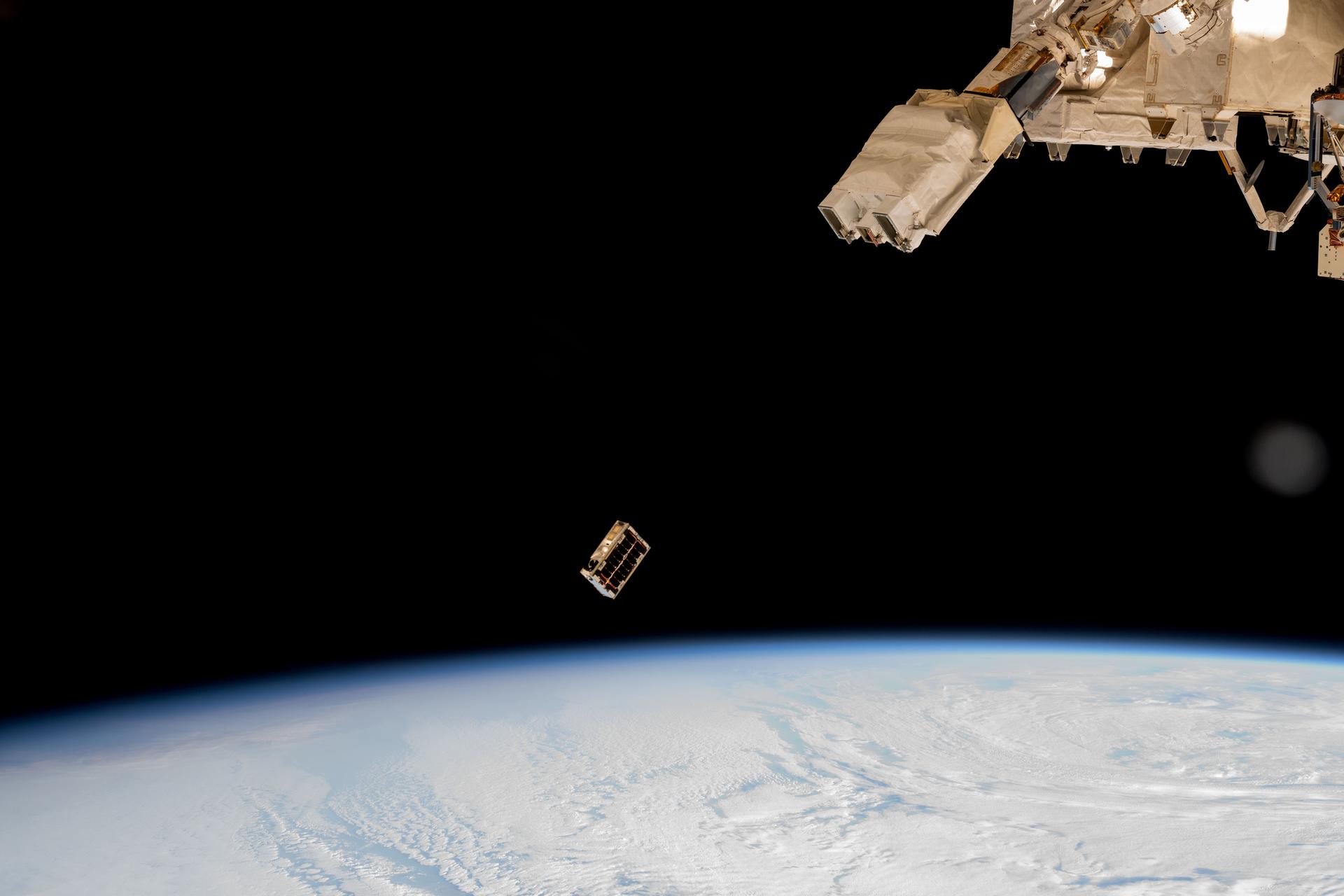
Gravitics has spent the past few years talking about orbital carriers as a concept — big, modular platforms that could park multiple smaller spacecraft in orbit and release them on demand. That concept now has a signature on it. According to a report published Aug. 31, 2026 by SpaceNews, Lockheed Martin Space has awarded the Seattle-based startup a subcontract to build three flight-ready Orbital Carriers, each capable of holding five or six smaller spacecraft pre-positioned in orbit for rapid deployment.
The subcontract is structured as a time-and-materials award, definitized at $249,900, signed May 26. That's a modest dollar figure for hardware development — closer to a study contract than a production run — but the context around it is what makes the deal notable. It's tied directly to the Pentagon's Golden Dome missile-defense initiative. Separately, Gravitics was also selected this year for the Missile Defense Agency's SHIELD contracting vehicle, a framework that lets qualified companies compete for future missile-defense work — though, per SpaceNews, that selection alone "doesn't itself guarantee significant orders."
What an Orbital Carrier Actually Is
Strip away the marketing language and an Orbital Carrier is essentially a bus for other spacecraft — a larger structure designed to loiter in orbit carrying smaller satellites, sensors, or interceptors until they're needed, then release them quickly. Instead of launching individual assets one at a time and waiting for them to reach useful positions, the idea is to pre-stage capability in space and cut the response time from "launch decision" to "asset in position" down dramatically. Gravitics isn't building this in the abstract. The company unveiled its carrier design, named Diamondback, on Nov. 6, 2025, according to Payload Space. Diamondback's headline capability is speed of repositioning: the company says it can reach any cislunar orbit within 12 hours and reach some low Earth orbit locations in under two hours. That's the kind of maneuverability that matters for a defense platform meant to protect other military satellites, stage space-based interceptors, or house other deterrent technology that needs to move fast in a crisis.
How the Money Traces Back
The Lockheed subcontract isn't Gravitics' first government money for this line of work. Diamondback's development has been funded through a Space Force Strategic Funding Increase (STRATFI) agreement worth up to $60 million — $30 million in government funding matched by $30 million in private investment — awarded in March 2025. STRATFI awards are designed to bridge small companies from prototype demonstrations into production-scale defense contracts. SpaceNews, however, describes the Lockheed subcontract as a separate path toward an operational application rather than a direct continuation of the STRATFI funding itself, so it's more accurate to call these two parallel bets on the same underlying hardware than one feeding directly into the other. The Missile Defense Agency's SHIELD IDIQ — short for Scalable Homeland Innovative Enterprise Layered Defense — is a related but distinct piece of context. Per MDA's own release, SHIELD is a $151 billion-ceiling, 10-year multiple-award contracting vehicle covering everything from R&D and prototyping to weapon design, integration, production, testing, and sustainment for next-generation missile defense. Gravitics' selection for SHIELD gives it an opportunity to compete for future missile-defense work, but SpaceNews is explicit that the vehicle "doesn't itself guarantee significant orders," and it reports the Lockheed subcontract as a separate track rather than a task order issued under SHIELD. Either way, a quarter-million-dollar subcontract is a rounding error against a $151 billion ceiling — but it's also how large defense primes typically start: small, definitized task orders that prove out a subcontractor before bigger production orders follow.
The Guetlein Line
Gravitics CEO Colin Doughan has been leaning on one endorsement in particular. In the Payload Space piece, he quotes Golden Dome Director Gen. Michael Guetlein describing Diamondback as "the first true deterrent I have for space." It's a striking line — deterrence, in the classic Cold War sense, has mostly been a story about missiles and submarines, not orbital carrier platforms. Whether that framing holds up as the hardware actually reaches orbit is a separate question, but it signals how the program's leadership is positioning the capability: not as a passive sensor or communications relay, but as something with an active defensive posture in the same category as more traditional deterrent assets.
Timeline and the IPO Question
Gravitics is targeting orbital demonstrations of the carrier hardware in 2027 and 2028, per the SpaceNews report. Separately, and somewhat unusually for a company at this stage, Gravitics is pursuing a reverse merger to go public by Sept. 30, 2026, seeking to raise $125 million. A reverse merger would let the company skip a traditional IPO roadshow and access public capital markets faster — useful for a hardware company that needs to scale manufacturing to meet defense production timelines rather than iterate slowly the way a typical venture-backed startup might.
Why It Matters
Golden Dome has, so far, generated a lot of architecture diagrams and dollar figures — a $151 billion contracting ceiling, competing prime contractor teams — without much in the way of concrete, named hardware orders reaching smaller companies. This Lockheed-Gravitics subcontract, small as it is in dollar terms, is a data point that the program is starting to convert into actual task orders rather than remaining a planning exercise. It also illustrates one way Golden Dome money can move: primes like Lockheed win architecture-level contracts and then flow money down to specialized subcontractors who bring a specific capability — in this case, a company that has spent years developing orbital platform hardware — even as Gravitics pursues other government paths, like its SHIELD eligibility and STRATFI funding, in parallel rather than as one continuous pipeline. For companies like Gravitics, being first through with flight hardware, rather than just a STRATFI study contract, is the difference between being an interesting startup and being a validated defense supplier. Whether the 2027-2028 demonstration timeline holds, and whether $249,900 in seed hardware money turns into the kind of production-scale orders that would justify a $125 million public offering, will be the real test of whether Golden Dome's space layer moves from PowerPoint to orbit on schedule.
