
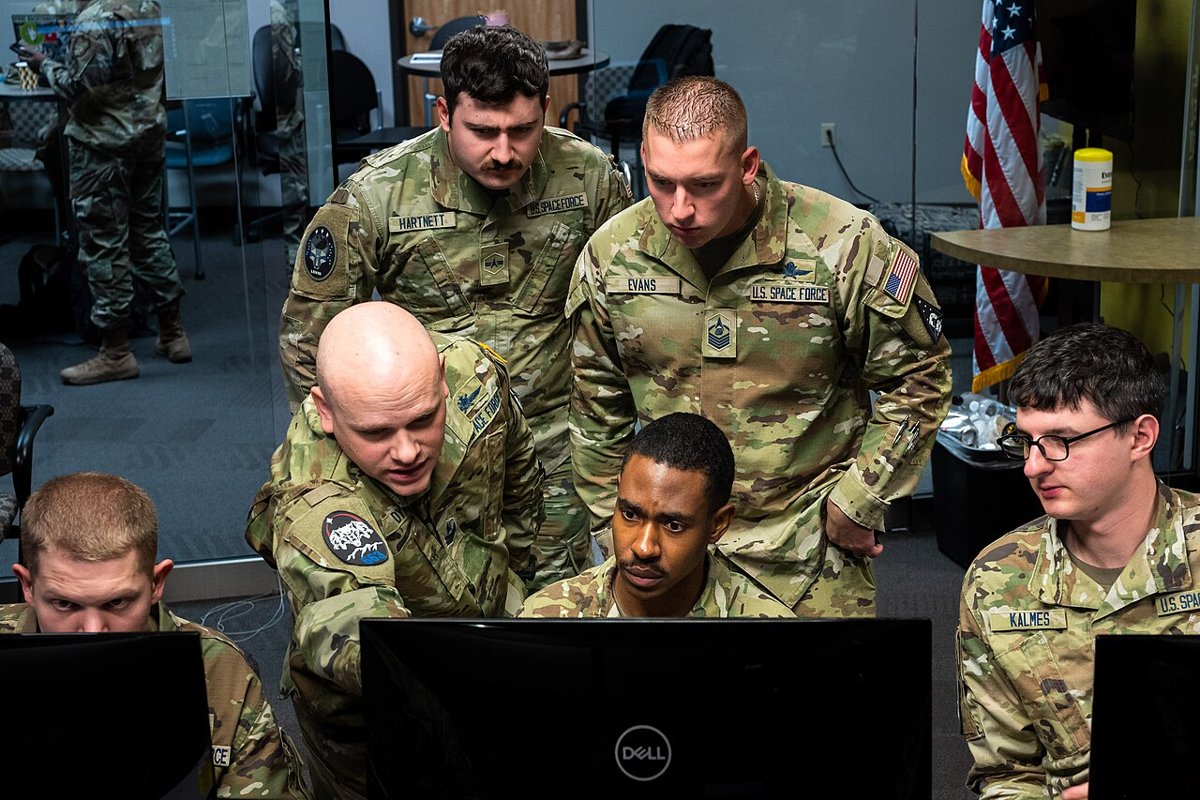
The U.S. Space Force has never been particularly shy about the scale of its ambitions, but the branch's latest planning document puts hard numbers behind the rhetoric for the first time. The Objective Force plan — a dense, 100-page blueprint — charts a 15-year course for transforming the Pentagon's youngest service from a monitoring outfit into something that looks a lot more like a warfighting force.
The priorities, boiled down: more people, better simulators, and satellites tough enough to survive a fight.
A Branch That Needs to Grow — Fast
Today the Space Force fields roughly 15,000 military and civilian personnel. That makes it by far the smallest branch of the U.S. armed forces, a fact that has been a point of pride for some leaders and a source of anxiety for others. The Objective Force plan lands firmly in the anxiety camp. It calls for approximately 30 percent growth in personnel dedicated to the Space Domain Awareness mission alone — the analysts, operators, and engineers who track objects in orbit and assess threats in real time.
That growth isn't speculative. The document ties it directly to the anticipated explosion in orbital traffic over the next decade and a half, as both government and commercial operators worldwide continue launching constellations at an accelerating pace. Keeping track of all that hardware — and distinguishing routine maneuvers from potentially hostile repositioning — demands warm bodies with specialized training, not just better algorithms. The plan acknowledges as much by calling for new mission sets to handle emerging requirements as the domain becomes increasingly congested and contested.
Simulation as Institutional Muscle Memory
You cannot run a live-fire exercise in orbit. There are no bombing ranges in geosynchronous orbit, no Red Flag equivalents where satellite operators can stress-test tactics against a thinking adversary and then debrief over bad coffee. That constraint has left the Space Force with a training gap that its leadership openly regards as unacceptable for a service expected to operate in contested environments.
The Objective Force plan addresses this head-on by prioritizing simulation ecosystems that blend real hardware-in-the-loop feeds, synthetic threat scenarios, and physics-based models of orbital mechanics and electromagnetic interference. The goal is to give missile warning personnel the ability to practice threat identification under realistic conditions, and to allow satellite operators to rehearse maneuver-and-reconstitution drills without risking expensive assets.
This is not a new aspiration; the Space Force has been talking about better simulation for years. What the Objective Force plan adds is the explicit acknowledgment that simulation infrastructure must be treated as a core capability investment — not a training-budget afterthought — if the service hopes to build the kind of institutional muscle memory that other branches develop through regular field exercises.
Survivability: From Sitting Ducks to Maneuverable Fleets
The most significant conceptual shift buried in the document may be its language about survivability. For most of the Space Force's existence — and the decades of Air Force Space Command that preceded it — American military satellites were designed on the assumption that they would operate in a largely permissive environment. They were exquisite, expensive, and essentially stationary targets.
The Objective Force plan explicitly retires that assumption. It calls for a transition from attrition-based thinking to an operational model built around campaigning, maneuver, and reconstitution. In plainer English: instead of building a small number of irreplaceable satellites and hoping no one shoots at them, the Space Force wants fleets of resilient spacecraft that can dodge threats, absorb losses, and be quickly replenished.
The plan envisions integrating operations across multiple domains — treating a satellite jamming attack, a cyber intrusion into ground-control software, and a physical anti-satellite intercept as facets of the same fight rather than separate problems managed by separate teams. Commercial space providers are written into this architecture as well, with the document calling for deeper integration of commercial launch capabilities to enable rapid reconstitution of degraded constellations.
The Industrial Base Problem Nobody Has Solved
Grand strategic visions are only as credible as the industrial base behind them, and on that front the Space Force faces headwinds that the Objective Force plan acknowledges but cannot unilaterally fix. A parallel challenge playing out across the defense establishment illustrates the gap between aspiration and capacity: stockpiles of solid rocket motors — the propulsive backbone of everything from missile defense interceptors to satellite launch vehicles — have been dwindling for years.
The problem is structural, not sudden. Manufacturing facilities that once operated at scale have been running below capacity, and inconsistent procurement signals have left suppliers unable to justify the capital investment needed to ramp production back up. The result is a bottleneck that affects not just the Space Force but the entire defense establishment's ability to field and sustain critical systems.
For the Space Force, which depends on launch capacity for everything from deploying new constellations to reconstituting damaged ones, the solid rocket motor shortage is not an abstract supply-chain problem. It is a direct constraint on the branch's ability to execute the Objective Force vision. A strategy built around rapid reconstitution only works if you can actually get replacement satellites into orbit on demand — and right now, the industrial base is not configured to deliver that.
Training Leaders for a Domain That Didn't Used to Need Them
The Space Force's transformation also requires a different kind of leader. Air University, the professional military education institution that has historically trained Air Force officers, has been evolving its curriculum to prepare leaders specifically for the challenges of contested space operations. The shift reflects a broader recognition that space professionals need more than technical proficiency — they need the strategic judgment to make command decisions in a domain where the rules of engagement are still being written and where the consequences of miscalculation could cascade across every other warfighting function that depends on space-based assets.
This educational pivot is significant because it signals that the Space Force is thinking beyond hardware. Satellites and simulators are necessary but insufficient. The branch also needs a leadership cadre that understands orbital mechanics, electromagnetic warfare, and great-power competition well enough to integrate them under pressure. Building that cadre takes years, which is precisely why the Objective Force plan's 15-year horizon matters — it gives the service enough runway to grow leaders alongside systems.
Why It Matters
The Objective Force plan is not the first time the Space Force has articulated a vision for its future, but it is the most granular. Previous strategy documents spoke in generalities about contested space and the need for resilience. This one puts personnel growth percentages and capability priorities on paper — the kind of specifics that Congress can use to hold the service accountable and that the defense industry can use to plan investment.
The plan also arrives at a moment when the gap between American space ambitions and American industrial capacity is widening, not narrowing. Solid rocket motor shortages, workforce constraints, and production bottlenecks are not problems the Space Force can solve alone. They require sustained attention from Congress, the broader Pentagon, and commercial partners willing to bet on defense demand signals that have historically been unreliable.
If the Objective Force vision holds, the Space Force of 2040 will look fundamentally different from the service that exists today — larger, more distributed, more commercially integrated, and trained for combat rather than monitoring. Whether the nation's defense industrial base can keep pace with that ambition is the question the plan raises but cannot answer on its own.
