
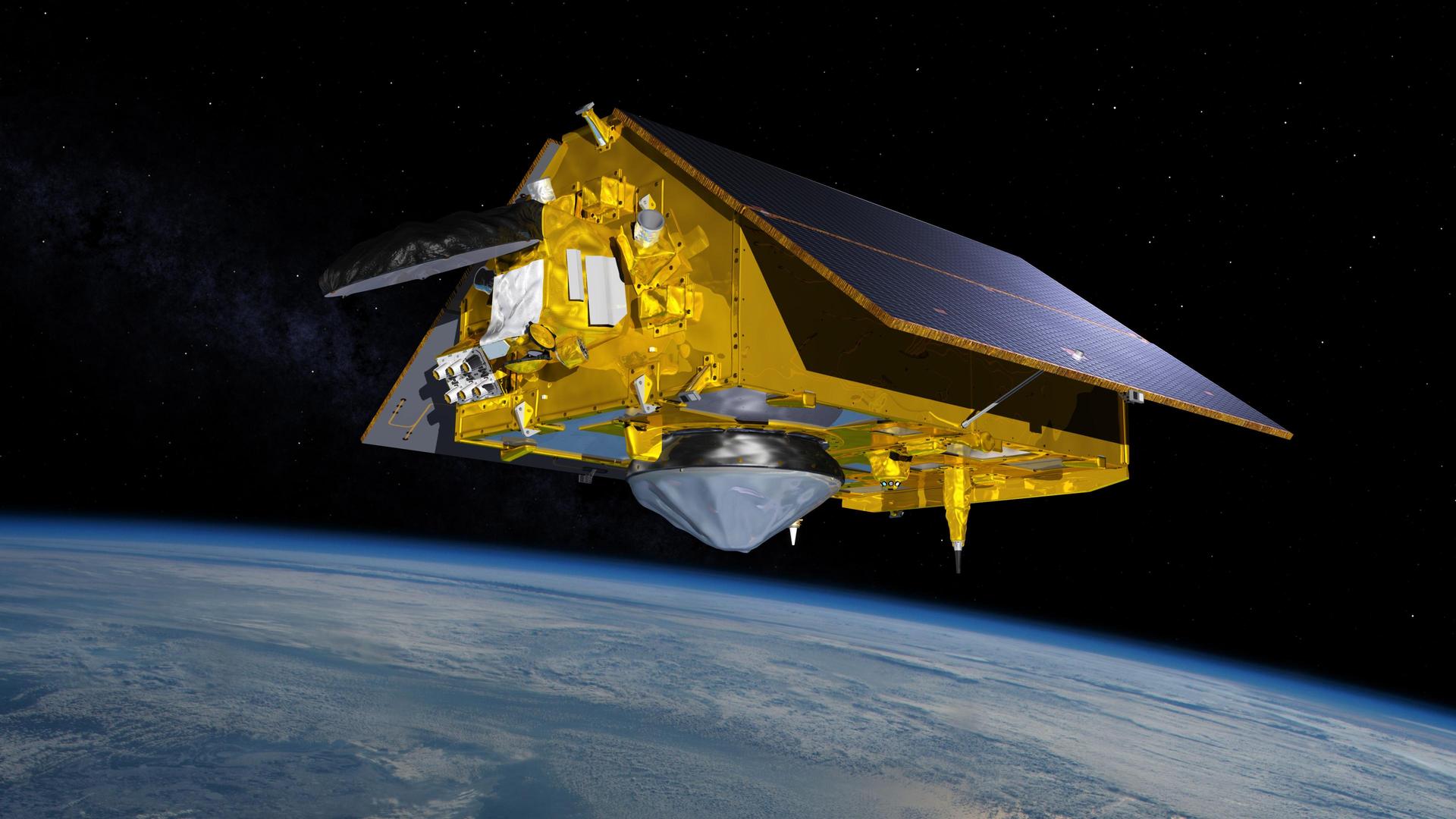
The U.S. Space Force wants to watch the sky from above it. On August 4, Space Systems Command announced $615 million in new contracts under a program called Space-Based Airborne Moving Target Indicator — SB-AMTI for short — a mouthful of an acronym for a straightforward goal: detect and track aircraft, cruise missiles, and other airborne objects using satellites instead of manned surveillance planes.
Three companies split the award. Rocket Lab took the largest share, $397 million, to build and launch a constellation of sensor satellites it calls "Flatellites." Defense contractor STR LLC picked up a portion of the remaining $218 million. A third vendor was awarded funding too, but the Space Force isn't naming them — the agency says withholding the name is a matter of operational security.
It's the second task order issued under an existing SB-AMTI industry-partner pool, following an initial rapid-acquisition award earlier this year. That first round went almost entirely to SpaceX, in a deal reported at roughly $4.16 to $4.2 billion — dwarfing the sum handed out this week. The gap between the two awards is itself the story: after leaning heavily on one contractor the first time around, the Space Force is now spreading the next phase of the program across multiple companies and, notably, multiple technical approaches.
What SB-AMTI Actually Does
Airborne moving target indication is a surveillance discipline the Air Force has relied on for decades through aircraft like the E-3 Sentry AWACS — a modified Boeing 707 bristling with radar that circles at altitude, watching for enemy aircraft and cruise missiles below the horizon of ground-based radar. It works, but it has a structural weakness: AWACS aircraft are large, slow, and easy to target. In a conflict against an adversary with modern long-range weapons, keeping a fleet of unstealthy radar planes airborne and safe becomes its own military problem.
SB-AMTI is the Space Force's answer: put the same tracking capability into orbit, where satellites can maintain continuous overhead coverage without needing to avoid contested airspace the way a manned aircraft would. It's part of a broader shift at Space Systems Command toward proliferated satellite constellations — many smaller, cheaper spacecraft replacing a handful of exquisite, expensive ones — a philosophy that also shows up in the Flatellite design itself, built to pack more satellites onto fewer launches.
Rocket Lab's Neutron Problem — and Opportunity
The most consequential detail in this week's award isn't the dollar figure. It's the rocket.
Rocket Lab plans to launch its Flatellite satellites aboard Neutron, the company's medium-lift rocket that has not yet flown. Neutron is designed to loft roughly 13 metric tons to low Earth orbit — a significant step up from Rocket Lab's smaller Electron rocket, which carries far less payload to orbit — and the company has been racing to get it to the pad this year. According to satellite industry trade press, Neutron's debut is targeted for the fourth quarter of 2026, putting the SB-AMTI launch in the October-to-December window.
That timeline means Neutron's debut, or something close to it, will double as a Space Force mission — the first time Neutron has been assigned a named national-security satellite mission. For a vehicle that hasn't yet demonstrated it can reach orbit, that's a considerable vote of confidence from the Pentagon, and a fair amount of schedule pressure for Rocket Lab. A slip in Neutron's test campaign doesn't just delay a commercial milestone anymore; it delays a national security constellation the Space Force has already put its name and budget behind.
Deliberately Not Betting on One Vendor
Space Systems Command has been unusually explicit about why the contract is split three ways. Col. Ryan Frazier, quoted in the command's announcement, framed it as a hedge: the goal, he said, is "diversifying our capabilities and ensuring we don't rely on a single technical solution."
That's a notable posture shift from the first SB-AMTI task order, which concentrated the bulk of the money with SpaceX. Running Rocket Lab's sensor-equipped Flatellites, STR's signal-processing approach, and an undisclosed third architecture in parallel gives the Space Force multiple ways to detect the same threats — useful if one sensor type turns out to have blind spots, and useful strategically if an adversary only knows how to counter one of the architectures. It also means the program isn't tied to a single company's launch cadence or supply chain, a real consideration when one of the three vendors is flying satellites on a rocket that hasn't left the ground yet.
Why It Matters
SB-AMTI sits at the intersection of two trends reshaping military space: the push to move surveillance functions off vulnerable manned aircraft and onto satellites, and the Pentagon's growing comfort spreading contracts — and risk — across multiple vendors rather than a single prime. The $615 million awarded this week is modest next to the roughly $4.16-4.2 billion SpaceX collected in the program's first round, but it signals the Space Force wants competing technical approaches maturing simultaneously rather than a monoculture it can't easily walk back if one architecture underperforms.
For Rocket Lab, the award is validation and pressure in equal measure. Landing a nine-figure defense contract tied to Neutron gives the company a marquee national-security customer before the rocket has even flown — but it also means Neutron's maiden launch now carries expectations that go well beyond proving the vehicle works. If Neutron slips, so does a piece of the Space Force's airborne-tracking architecture, in full public view.
