
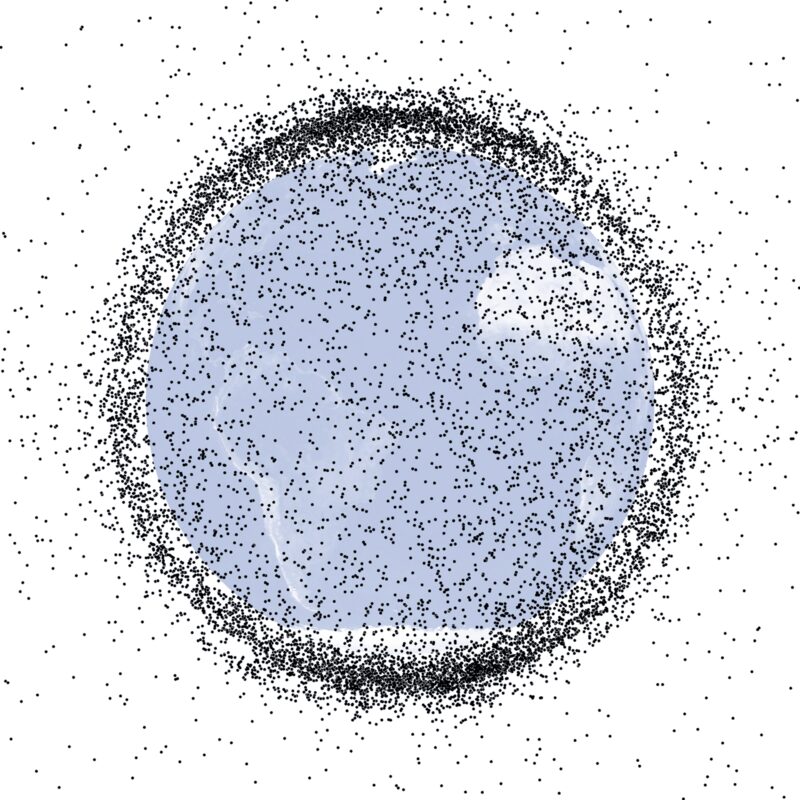
Every useful thing humans put in low Earth orbit shares that space with a growing cloud of useless and dangerous things: dead satellites, spent rocket stages, and hundreds of thousands of fragments from past collisions and explosions, all circling the planet at speeds around 28,000 kilometres per hour. At those velocities, a fleck of paint hits with the force of a bullet, and a piece the size of a marble can destroy a working spacecraft. The fear that has haunted space agencies for decades is a chain reaction — collisions creating debris that causes more collisions — that could eventually make whole orbital regions unusable. After years of treating the problem as tomorrow's, the first missions built specifically to clean up are now reaching space.
From warning to hardware
Europe has led the push. The European Space Agency, through its Space Safety programme, has partnered with the Swiss startup ClearSpace on a series of missions to demonstrate that a spacecraft can rendezvous with a dead object, capture it, and drag it down to burn up in the atmosphere. In early 2026 the partnership began a demonstration called PRELUDE, flying two small spacecraft to test the close-approach navigation and delicate manoeuvring that any capture mission depends on — the difficult art of one spacecraft sneaking up on another, tumbling and uncooperative, without smashing into it. It is the technical groundwork for ClearSpace-1, the flagship mission to actually grab and de-orbit a real piece of European space junk with a four-armed "claw," now targeted for later this decade.
The effort has already taught a humbling lesson. ClearSpace-1's original target — a discarded rocket adapter left in orbit — was itself struck by other debris before the cleanup mission could launch, breaking into multiple pieces and forcing the team to choose a new target. The junk problem, in other words, is getting worse fast enough to disrupt the missions meant to address it.
The numbers behind the worry are stark. Tracking networks follow tens of thousands of objects larger than ten centimetres, and models put the count of smaller, untrackable but still lethal fragments in the millions. The runaway-collision scenario even has a name — the Kessler syndrome, after the NASA scientist Donald Kessler who described it in the 1970s — and it is not merely theoretical: the International Space Station periodically fires its thrusters to dodge tracked debris, and crews have occasionally sheltered in their return capsules as a precaution when a fragment passes too close. Every new collision or breakup adds to a population that, above a certain density, could begin to feed on itself.
A commercial market for cleanup
Alongside the agency-led work, a commercial market is forming. The Japanese company Astroscale has flown missions to inspect derelict objects up close, including a rocket upper stage, demonstrating the rendezvous techniques from the private sector, and is developing services to de-orbit satellites at the end of their lives. The emerging model is twofold: clean up the dangerous legacy debris already up there, and prevent new debris by building future satellites with docking fixtures and de-orbit plans so they can be removed cleanly when they die. Increasingly, regulators are pushing operators to plan for that disposal from the start.
None of this is easy or cheap, and the scale of the problem dwarfs the capacity of any single mission — there are far more dangerous objects in orbit than there are cleanup spacecraft to remove them, and likely will be for years. But the significance of these first flights is that the conversation has moved from studies and warnings to actual hardware in actual orbit, attempting the actual task. Space sustainability has become a real engineering discipline with a real market, driven by a simple recognition: the orbital environment is shared infrastructure, and like any shared resource, it can be ruined by neglect. The first cleanup crews are now on the job, and the junkyard they are tackling is only getting more crowded.
