
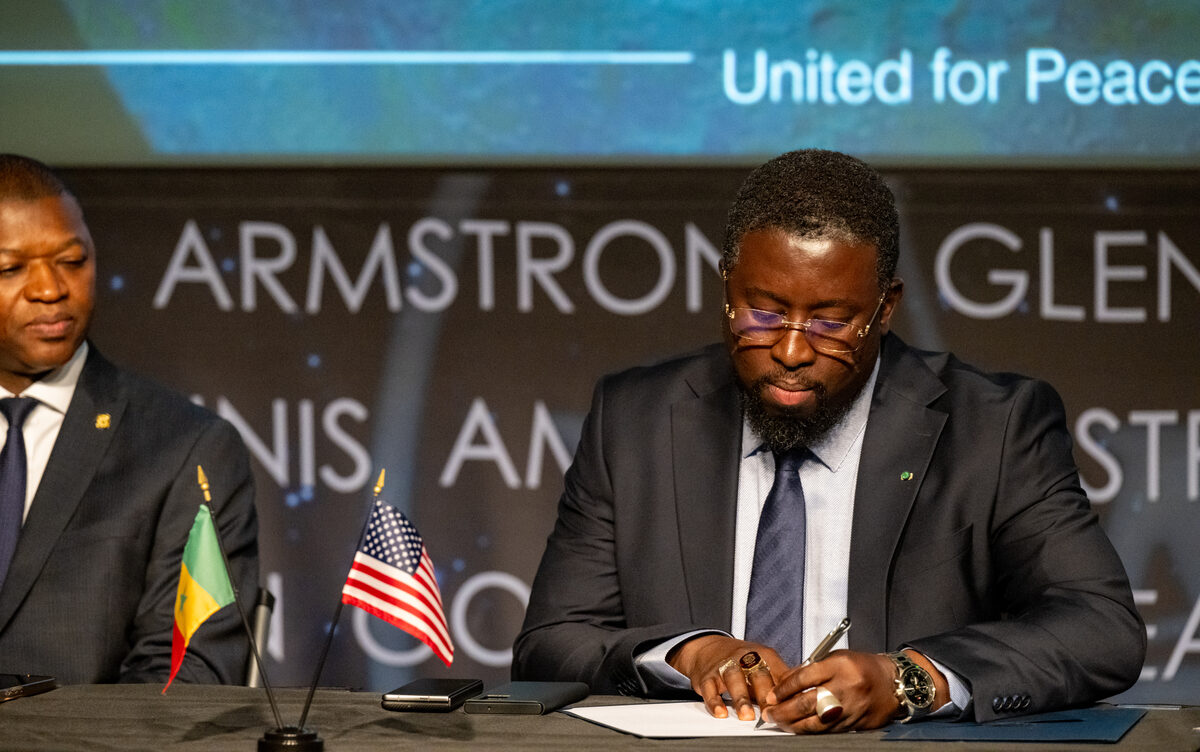
On Thursday, July 16, 2026, Serbia added its name to the Artemis Accords, becoming the 69th nation to sign the U.S.-led framework for how countries should behave in space. Serbian Foreign Minister Marko Đurić signed on his country's behalf at a NASA ceremony hosted by Deputy Administrator Matt Anderson. It was the tenth signing of 2026 — a brisk pace that keeps the Accords expanding roughly a nation per month this year.
The event leaned heavily on history. Anderson used his remarks to reach back more than half a century: "Serbia's connection to NASA reaches back to the Apollo program, when the work of Serbian engineers helped make some of humanity's greatest achievements in space possible." Đurić, for his part, invoked a lineage of Serbian scientific figures — inventor Nikola Tesla, climatologist Milutin Milanković, and Apollo-era pioneer David Vujic — before framing the signing in generational terms. "We owe it to both our brave ancestors and our children to keep pushing toward new frontiers," he said.
For Serbia, the practical payoff is access: the country now gains eligibility for lunar payload and CubeSat opportunities, the kind of concrete cooperation that turns a diplomatic signature into hardware and data.
What the Accords actually are
The Artemis Accords were established in 2020 by NASA together with the U.S. State Department, launched with seven founding nations. They are not a treaty and they are not binding law. Instead, they are a set of shared principles — a common rulebook that signatories agree to operate by as human and robotic activity on and around the Moon accelerates.
The commitments cover a familiar list of behaviors: exploration for peaceful purposes, transparency about plans and activities, interoperability of systems, emergency assistance to astronauts in distress, registration of space objects, the public release of scientific data, and the preservation of heritage sites. Two of the more contested principles deal with physical operations in space — the "deconfliction" of activities through so-called safety zones, and the mitigation of orbital debris. Taken together, these principles are the United States' attempt to shape the norms of lunar activity before a crowded field of nations and companies arrives.
The part that makes Serbia interesting
Serbia's signature is not just another entry on a growing list. In May 2024, Serbia joined the International Lunar Research Station (ILRS), the rival Moon program led by China. That makes Thursday's ceremony a small but telling example of a pattern that is becoming harder to ignore: nations are increasingly declining to pick a side.
Serbia is not alone in this. Other ILRS members have subsequently signed the Accords too — Thailand did so in December 2024, and Senegal followed in July 2025. U.S. officials have been explicit that this is allowed, saying countries can participate in both programs simultaneously. The framing matters. Rather than treating the Accords as a loyalty test that excludes anyone cooperating with Beijing, Washington is positioning them as an open set of norms that a nation can adopt regardless of its other partnerships.
Whether that openness reflects confidence or pragmatism is a fair question. What's clear is that the binary "American Moon versus Chinese Moon" story does not describe how many middle powers are actually behaving. For a country like Serbia — with a real scientific heritage but modest independent spaceflight capability — signing onto both frameworks is a way to keep every door open.
Why It Matters
The Artemis Accords were sold, in part, as a way for the United States to set the terms of lunar activity before rivals could. Every new signatory strengthens that claim to being the default framework — and at 69 nations, the roster is large enough that non-participation, rather than participation, is becoming the notable choice. But Serbia's case complicates the tidy geopolitical narrative. When the same nation belongs to both the U.S.-led Accords and China's ILRS, the two programs start to look less like competing alliances and more like overlapping standards bodies that individual countries can join à la carte.
That has consequences for how the coming decade of Moon activity gets governed. If dual membership becomes normal, the real test of the Accords won't be how many nations sign, but whether their non-binding principles — safety zones, data sharing, debris mitigation — actually shape behavior when a signatory is simultaneously cooperating with a program that hasn't signed onto them. For now, Serbia gets access to lunar payload and CubeSat opportunities, and the United States gets another name on the list. The harder questions about what the norms mean in practice remain unanswered.
