
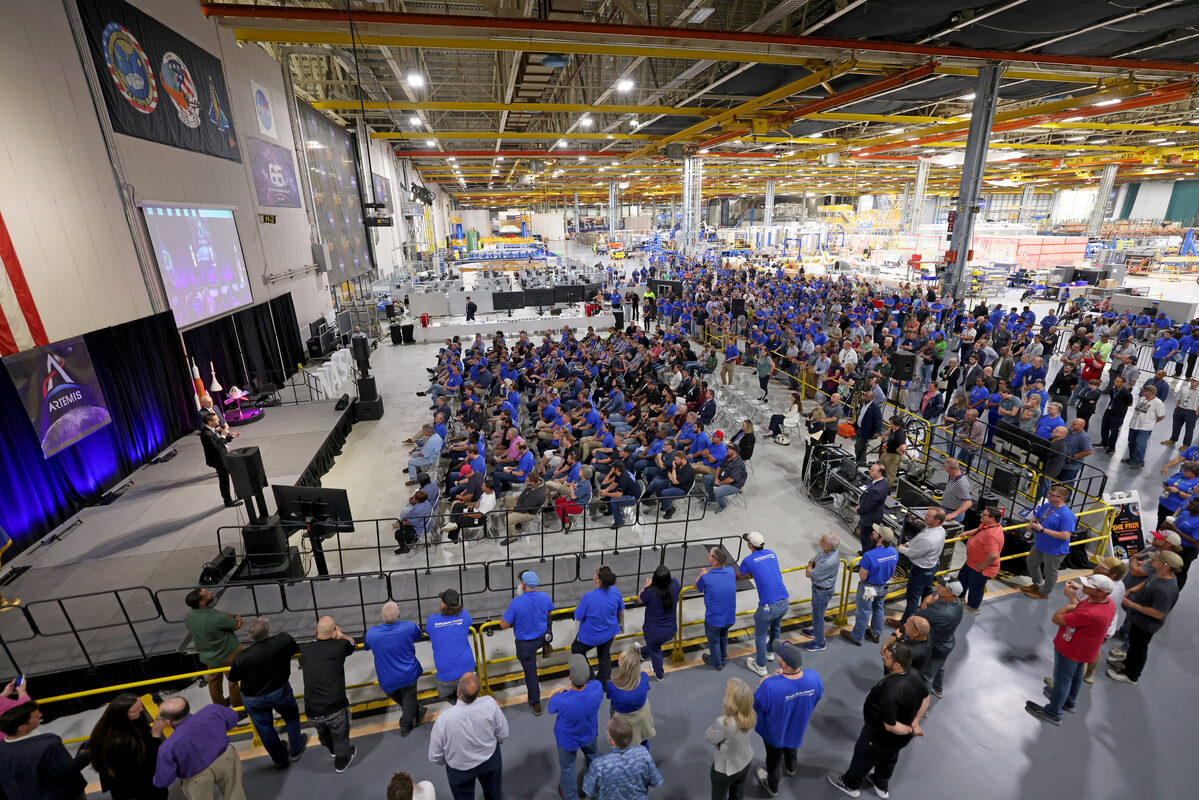
Every year the Government Accountability Office publishes a thick assessment of NASA's largest projects, and every year the headline findings are about the same handful of things: a cost overrun here, a slipped launch date there, a stubborn technical problem on some spacecraft that refuses to be solved on schedule. The 2026 edition, GAO-26-108556, released July 23 and the 18th in the annual series, breaks that pattern. The dominant finding this year isn't about hardware at all. It's about who is left to build it.
NASA reduced its civil servant workforce by roughly 4,000 people — "nearly 22 percent," in GAO's phrasing — over the course of 2025, largely through voluntary buyout programs. Of the 36 major projects GAO tracks — those exceeding $250 million in cost — 25 have now reported effects from the reduced staffing. That is not a warning about what might happen. It is a count of programs that have already filed the paperwork saying it happened to them.
The cuts were not distributed evenly
The single most useful thing in this year's report is the center-by-center breakdown, because the aggregate 22 percent figure conceals how lopsided the losses were. As Jeff Foust reported for SpaceNews, Goddard Space Flight Center — NASA's science-instrument and astrophysics powerhouse — lost 34 percent of its civil servants, the deepest cut of any center. Other field centers landed somewhere between 16 and 28 percent.
NASA Headquarters, at 11 percent, was the least affected organization in the agency. Read that sentence twice. The place that writes the policy took the smallest share of the reduction it was implementing.
Program offices fared differently again. The Space Launch System program shed nearly 20 percent of its civil servants; Orion lost 10 percent. On paper Orion looks like it got off lightly, and yet Orion is the program whose officials reported "challenges in filling several key positions" — a reminder that a workforce cut is not a subtraction problem. Losing 10 percent of a program is survivable if the 10 percent who left were interchangeable. They rarely are.
GAO's own summary is unusually direct for a document of this genre: "The civil servant departures have left NASA's workforce out of balance with NASA's programmatic needs." The skill gaps it identifies are exactly the ones you would least want to open at a spaceflight agency — aerospace engineering, mechanical engineering, electrical engineering, computer engineering, plus IT and cybersecurity.
What it looks like at the project level
Abstractions about "workforce balance" become concrete fast when you look at individual missions.
The SLS program is now considering adding workforce as a formal program risk — a bureaucratic step that matters more than it sounds, because it would elevate staffing from a management complaint to a tracked item with a mitigation plan attached. Orion reported challenges filling several key positions. On the science side, the DAVINCI mission to Venus lost key personnel and faced a cancellation threat in the FY2026 budget; its sibling Venus orbiter VERITAS was delayed by the staffing problems on Psyche. Psyche, the mission to the metal-rich asteroid of the same name, absorbed a one-year launch delay and $132 million in additional cost.
Not everything moved backwards. IMAP launched three months early, despite the reductions — a data point worth holding onto, both because it is genuinely good news and because it complicates any tidy narrative that staffing cuts uniformly wreck schedules. Some teams were far enough along, or lucky enough in who stayed, to absorb the hit.
The money, which is a smaller story than you'd expect
Here is the counterintuitive part. By the raw portfolio numbers, this was not a catastrophic year. Across a portfolio GAO values at at least $70 billion in life-cycle costs, three projects reported $501.4 million in overruns and two reported schedule delays totaling just two months. Cumulative cost growth across the portfolio rose from $4.4 billion to approximately $4.7 billion, and cumulative delay went from 13.1 years to 14 years. Those are increases, not spikes.
Two caveats. First, Orion alone accounted for over half of the annual cost overruns and nearly 75 percent of the cumulative overruns — meaning the portfolio's financial performance is substantially one program's performance wearing a trench coat. Second, SpaceNews highlights a net overrun figure of $478.2 million, concentrated in the SLS Block 1B and Orion programs, alongside GAO's $501.4 million total. Either number is small relative to a $70 billion portfolio.
The reason that should not be reassuring is timing. Staffing losses concentrated in 2025 do not show up as schedule variance in 2025. They show up two and three years later, when a test campaign runs long because the person who knew the fixture is gone, or when an anomaly investigation stalls for want of a specialist. Eighteen of the 36 projects are still in development — the phase where thin staffing does the most damage and where the resulting slips take the longest to surface.
The FY2027 problem
The compounding threat GAO flags is fiscal. In February 2026, NASA Administrator Jared Isaacman announced the agency would seek to bring in new civil servants to close these skill gaps, including converting existing contractors and taking on temporary technical assignments through a "NASA Force" partnership. That is a sensible response to the problem GAO describes.
It also runs headlong into the President's FY2027 budget request, which, as NASA Watch notes in its coverage of the report, proposes reducing NASA's funding by more than 20 percent. An agency cannot simultaneously hire its way out of a 4,000-person hole and absorb a fifth of its budget disappearing. NASA officials told GAO they would have more clarity on their workforce plans once the agency completed a set of actions expected in late spring; no public update on those plans has followed.
GAO adds one more item to the pile: as of May 2026, NASA had not fully implemented multiple prior recommendations on cost transparency and schedule controls. Those are precisely the management capabilities that make a resource-constrained portfolio survivable, and they are the sort of work that gets deprioritized first when the people who do it are the people who left.
Why It Matters
NASA's project portfolio has always been a slow-motion system: decisions made in one year express themselves in launch dates five years out. That property cuts both ways. It means the 2026 numbers — a two-month aggregate delay, half a billion in overruns concentrated in one program — genuinely understate the disruption of losing a fifth of the civil service workforce in twelve months. And it means the window to correct the imbalance is measured in years, not quarters.
What makes this year's assessment worth reading rather than filing is that GAO has, unusually, identified a single upstream cause behind effects at 25 separate projects. Portfolio problems normally decompose into 25 unrelated engineering stories. This one doesn't. It decomposes into a staffing decision, an unevenly distributed one that hit Goddard hardest and headquarters least, followed by a budget request that would make the announced remedy unaffordable. Whether the missions currently in development launch on anything resembling their current dates depends less on solving hard technical problems than on whether anyone is left to solve them.
