
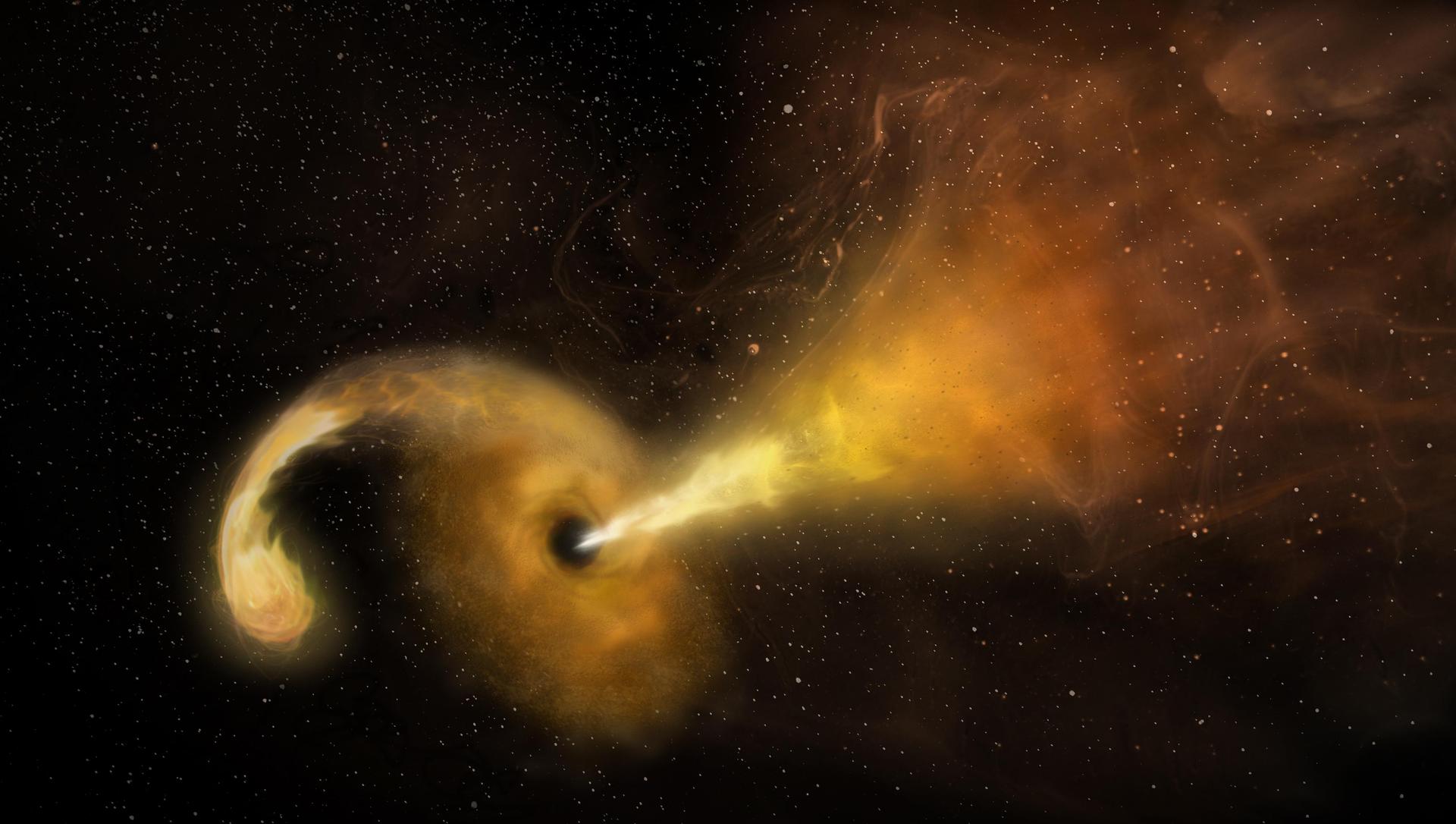
In late 2024, a survey telescope on Palomar Mountain caught a flash that, for a few days, released more energy than any supernova ever recorded. Astronomers eventually gave it a catalog name, AT2024wpp, and a nickname that stuck: the Whippet. New spectroscopic analysis released Aug. 14, 2026, suggests the black hole responsible for the Whippet may not have finished the job. Something — a clump of stellar debris, or possibly an entire second star — appears to have survived the encounter and is now racing away from the wreckage at more than 6,000 kilometers per second.
The discovery adds a strange coda to what was already an extreme event. According to the discovery paper, led by Daniel A. Perley of Liverpool John Moores University with 71 co-authors and accepted to Monthly Notices of the Royal Astronomical Society, the Whippet briefly radiated at a peak luminosity of 2×1045 erg per second — the light of roughly 400 billion Suns — and released a total of about 1051 erg over its outburst. It sits at redshift z=0.0868, making it the fourth-nearest event of its kind ever cataloged, which is part of why astronomers were able to study it in such detail.
What actually happened to the star
The Whippet belongs to a class of events called tidal disruption events, or TDEs: a star wanders too close to a supermassive black hole, and the hole's gravity stretches it until it tears apart. Some of the star's mass falls inward and is eventually swallowed; the rest is flung outward. As infalling gas spirals toward the black hole, it heats up violently and radiates across the spectrum — which is what telescopes on Earth actually detect.
Cornell astronomer Anna Ho first spotted the transient using the Zwicky Transient Facility at Palomar Observatory. Within a day, follow-up observations with the Liverpool Telescope and NASA's Swift satellite confirmed it as a Luminous Fast Blue Optical Transient — a rare, rapidly evolving category of explosion. The discovery paper adds a key physical detail: the black hole appears to be driving a wind outward from its accretion disk at roughly one-fifth the speed of light, a signature of just how much energy was dumped into the debris in a short time.
"We discovered what we think is a black hole merging with a massive companion star, shredding it into a disk that feeds the black hole," Perley said, describing the event in terms that place it among the most violent stellar deaths known.
The clue that came 35 days late
The survival hint didn't show up in the initial fireball. It emerged more than a month afterward, when astronomers picked up faint, double-peaked emission lines of hydrogen and helium in the object's spectrum, appearing around day 35. Double-peaked lines are a telltale sign of gas moving in two directions along the line of sight at once, and here the two components were separated by about 6,600 kilometers per second.
That's fast even by TDE standards, and according to the ScienceDaily report on the finding, it points to something specific: a compact, densely bound clump of material that held together after the black hole's initial assault, rather than smearing out into a diffuse, disorganized debris stream the way most disrupted stellar material does. Two explanations are currently competing for what that clump actually is. One possibility is that it's a stream of material dredged up from the disrupted star's dense core — the part of the star least willing to be torn apart. The other is more dramatic: that the disrupted star had a companion, and the black hole is now blasting that companion with radiation, stripping gas from it in real time rather than destroying it outright.
Neither the discovery paper nor the new spectroscopic work claims to have settled which scenario is correct. Both are described as consistent with the data — "streams of tidal ejecta or an ablated companion star," in the paper's own phrasing — which is a reminder that even a well-observed, nearby TDE can still leave its central mystery open.
Why It Matters
Tidal disruption events are one of the few natural experiments that let astronomers watch a supermassive black hole feed in real time, rather than infer its presence from a quiescent galaxy's stellar motions. Most TDEs are faint and distant enough that only the broad strokes are visible; the Whippet's proximity — fourth-closest of its class — and extreme luminosity gave researchers an unusually clean look at the debris itself, down to the velocity of individual gas components months after the initial flare.
That detail matters because the standard picture of a TDE assumes total, or near-total, destruction: the star is gone, and what's left is an accretion disk settling in around the black hole. If a dense clump of the star's core — or worse, an entire companion star — can survive that process intact enough to be tracked by its own spectral signature, it changes how completely these events actually consume their victims. It also opens a narrow but real window into stellar physics that's otherwise inaccessible: how tightly bound a star's core is, and whether multi-star systems interacting with a supermassive black hole leave survivors, isn't something that can be tested in a lab. Events like the Whippet are the closest astronomers get to running that experiment.
