
Most months ask you to pick one thing to look at. The back half of June 2026 refuses to make that easy. Inside a single twelve-day window the sky delivers a daytime disappearing act starring Venus, the year's longest day, a full Moon with a famous name, and — once the Sun finally clears out — the summer Milky Way climbing into view. None of it requires a telescope to enjoy, though one helps for the headliner. Here is what is happening, when, and how to actually catch it.
The hardest one to see is the most interesting: Venus vanishes in daylight
The standout event arrives early and in broad daylight. On June 17, the Moon passes directly in front of Venus — an occultation — with the planet slipping behind the lunar disk roughly between 3:30 and 4:00 p.m. EDT (the exact minute shifts by location) and re-emerging near 5:00 to 5:30 p.m. EDT. Occultations that happen high in a daytime sky, where you have a fighting chance of seeing them, are uncommon enough to be worth planning around.
Daytime is the catch. Venus is bright enough to register against a blue background if you know precisely where to look. The Moon, conveniently, is right there to serve as a signpost. The trick is finding the Moon in daylight first — easier than it sounds once you've spotted it — and then watching Venus, a steady white point off its edge, blink out at the lunar limb and later reappear on the other side.
A few practical notes. Binoculars or a small telescope make this dramatically easier, and the disappearance and reappearance are crisp, near-instantaneous events worth timing for yourself. The single most important safety rule: the Sun is up. Never sweep binoculars or a telescope across the sky near the Sun while hunting for the Moon. Put the Sun behind a building, a roof edge, or some other hard block before you start scanning, and keep it there. The exact clock times for disappearance and reappearance shift with your location, so treat these times as a rough anchor and check a local almanac or IOTA occultation tables for your own coordinates.
The longest day, explained
A few days later comes the summer solstice, listed as June 21, 2026 at 4:25 a.m. EDT. The solstice is a single instant fixed across the whole planet, and which calendar date it lands on depends on your time zone. The moment itself is identical everywhere; only the local clock disagrees.
What the solstice marks is the Sun reaching its highest, longest arc across the Northern Hemisphere sky — the day of maximum daylight, and the start of summer in the Northern Hemisphere. After it, the days begin their slow contraction back toward winter, even as summer heat is only getting started. It is an astronomical milestone rather than a viewing event: there is nothing to point binoculars at. But it is the structural reason the rest of this month's observing has to wait so late into the evening. The longest day means the latest sunsets, which pushes true darkness — and the Milky Way — well past the hour most people give up.
What's in the evening sky while you wait for dark
That long twilight is not wasted. The western sky after sunset belongs to Venus, which dominates the post-sunset glow as the unmistakable bright "evening star." Jupiter is also low in the west, bright in its own right, and the two giants anchor a planet lineup that gets more interesting as the month wears on. By June 25, Mercury climbs up near Jupiter at dusk, giving you a shot at three planets in one stretch of western sky.
Mercury is the one to be deliberate about. It sits low on the western horizon and gets washed out fast as twilight fades, so the window is short: look soon after sunset, find the higher Jupiter first, and use it as a reference to pin down the lower Mercury nearby. Venus, by contrast, is impossible to miss and a fine starting point for getting oriented.
Then the Milky Way, and a Strawberry Moon to close
Once full darkness finally settles — and thanks to the solstice, that is late — the summer sky's main attraction rises. The Milky Way is visible after dark, spanning the sky from the northeast to the southeast, the densest, most luminous stretch of our galaxy. Overhead, the Summer Triangle takes shape, with its bright corner star Altair appearing above the horizon around 10 p.m. EDT. This is genuinely dark-sky territory: the Milky Way rewards getting away from city lights, where it resolves from a faint smudge into a textured band of star clouds and dust lanes.
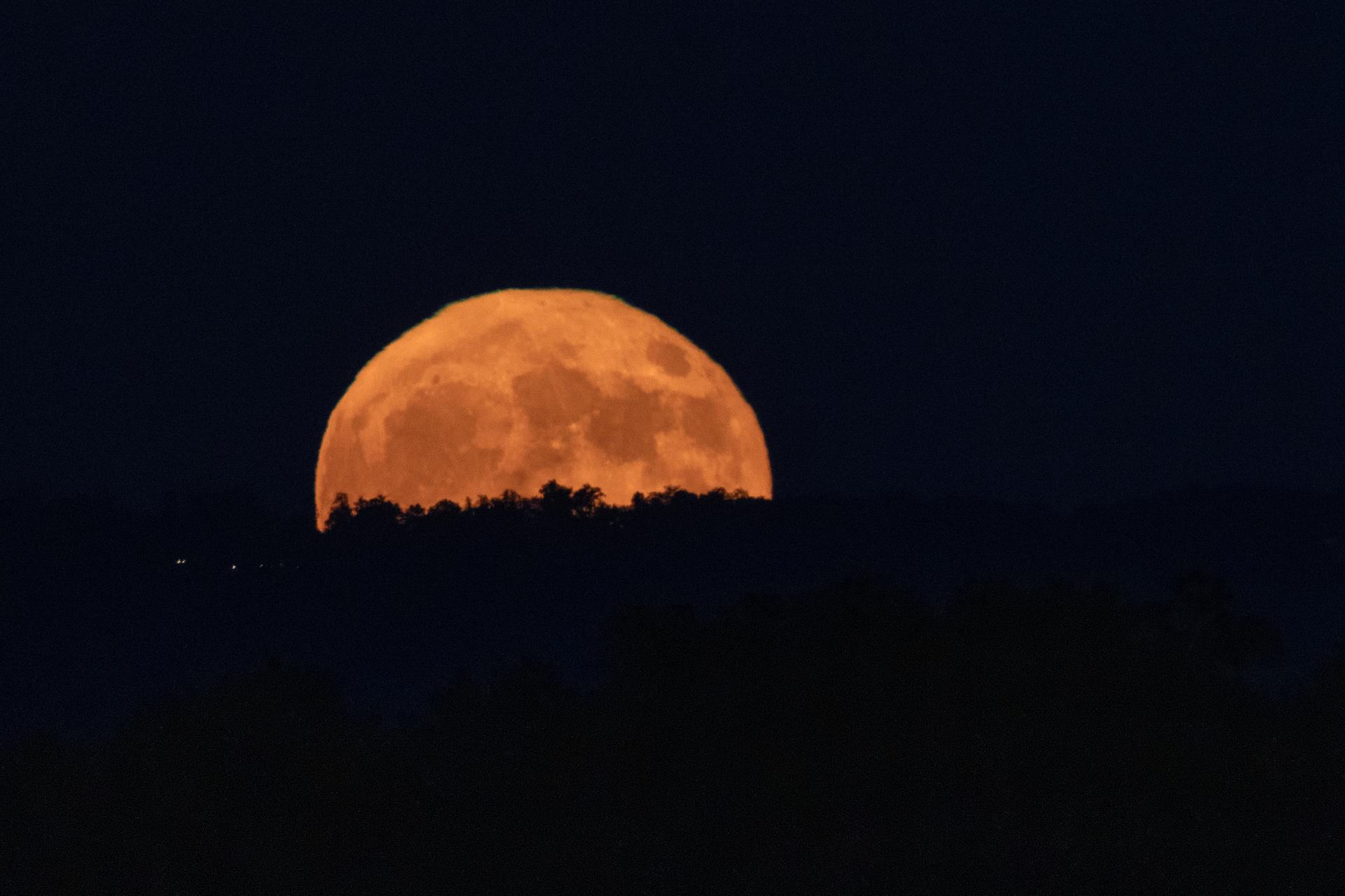
The month signs off on June 29 with the full Strawberry Moon, reaching fullness at 7:57 p.m. EDT. The name is seasonal folklore rather than a description of color — it traditionally marks the early-summer strawberry harvest, not a tinted Moon. A bright full Moon also floods the sky with light, so if the Milky Way is your goal, the darker nights earlier in the month are far better than the nights bracketing the 29th. The full Moon and the Milky Way are, in practice, competing for the same dark sky.
A rough order of operations
If you want to catch all of it, the sequence is straightforward. June 17, afternoon: the daytime Venus occultation, Sun safely blocked, binoculars ready, roughly 3:30 to 5:30 p.m. EDT (check IOTA tables for your city). The nights leading up to and just after the solstice (June 21): Venus and Jupiter in the west right after sunset, then the Milky Way and Summer Triangle once it's fully dark, late, away from lights. June 25 onward: add Mercury to the western lineup near Jupiter. June 29: the Strawberry Moon at its fullest just before 8 p.m. EDT — beautiful in its own right, and a cue that the dark-sky window has closed for a while.
Why It Matters
Skywatching events are usually sold one at a time, but late June 2026 is unusual for how it stacks an accessible daytime occultation, a calendar milestone, a multi-planet evening lineup, and the season's best deep-sky view into a single window. The daytime Venus occultation in particular is the kind of event that rewards a little preparation: it happens when most people are awake and outdoors, needs only binoculars, and offers a tangible, real-time demonstration of the Moon's motion against the planets — the same celestial clockwork that astronomers have used for centuries to measure the sky. It also makes a practical point about how to observe: the long days of the solstice push true darkness late, the full Strawberry Moon will wash out the Milky Way at month's end, and Mercury's brief appearance near Jupiter closes fast after sunset. Knowing the timing is the difference between catching these and missing them.
