
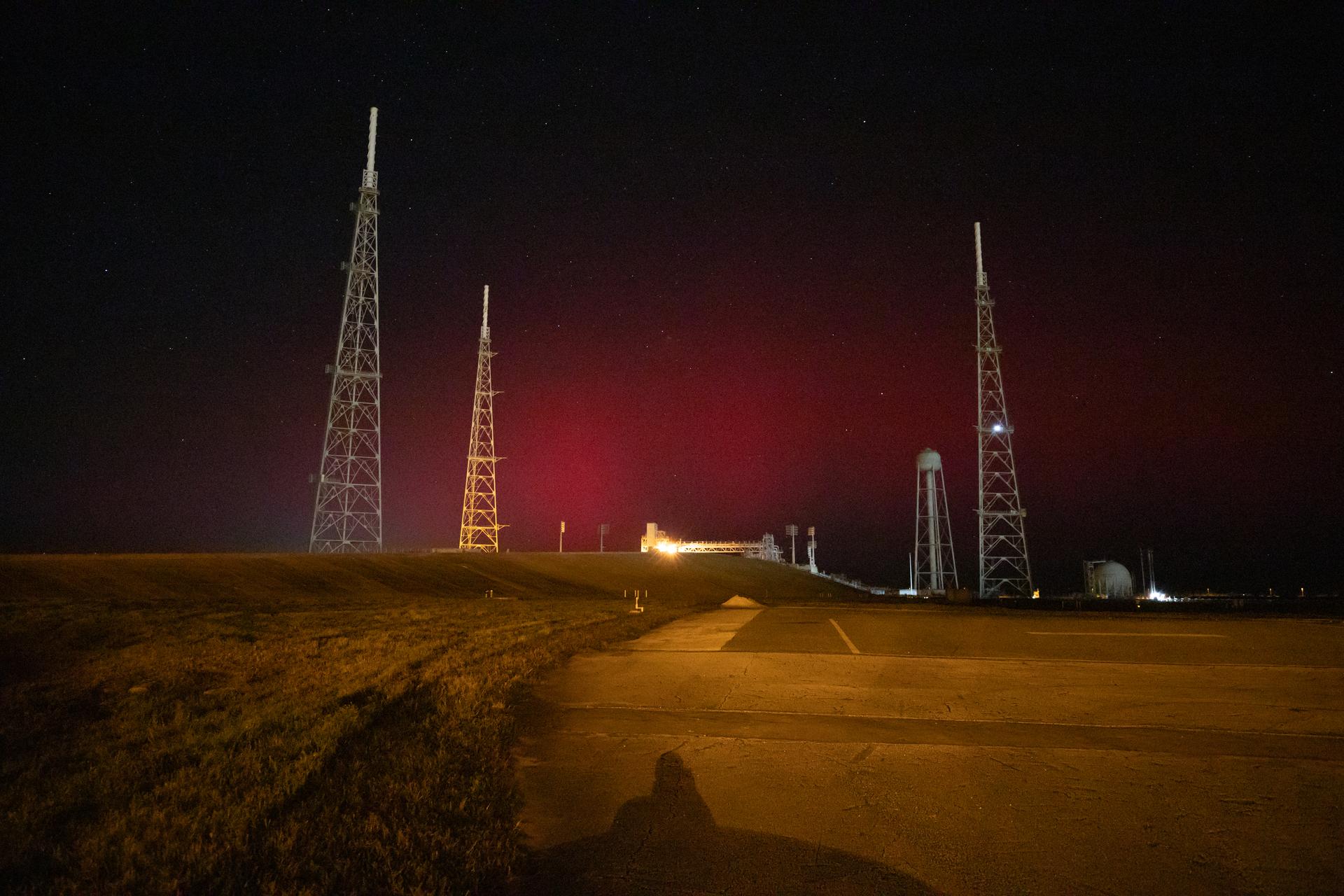
Space weather forecasters are watching a modest but real chance of aurora over the next two nights, and the setup is a bit more layered than the usual "a CME is coming" alert. Two faint coronal mass ejections (CMEs) that left the Sun on July 26 and 27 are due to deliver glancing blows to Earth's magnetic field between July 30 and August 1. Then, on July 30, active region AR4492 threw an M1.9 flare that produced its own partial-halo CME — one forecasters are still working to characterize. Forbes has reported NOAA putting the odds at roughly 25-30% for G1 (minor) geomagnetic storming, while NOAA's own three-day outlook — issued in the early hours of July 31 — pegs the maximum Kp index at 4.00 for the July 31-August 2 window and states plainly that no G1-or-greater storm is officially expected.
For the aurora-curious in the northern United States, that's enough to be worth a glance outside after dark — with caveats.
Two Glancing Blows, Then a Wildcard
The first two CMEs are the more predictable part of the forecast. Launched from the Sun on July 26 and 27, 2026, they were never expected to be direct hits — SWPC and outlets tracking the event, including EarthSky, characterized them as "glancing blows," meaning Earth is expected to catch the edge of the expanding plasma clouds rather than a head-on impact. EarthSky reported on July 30 that forecasters had confirmed both CMEs were "fairly faint." That geometry generally caps how strong any resulting storm can get, which is part of why the outlook tops out at G1, the weakest category on NOAA's five-step geomagnetic storm scale.
The wildcard arrived July 30, when AR4492 produced an M1.9-class flare — a mid-tier event, not dangerous to satellites or the power grid, but strong enough to launch a partial-halo CME of its own. "Partial halo" describes how the ejection appears in coronagraph imagery: material spreading outward in a broad arc rather than a narrow jet, which usually means at least some of it is aimed roughly toward Earth. AR4492 itself sat well to the northwest on the Sun's disk, a location that makes a direct hit unlikely, but as of the available reporting, analysts were still modeling the CME to determine whether any component of it is heading toward Earth, and if so, when. If it does arrive, it would stack on top of the two earlier glancing blows already expected to buffet the magnetosphere around July 30-August 1.
What the Forecast Actually Says
NOAA's official three-day geomagnetic forecast — the primary data product underlying this watch — lists a maximum expected planetary Kp index of 4.00 across July 31 through August 2, with that peak value falling specifically around midday on August 1. Kp is a 0-9 scale measuring disturbance in Earth's magnetic field; a Kp of 4 sits right at the boundary where NOAA's storm classifications begin, corresponding to "active" conditions that can tip into minor G1 storming. Notably, that same NOAA forecast's stated rationale is more conservative than headlines suggest: it reads, "No G1 (Minor) or greater geomagnetic storms are expected." The widely cited 25-30% G1 probability comes from Forbes's coverage of NOAA's outlook, published July 30 as the two source CMEs were still being confirmed — a reminder that these numbers can shift quickly as forecasters get more coronagraph data, and that different NOAA products issued hours apart can read differently.
In plain terms: this is not a guaranteed light show. It's a modest, single-digit-to-low-double-digit percentage chance that geomagnetic activity ticks up enough to push the aurora oval down into the northern-tier United States for a night or two — and NOAA's own latest numbers suggest even that may be optimistic.
Where to Look
Coverage from Forbes named ten states sitting in the potential viewing zone if a G1 storm materializes: Washington, Idaho, Montana, North Dakota, Minnesota, Wisconsin, Michigan, Maine, Vermont, and New Hampshire. EarthSky's rundown similarly noted that aurora watchers in northern Scotland, Scandinavia and similar high-latitude locations should stay alert, with the northern-tier U.S. states representing the southern fringe of what a G1 event could reach.
That framing matters. G1 storms are the entry-level tier of NOAA's scale, and their aurora is typically faint, low on the horizon, and easiest to detect with a camera rather than the naked eye. Anyone watching from Minnesota or Maine on the nights of July 31-August 1 should manage expectations accordingly.
Two Obstacles: Moon and Midsummer Nights
Even if the Kp index cooperates, two factors are working against skywatchers this week. The Moon is near full, and its glare will wash out all but the brightest auroral displays — a G1 storm's typically faint green glow is exactly the kind of thing lunar light drowns out. Compounding that, early August still falls within the short-night stretch of the year across the northern U.S., leaving a narrower window of true darkness in which to catch anything.
Forbes's reporting flagged both obstacles and suggested that phone night-mode photography or long-exposure camera shots are the more realistic way to catch a G1-level display under these conditions — a phone or camera sensor gathering light over several seconds can register a faint aurora that the human eye, especially under moonlight, will miss entirely.
Why It Matters
Minor geomagnetic storms like the one being watched here rarely make headlines for disruption — G1 is the mildest rung on NOAA's scale, with effects generally limited to minor fluctuations in power grids and a slight chance of aurora at unusually low latitudes. But events like this are a useful reminder of how routinely the Sun is shedding material toward Earth, and how much forecasting still comes down to probability rather than certainty. AR4492's M1.9 flare and its still-unresolved CME trajectory illustrate the real uncertainty baked into space-weather prediction: even with continuous coronagraph monitoring, forecasters often can't say with confidence whether a given eruption will connect with Earth's magnetic field until it's almost here. The gap between Forbes's 25-30% figure and NOAA's own "no G1 expected" rationale, issued just hours apart, is itself a small case study in that uncertainty. For skywatchers, the practical takeaway is modest: the odds favor a quiet couple of nights, but a G1 watch is real, the northern tier has a shot, and a camera will likely see more than your eyes will.
