
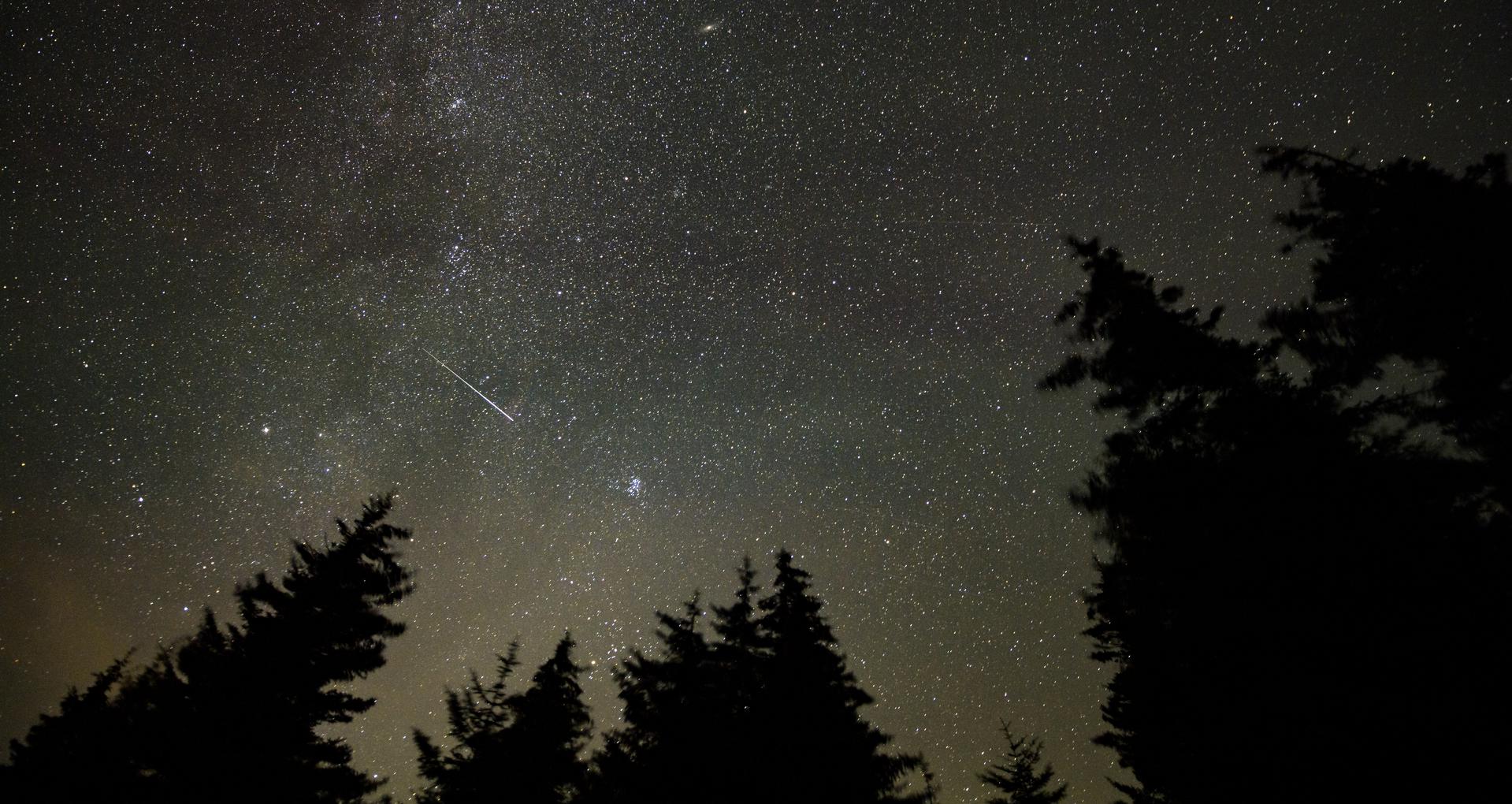
Late July usually rewards meteor watchers with one of the more generous overlaps of the year: the Southern Delta Aquariids ramping up just as the Alpha Capricornids join in, producing a stretch of nights with two active showers at once. This year, the timing is generous but the sky is not. The Southern Delta Aquariids reach their peak the night of July 28-29, 2026, and the Alpha Capricornids follow on July 30-31 — right as the Moon swells to full, according to Scientific American and EarthSky. The result is a classic case of good geometry undone by bad lighting.
EarthSky puts the Moon at full at 14:36 UTC on July 29, 2026, meaning it will be effectively full for both shower peaks. National Geographic adds that by the Alpha Capricornid peak on July 30-31, the Moon is still about 98% illuminated. A waxing gibbous-to-full Moon rising in the evening and staying up most of the night will flood the sky with enough scattered light to erase all but the brightest meteors, cutting deeply into what would otherwise be one of summer's more reliable shows.
Two Showers, Two Very Different Personalities
The Southern Delta Aquariids are the higher-volume of the pair. Under dark skies, EarthSky puts their peak rate at roughly 15 to 20 meteors per hour, radiating from a point near the star Delta Aquarii in the constellation Aquarius. NASA's Southern Delta Aquariids page describes the shower as active from mid-July through late August, with the peak clustering near the end of July, and traces the debris to comet 96P/Machholz, discovered by Donald Machholz in 1986. EarthSky adds that the material streaming through this part of the shower's path was likely shed around 20,000 years ago, and that the shower tends to "ramble" — producing meteors at a fairly steady rate for weeks rather than a sharp single-night spike from late July into early August. The shower favors observers at southern latitudes, including the southern United States, where the radiant climbs higher before dawn.
The Alpha Capricornids are sparser but showier. Scientific American notes the shower produces fewer meteors overall but is known for slow, bright, sometimes colorful fireballs — the kind of meteor that's hard to miss even with a bright Moon nearby. Those fireballs trace back to debris trailing comet 169P/NEAT. Unlike the Aquariids, the Capricornids are visible from both the Northern and Southern Hemispheres, per Scientific American, giving a wider swath of observers a shot at seeing something even if the Aquariid peak proper is a bust.
How to Watch Anyway
NASA's viewing guidance, written for typical shower conditions, still applies as a baseline: find a spot away from city lights, lie flat on your back, and look about halfway between the horizon and the zenith, roughly 45 degrees away from Aquarius. Scientific American recommends giving your eyes about 30 minutes to adjust to the dark before you expect to see much — a step that matters even more this year, since every faint meteor the Moon erases makes dark adaptation more valuable, not less.
Timing matters too. EarthSky points to the hours after midnight through dawn as the best viewing window, when the shower radiants are highest in the sky. National Geographic's coverage of the same July 30-31 overlap frames it as a mixed bag: frequent, faint Delta Aquariid streaks combined with the slower, dazzling Alpha Capricornid fireballs, tempered throughout by the bright Moon suppressing the fainter meteors from both streams.
Practically, that means dialing down expectations for total meteor counts while keeping an eye out for the standouts. An observer under moonlit skies this week is far more likely to catch an occasional Alpha Capricornid fireball streaking slowly across the sky than to log anywhere near the Delta Aquariids' theoretical 15-to-20-per-hour dark-sky rate.
Why It Matters
Meteor showers are predictable in timing but not in visibility, and the Moon is the single biggest variable amateur observers actually control by choosing when and where to look. This year's Delta Aquariid-Alpha Capricornid overlap is a useful reminder that a shower's rated peak rate is a ceiling set under ideal, moonless, light-pollution-free conditions — not a guarantee. For casual skywatchers, understanding why a "good" shower can still produce a disappointing night helps set realistic expectations and points to the smarter move: prioritize the Alpha Capricornids' bright fireballs over the fainter, more numerous Aquariids this year, since brightness matters more than raw count when a full Moon is working against you. It's also a small but real lesson in how celestial mechanics stack — two independent debris streams from two different comets, 96P/Machholz and 169P/NEAT, happening to cross Earth's orbit in the same late-July window, only to have their shared moment undercut by the equally independent, 29.5-day rhythm of the lunar cycle.
Sources
- Southern Delta Aquariids Meteor Shower — NASA Science
- Delta Aquariid meteor shower: All you need to know in 2026 — EarthSky
- The Southern Delta Aquariids and Alpha Capricornids meteor showers are about to peak — Scientific American
- July's double meteor shower could produce brilliant fireballs. Here's how to see them. — National Geographic
