
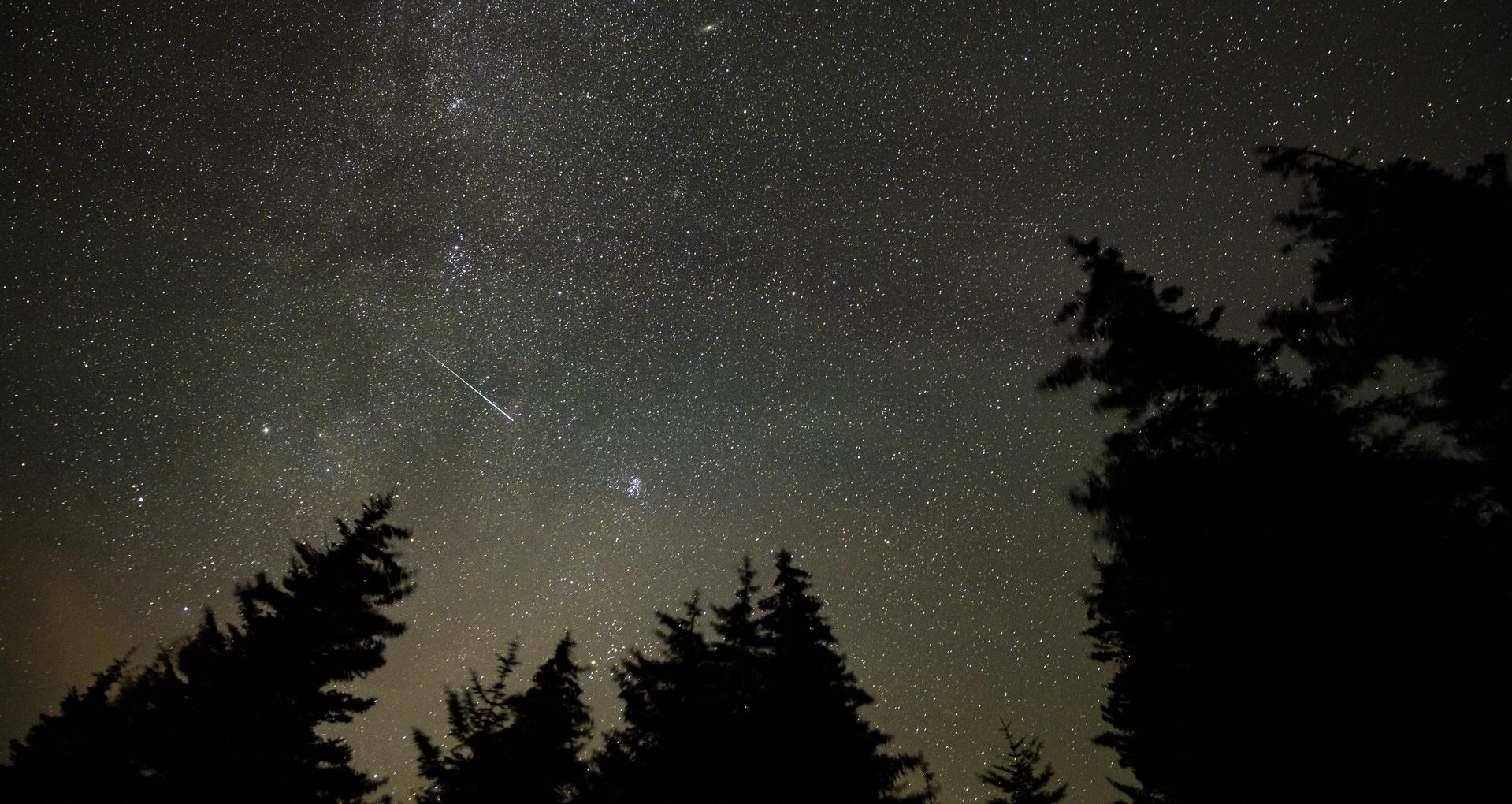
Most months hand skywatchers one worthwhile event, maybe two. August 2026 hands them three, and they're clustered so tightly that the same lunar cycle is doing double duty. The New Moon that darkens the sky for the year's best meteor shower is the very same New Moon that lines up precisely enough to blot out the Sun over parts of the Arctic and Europe. Two and a half weeks later, the Full Moon slides through Earth's shadow so deeply that it will look, for a while, like a total eclipse that missed by a whisker.
Here's what's actually happening, when, and where you need to be standing.
The Perseids peak in the dark, for once
The Perseid meteor shower is reliable in the way a favorite band's setlist is reliable — it shows up every year, active broadly from mid-July through the start of September, and it's popular because it's rich in bright, fast meteors that streak into the atmosphere and burn up roughly 60 miles overhead. According to NASA's monthly skywatching guide, this year's peak falls the night of August 12 into the early hours of August 13. EarthSky pins the predicted maximum more precisely, at 14:53 UTC on August 13 — daylight for the Americas, meaning the best viewing window is actually the night before, and again the following night, as rates ramp up and taper off around that peak.
What makes 2026 special isn't the shower itself but the timing of the calendar. New Moon lands on August 12 at 17:37 UTC, per EarthSky, just hours before the predicted peak. EarthSky puts the rate at 90-plus meteors per hour under those dark-sky conditions; NASA doesn't cite its own number but agrees on the underlying point, noting that with the New Moon arriving on the 12th, the skies will be ideally dark — with no moonlight washing out the sky, this is about as good as Perseid viewing gets. The shower's parent body is Comet 109P/Swift-Tuttle, which swings through the inner solar system once every 133 years, leaving behind the trail of debris Earth plows through every August.
No equipment is required — in fact, binoculars and telescopes narrow your field of view and work against you here. Find a dark spot away from city lights, give your eyes 20 to 30 minutes to adjust, and look up. Meteors will appear to radiate from the direction of the constellation Perseus, but they can streak across almost any part of the sky.
A total solar eclipse over the Arctic and Iberia
The same New Moon that clears the sky for the Perseids is, geometrically, doing exactly what a New Moon has to do to cause a solar eclipse: passing directly between Earth and the Sun. On August 12, that alignment produces a total solar eclipse whose path of totality — per NASA — crosses northern Russia, Greenland, Iceland, and northern Spain. Forbes' rundown narrows the Western-Hemisphere-adjacent leg of that path to eastern Greenland, western Iceland, and northern Spain specifically.
Totality is the headline, but the partial phases reach much further. NASA describes partial visibility stretching from Alaska to North Carolina. Forbes adds specific numbers for North America's edge of the shadow: up to 28% of the Sun's disk covered as seen from northern Maine, and more than 60% coverage in parts of Canada. If you're not in the path of totality, a partial eclipse is still worth watching — with proper eclipse glasses, never with the naked eye — as the Moon takes a visible bite out of the Sun.
Venus at its best, and a lunar eclipse to close the month
Venus reaches greatest elongation — its maximum apparent separation from the Sun in our sky — in mid-August. NASA's guide places this window at August 14-16; Forbes cites August 15 specifically for greatest eastern elongation. At greatest elongation, Venus shows a "half lit" phase through a telescope, similar to a quarter Moon, and sits at its most convenient position for viewing since it's as far from the Sun's glare as it gets during this apparition. Forbes also notes Jupiter re-emerging from the Sun's glare in the predawn sky during the mid-to-late month, a preview of the giant planet's return to prominence.
The month closes with a partial lunar eclipse on August 27-28, coinciding with the Full Moon on August 27. NASA puts the coverage at approximately 93% of the Moon's diameter; Forbes rounds it to 96%, describing it as a "blood moon" event. Either figure describes the same phenomenon: a partial eclipse deep enough that it will look, to a casual observer, almost total, with the shadowed portion of the Moon taking on the reddish cast produced by sunlight filtering through Earth's atmosphere. NASA and Forbes agree this eclipse is visible from the Americas, Europe, and Africa — no special equipment needed, just clear skies and a view of the Moon.
For reference, the Moon's other phases this month, per NASA: Last Quarter on August 5, New Moon on August 12, First Quarter on August 19, and Full Moon on August 27.
Why It Matters
Eclipses and meteor showers happen on their own independent schedules — one governed by orbital mechanics precise enough to predict centuries in advance, the other by a comet's debris trail that Earth crosses annually regardless of the Moon's phase. That August 2026 stacks a moonless Perseid peak, a total solar eclipse, and a near-total lunar eclipse into a single lunar cycle is a coincidence of timing, not a coordinated event — but it's the kind of coincidence that makes for once-in-a-while planning. A dark-sky Perseid peak is far less common than the shower itself, since New Moon and peak night don't always align. Total solar eclipse paths are narrow and geographically fickle — this one favors the North Atlantic and Iberia specifically, a very different footprint than, say, a path crossing North America. And a 93-96% partial lunar eclipse, visible across three continents without travel or equipment, is a low-effort, high-payoff event for anyone who simply steps outside. For skywatchers weighing where to spend limited clear-sky nights or vacation days this year, August 2026 concentrates an unusual amount of astronomical value into about two and a half weeks.
