
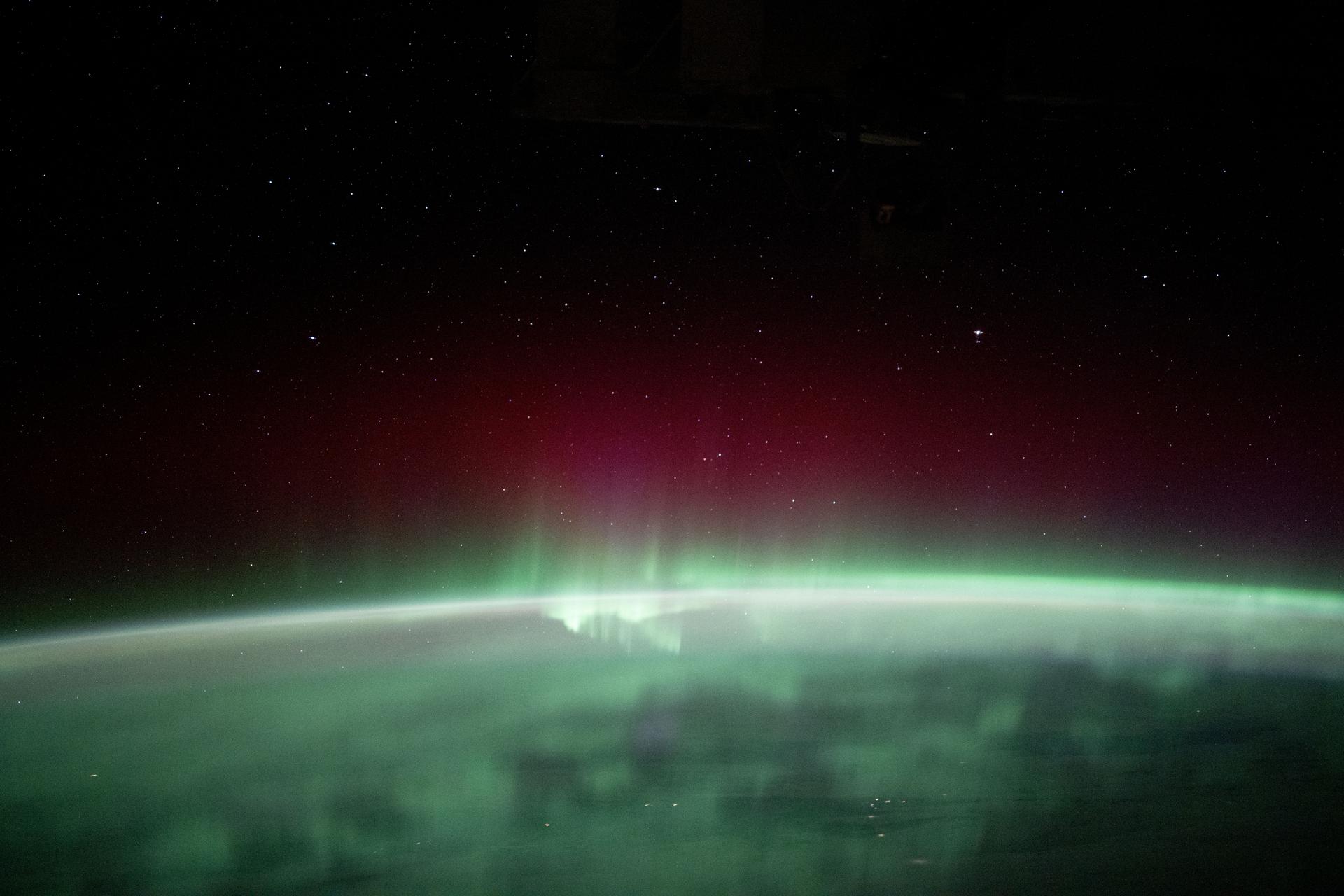
If you've got a clear northern horizon this week, it might be worth stepping outside after dark. The sun has been busy: a single active region has thrown off at least four coronal mass ejections in the span of two days, and the U.S. government's space weather forecasters say the resulting traffic jam of charged particles could rattle Earth's magnetic field enough to push the aurora borealis well outside its usual polar haunts.
NOAA's Space Weather Prediction Center (SWPC) issued a geomagnetic storm watch this week — G1-Minor conditions considered likely, with a slighter chance of reaching G2-Moderate, and an outside chance of brief G3-Strong intervals if enough of the incoming material lines up right. Translation for anyone without a space weather decoder ring: a stretch of nights, roughly September 8 into September 9, when the ordinarily polar-locked aurora could sag southward into places that don't usually get to see it.
What actually happened on the sun
The source is a sunspot region cataloged as AR4524, which spent September 5 and 6 lobbing at least four separate coronal mass ejections (CMEs) out into space, according to tracking by EarthSky's solar-activity desk. The headline event was a C5.0-class solar flare paired with a full halo CME that erupted at 10:31 UTC on September 6 — a "halo" CME being the kind that appears to expand in a ring around the sun from Earth's point of view, a signature that usually means the eruption is heading more or less straight at us rather than off to the side.
A C5.0 flare is solidly mid-range — not the X-class monsters that make headlines for knocking out radio communications, but enough to matter, especially stacked with three other CMEs from the same active region in the same 48-hour window. When multiple CMEs leave the sun close together, they don't necessarily arrive in a tidy, evenly spaced sequence. Faster ejections can catch up to slower ones, compressing and combining their magnetic fields by the time they reach Earth — which is part of why forecasters are watching this event with more than the usual interest.
Not everything the sun threw off this week is part of the story, though. A large CME observed on September 7 was confirmed as a far-side event — erupting from the portion of the sun currently facing away from Earth — and isn't expected to contribute to the geomagnetic disturbance at all. Worth noting, since a firehose of "the sun is erupting" headlines can blur together into one undifferentiated blob of concern when in fact space weather forecasters are tracking each eruption's trajectory individually.
How the watch has evolved
SWPC's geomagnetic storm watches are built on real solar wind measurements streaming in from spacecraft stationed between the sun and Earth, and the numbers as of September 7 gave forecasters something to work with: the interplanetary magnetic field measured around 18 nanotesla, with its north-south component (Bz) pointed at -14 nT — southward — and peak solar wind speeds around 434 km/s. A southward-pointing Bz matters more than the raw field strength; it's the orientation that lets solar wind couple efficiently into Earth's own magnetic field and drive a storm, roughly the geomagnetic equivalent of a key fitting a lock.
By September 7, coverage from Watchers.News described NOAA forecasting a combined arrival of CME material starting early September 8 and continuing into September 9, with isolated G1-Minor periods considered likely and a slight chance of reaching G2-Moderate. SWPC's own confidence in exact timing and magnitude was explicitly rated low — CME arrival forecasting is still an inexact science, closer to predicting a storm system's exact landfall three days out than nailing down tomorrow's weather.
The first measurable effects showed up fast: geomagnetic activity reached Kp 5 — the threshold that defines G1-Minor storming — at 7:30 UTC on September 8, right in the forecast's early window. EarthSky's tracking suggests the most intense activity is likely September 9, when the various CME arrivals from AR4524's outburst have had time to combine into a single, larger disturbance. Forecasters expect the storm to subside by around September 10 UTC as the CME material passes and Earth's magnetic field settles back down.
Where you might actually see something
Aurora visibility scales directly with storm intensity, and the geomagnetic Kp index is the rough proxy skywatchers use to guess how far from the poles the display might reach. Under G2 conditions, EarthSky's forecast puts the aurora's southern edge within range of Edinburgh, Seattle, Minneapolis, Toronto, Chicago, and northern England — a solid swath of mid-northern latitudes that don't typically make anyone's aurora bucket list. At the more likely G1 level, the reach is more modest, generally limited to far northern Scotland and Scandinavia.
If conditions tip into G3-Strong territory — the less likely but not impossible scenario SWPC flagged — the display could theoretically stretch as far as New York, London, and northern France. That's a genuinely unusual reach; G3 storms are uncommon enough that most residents of those cities have never seen aurora from their own backyard.
For anyone hoping to catch it: get away from city lights, find a clear view toward the northern horizon, and check after full dark. Aurora during moderate storms often shows up better in long-exposure phone or camera shots than to the naked eye, so it's worth pointing a phone camera north even if the sky looks unremarkable at first glance.
Why It Matters
Geomagnetic storms in the G1-G3 range are a useful mid-tier case study in how space weather actually threatens modern infrastructure — not through anything as dramatic as a Carrington-scale catastrophe, but through smaller, cumulative stresses. Storms in this range are associated with R1-Minor radio blackout impacts, can degrade high-frequency radio communications used by aviation and shipping, and can induce extra current in long-distance power grid infrastructure. None of that is severe at G1-G2 levels, but it's the same physical mechanism that scales up to genuinely disruptive events at G4 and G5. Watching how a modest, well-forecast convoy of CMEs like this one unfolds — from eruption, to solar wind measurement, to storm onset, to decay — is effectively a live rehearsal of the monitoring infrastructure that would need to work flawlessly during a far more dangerous storm. It's also simply a rare chance for a lot of people who've never seen the aurora to have a shot at it without booking a flight to the Arctic Circle.
