
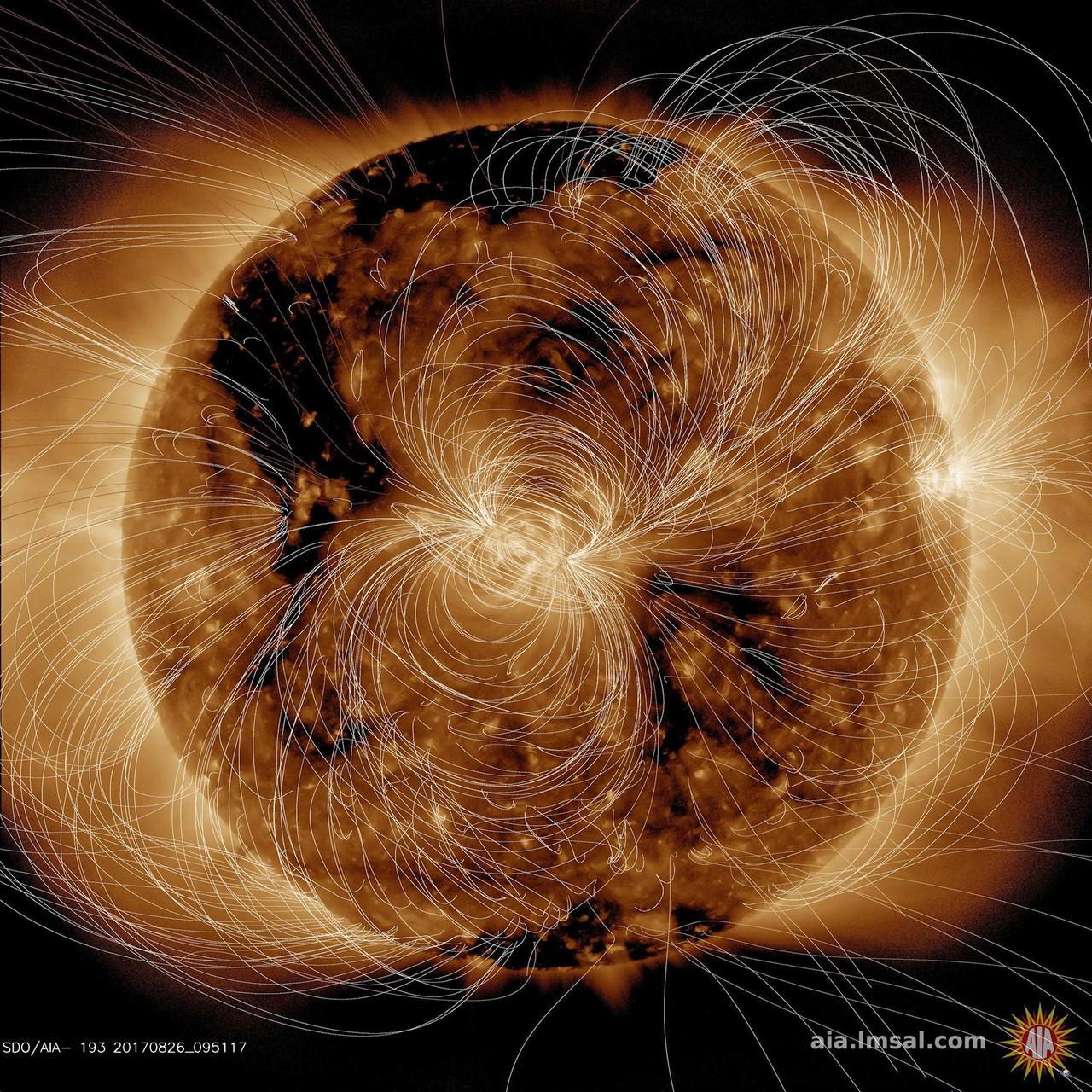
Scientists have argued for years about where magnetic switchbacks come from. These are S-shaped kinks in the magnetic field carried by the solar wind. One camp says they are born at the Sun, when magnetic structures there snap and reconnect. The other says they form along the way, as waves and turbulence bend the field while the wind flows outward. A new paper in Nature Astronomy uses data from ESA's Solar Orbiter and finds that both camps are partly right.
The study is led by Jesse Coburn of CNRS and the Laboratoire de Physique des Plasmas (LPP) in France, and Stephanie Yardley of Northumbria University in the UK is a co-author. It describes a single large switchback that Solar Orbiter flew through at 0.55 astronomical units, about halfway between Earth and the Sun. The plasma inside that switchback still carried chemical evidence of where it came from.
Reading the plasma's birth certificate
The key instrument is the spacecraft's Solar Wind Analyser (SWA), which sampled the plasma making up the switchback. It did not just measure the magnetic field. It also measured heavy ions inside the structure, specifically the charge states of oxygen and carbon.
The number of electrons an ion has lost, its charge state, works like a thermometer. In general, a hotter corona produces higher charge states, and as the plasma escapes and thins out, the charge states freeze in. So ions measured far from the Sun still record conditions near where they started. According to the paper's abstract, the switchback showed elevated charge-state ratios of oxygen and carbon, along with a depletion of helium relative to protons. The authors say that combination points to an origin in hot, closed coronal loops, which are arches of magnetic field anchored to the Sun at both ends.
ESA's release puts it more simply: the mix of charged oxygen and carbon could only have formed in hot magnetic loops at the Sun's surface. Coburn calls the specific mix of particles "the smoking gun" for interchange reconnection. In that process, material from closed loops ends up on magnetic field lines that open out into space.
Connecting the spacecraft to the Sun
A chemical fingerprint is useful only if you can match it to a place on the Sun. To do that, the team built a semi-empirical model of the corona, constrained by electron temperature and density measurements from NASA's Solar Dynamics Observatory (SDO). The model linked what Solar Orbiter measured to what SDO saw on the solar disk.
The abstract says the trail leads to either the boundary of a coronal hole or loops inside the coronal hole. The authors say either location implicates interchange reconnection, where closed loops reconnect with open magnetic field and eject plasma.
But the waves are there too
The paper doesn't hand the win entirely to the reconnection camp. Inside the same switchback, the fluctuations in proton velocity and magnetic field match the pattern of an outward-propagating Alfvén wave. Yardley says in ESA's release that the team sees signs of waves and turbulence, but likely only after the switchback heads out into space.
The authors therefore say both processes contribute, at different stages. Interchange reconnection near the surface appears to create the structure and load it with hot-loop plasma. Wave and turbulence behaviour then governs how it moves through space. Based on ESA's description, the two theories were less wrong than incomplete, each describing a different part of a switchback's life.
A long-running puzzle
The debate is not new. In 2022, a team including Daniele Telloni and Gary Zank reported that Solar Orbiter's Metis coronagraph had imaged a single large propagating S-shaped vortex in the solar corona. They interpreted it as the first evidence of a switchback in the corona. ESA notes that the observation confirmed the S-shape of switchbacks. However, a picture of a switchback near the Sun does not say what created it. The new study adds the missing piece: a direct sample of the material inside one, with a composition that points to its source.
There is a limit worth stating plainly. The result rests on one well-measured switchback. It shows that interchange reconnection can make a switchback and that waves can act on one afterward. It does not show that every switchback forms this way, or that the balance between the two processes is the same each time. Answering that will need more encounters like this one, measured with the same kind of heavy-ion detail.
Why It Matters
Switchbacks are part of how the Sun's magnetic field and plasma reach the rest of the Solar System. If their origin is known, researchers can better connect what happens at the solar surface to what arrives at spacecraft and planets. ESA project scientist Daniel Müller pointed to space weather as one area where that link matters: the solar wind ties the Earth to the Sun, and understanding its dynamics has implications for keeping the planet safe from extreme space weather events.
The study also demonstrates a method. Matching heavy-ion composition measured in space to coronal conditions modelled from SDO data turns Solar Orbiter's in-situ measurements into a way of tracing structures back to their source. ESA says the finding gives a possible way to read the history of solar plasma even far from the Sun. An ESA statement adds that no other spacecraft has both the proximity to the Sun and the right instruments needed to make this connection.
The paper, "On the Coronal Origin of Magnetic Switchbacks in the Solar Wind," is published in Nature Astronomy (DOI: 10.1038/s41550-026-02928-0).
