
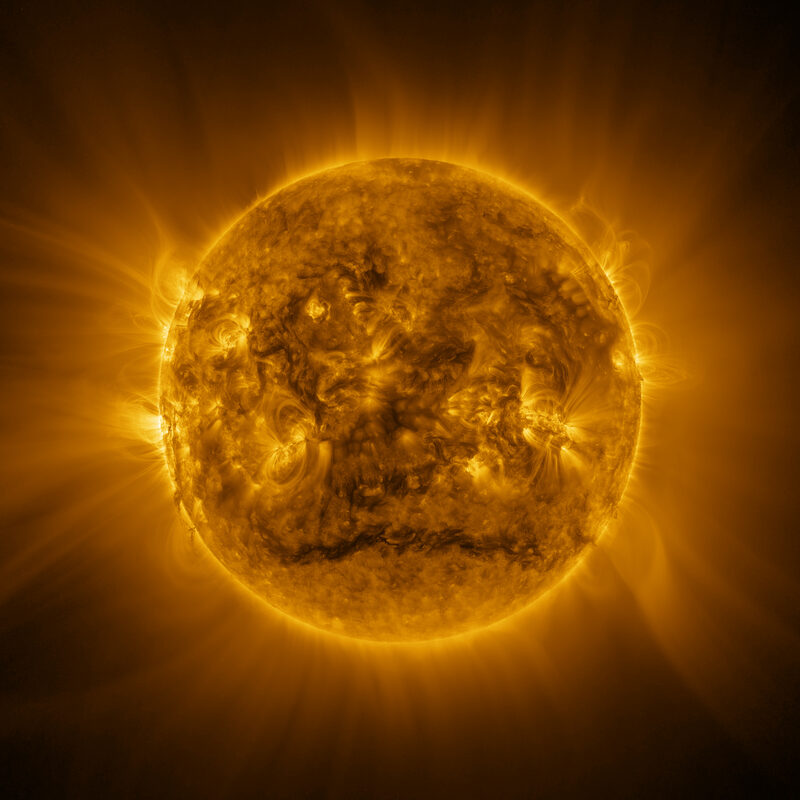
Every model of the Sun's magnetic activity — its 11-year cycle, its corona, the mechanism that heats the corona to millions of degrees while the surface sits at only 5,500 degrees — is built on solar images taken from the ecliptic plane. Earth orbits the Sun in that plane, and so have virtually all solar spacecraft. The poles of the Sun have never been directly imaged. We know they exist, we know they are magnetically important, and we know almost nothing about them in detail. Solar Orbiter is changing that, one orbit at a time.
The spacecraft, a joint ESA-NASA mission launched in February 2020, uses a sequence of Venus gravity assists to progressively tilt its orbit out of the ecliptic. By the mid-2020s, its inclination will reach 17 degrees — not polar, but high enough to image the solar polar regions with unprecedented clarity. Its perihelion — closest approach to the Sun — brings it to within about 42 million kilometers of the solar surface, inside the orbit of Mercury and closer than any solar imaging spacecraft before it. At that distance, its cameras can resolve features on the Sun as small as 300 kilometers across.
Campfires and the corona heating problem
The first perihelion images, released in July 2020, immediately showed something that had not been seen in previous solar imagery: thousands of tiny, short-lived bright flares distributed across the solar surface. The mission team named them campfires — a deliberate diminutive, since they bear a structural resemblance to solar flares but at a scale many orders of magnitude smaller. The largest campfires are about 1,000 times smaller than a typical solar flare in energy output; the smallest are pushing the limits of what the Extreme Ultraviolet Imager can resolve.
The significance of campfires is not certain, but they are candidate contributors to the coronal heating problem: the persistent mystery of why the Sun's corona is at least 100 times hotter than its surface. The established solar surface is at 5,500 degrees Celsius. The corona — the tenuous outer atmosphere extending millions of kilometers into space — reaches 1 to 3 million degrees. This temperature inversion violates the naive expectation that temperature should drop as you move away from the energy source. For decades, two competing mechanisms have been proposed: wave heating (Alfvén waves carrying energy from the surface into the corona, where they dissipate) and nanoflare heating (countless tiny magnetic reconnection events releasing energy throughout the corona). Campfires, if they are nanoflares at the bottom of an energy distribution extending up through flares and coronal mass ejections, would support the nanoflare model.
The solar wind connection
Solar Orbiter carries in-situ particle and field detectors as well as remote sensing cameras, making it possible to measure the solar wind at the spacecraft and simultaneously image the region of the Sun where that wind originated — something previous missions could do only approximately. The Wind Connection experiment — coordinating Solar Orbiter's plasma measurements with its images — has already identified specific coronal structures as sources of measured solar wind streams. This direct source-to-measurement tracing is a major advance over statistical correlations between solar images and wind properties measured at Earth's orbit.
As Solar Orbiter's orbit continues to evolve toward higher inclinations, the polar passes will become the mission's scientific centerpiece. The poles are where the Sun's global magnetic field is anchored — where the polarity of the entire solar dipole reverses at solar maximum, where polar coronal holes drive the fast solar wind, and where processes we cannot observe from the ecliptic drive the long-term behavior of the solar cycle. The data from those passes will inform solar weather forecasting for the rest of the decade and possibly beyond.
