
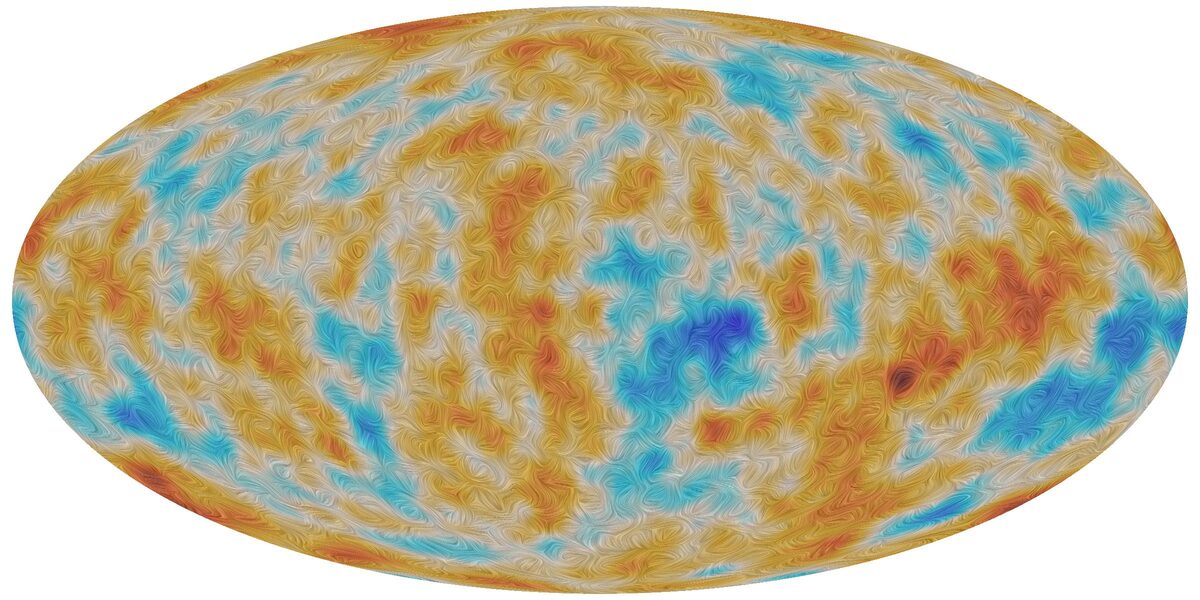
The Simons Observatory in Chile's Atacama Desert has spent two years calibrating instruments, bringing more telescopes online and installing a solar array. That work is done. According to the Simons Foundation, the observatory is now completely online and running science operations. Its target is the cosmic microwave background (CMB), the oldest light that can be observed, and the most ambitious goal is a faint pattern in that light that would carry the signature of the universe's earliest moments.
The team is already making strong claims. Spokesperson Jo Dunkley of Princeton says images built from just a few months of data are deeper and less noisy than those from Planck, the space mission whose all-sky maps have set the standard in CMB cosmology for years. Co-Director Suzanne Staggs, also at Princeton, said that having the whole observatory running makes her joyful, and that the prospect of what its big new deep maps could reveal is even more exciting.
Four telescopes, two jobs
The observatory is not one instrument. As Universe Today describes it, the site has four telescopes: three Small Aperture Telescopes (SATs), each 0.5 meters across, and one Large Aperture Telescope (LAT) with a 6-meter aperture.
The split matters. Small-aperture telescopes are suited to measuring polarization patterns that span large areas of the sky. The 6-meter LAT gives the fine angular resolution needed to map small-scale structure. With both, the observatory can study the CMB at many angular scales from a single high, dry site.
The bigger change is the detector count. Across the four telescopes, the observatory fields almost 98,000 detectors. Universe Today puts that at 16 times as many as the Atacama Cosmology Telescope, an earlier CMB experiment. The outlet also reports that the observatory's sensitivity is meant to be an order of magnitude higher than Planck's, and the Simons Foundation says its early data are already competitive with the best CMB maps, including Planck's.
Those figures explain Dunkley's claim. A ground-based array with this many detectors, staring at the sky continuously, can build up signal faster than earlier instruments could. A few months of data beating Planck's maps in depth is what you would expect from that much hardware working as designed.
The B-mode problem
The observatory's headline target is B-mode polarization. The CMB is slightly polarized, and that polarization can be split into two kinds of pattern. One kind, called B-modes, is the pattern that primordial gravitational waves would leave. Those waves would be ripples in spacetime produced in the very early universe, if the period of rapid expansion called inflation happened as many models predict.
Finding that signal would be a major result. It is also very hard to do. Universe Today notes that a B-mode detection by the South Pole Telescope was ambiguous because of gravitational lensing. As CMB light crosses the universe, its path is bent by the mass along the way, and that bending can turn one polarization pattern into another. Lensing creates B-mode signals that have nothing to do with primordial gravitational waves. Any claimed detection has to show that it is not just lensing.
This is where the two telescope types work together. The collaboration's forecasts paper says the high-resolution maps from the large telescope will aid in delensing the large-angle polarization signal, which is needed to measure the primordial signal. The small telescopes target the largest angular scales observable from Chile. Neither design could do the full job by itself.
More than inflation
B-modes are the most prominent goal, but they are not the only one. The collaboration's science-goals and forecasts paper, "The Simons Observatory: Science goals and forecasts" (arXiv:1808.07445), lists several targets for the survey. Besides primordial perturbations, it covers the mass of neutrinos and tests for deviations from a cosmological constant, which is the simplest description of dark energy.
That range is typical of CMB surveys. A precise map of the early universe constrains what came before it, such as inflation. Because the light passes through billions of years of growing cosmic structure on its way to Earth, it also carries information about what came after, including how much mass neutrinos contribute and how dark energy has shaped that growth.
Patience required
The early maps are encouraging, but nobody involved is claiming a discovery. Universe Today stresses that years of observation will be needed. A primordial B-mode signal, if one exists at a detectable level, is faint enough that building up the needed sensitivity and ruling out contamination from lensing and other sources will take time.
So the comparison to Planck is a good sign, not the result itself. It shows the instrument works and that its sensitivity matches what the hardware promised. The science goals depend on what the observatory finds after much longer integration.
Why It Matters
Universe Today calls the Simons Observatory the newest and most powerful observatory to study the CMB. It has the detector count, resolution and sensitivity to take on questions that earlier experiments could only approach. If it finds primordial B-modes, it would give direct observational evidence about the universe's first moments and about inflation, the theory many cosmologists rely on to explain why the universe looks the way it does.
The secondary targets, neutrino mass and dark energy, connect the CMB to particle physics and to the accelerating expansion of the universe.
The early results suggest that the approach of combining small polarization telescopes with a large high-resolution telescope at one site is working. The Simons Foundation says the observatory is now completely online and conducting science operations. Three more small telescopes, funded by the United Kingdom and Japan, are due to arrive in the coming year. The next few years of observing will show how much it can deliver.
