
Most retired spacecraft end up lying down. Museums show them horizontally, the way they landed, and visitors walk around them like a parked airliner. Space shuttle Endeavour is now on display the other way. At the California Science Center in Los Angeles it stands vertically in launch configuration, stacked as it would have been on the pad, nearly 200 feet (61 meters) tall.
The center held the ribbon-cutting for its new Samuel Oschin Air and Space Center on Friday, Nov. 13, 2026, and Space.com reports the center opened to the public the same day. collectSPACE describes Endeavour as the only fully authentic space shuttle stack in existence and says it is believed to be the tallest indoor museum artifact in the world.
A Reunion Under the Engines
More than 25 people who flew aboard Endeavour came back for the opening, according to collectSPACE. One of them was Sen. Mark Kelly, who commanded STS-134 in 2011. That was the orbiter's 25th and last flight, closing a career that began in 1992. Kelly spoke at the ceremony.
Jeffrey Rudolph, the California Science Center's CEO, called the opening the fulfillment of a decades-long dream, in a statement reported by collectSPACE. Former astronaut Garrett Reisman was more direct when he described the effect to Space.com: "It just takes your breath away."
Reporters, including Space.com's Chelsea Gohd, got a sneak peek on Oct. 28, and the exhibit lets visitors see the shuttle from underneath all the way to the top.
What Visitors Actually See
Many shuttle exhibits treat the orbiter as a sealed object to admire. This one opens it up. Here is what Space.com and collectSPACE report:
- An open payload bay. Endeavour is open, so visitors can peer inside and see the robotic arm tucked among handles, straps and electronic gear. collectSPACE says the payload bay is seen through one open 60-foot (18-meter) door and is configured after the 2007 STS-118 mission, with a Spacehab logistics module. That choice ties the display to a specific flight instead of a generic one.
- A ride up the tower. An elevator in the exhibit's launch tower carries guests to the level of the orbiter's nose.
- Views from above and below. A transparent floor sits over the shuttle, and visitors can also lie down beneath the engines and look straight up the stack.
- Hands-on flying. The center has a shuttle landing simulator and a replica cockpit.
- A faster way down. A shuttle-themed descent slide drops guests 45 feet.
Endeavour is the centerpiece, but it has company. collectSPACE reports that the center displays more than 100 aviation and aerospace vehicles and exhibits. Its galleries include the Korean Air Aviation Gallery, which lets guests access the forward 70 feet (21 meters) of a Korean Air-operated Boeing 747, and the Kent Kresa Space Gallery.
The Last Flight Over California
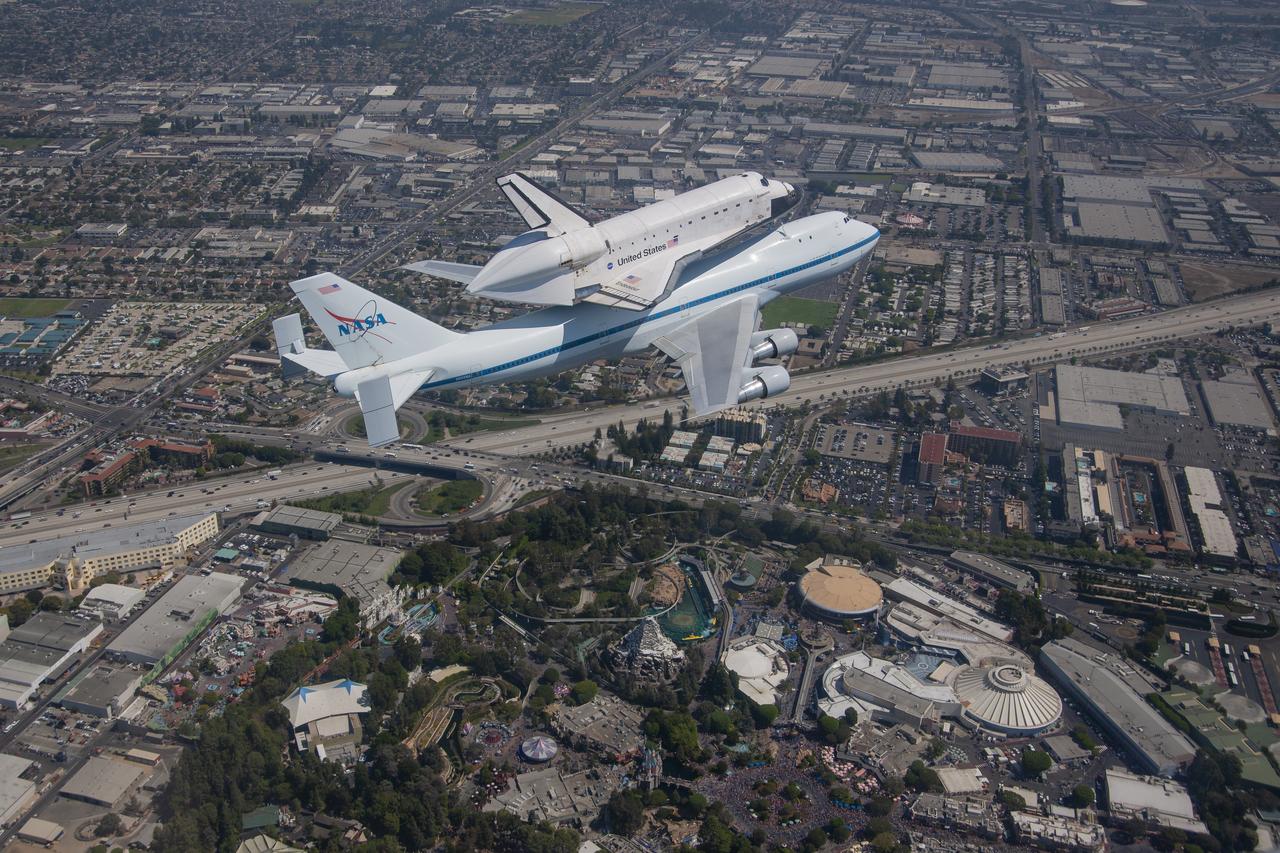
Endeavour's final trip through the air happened long before this building existed. On Sept. 21, 2012, the orbiter rode on top of NASA's Shuttle Carrier Aircraft on a ferry flight over some of California's best-known landmarks, including the Golden Gate Bridge, Disneyland and sites around Los Angeles.
Ahead of the opening, NASA's Armstrong Flight Research Center published a look back at how its imagery team recorded that flight. The team used two chase aircraft: one carried a photographer, and the other carried video crew. Lori Losey, Armstrong's lead videographer, said the assignment stands out over nearly four decades at the agency.
"Chasing Endeavour's final ferry flight ... was, without a doubt, a leading highlight of my 37-year career at NASA."
NASA describes the photographs from that day as iconic images shared around the world. Seeing Endeavour now, upright in launch position, adds a new chapter to the story that flight began: the ferry trip delivered the orbiter to Los Angeles, and the new display shows it stacked for launch.
Why It Matters
Endeavour flew 25 missions to Earth orbit from 1992 to 2011. Showing it horizontally explains what a shuttle looked like on the runway. Showing it vertically explains how it flew. The orbiter was one piece of a larger stacked system, and you only see the scale of that system when it is standing up.
Authenticity also matters. Because collectSPACE says this is the only fully authentic shuttle stack in existence, visitors in Los Angeles see something found nowhere else. Pairing the open payload bay with a real mission, STS-118 and its Spacehab module, lets the exhibit teach how the shuttle was actually used rather than only showing how it looked.
The opening also keeps NASA's institutional memory in public view. Armstrong's retrospective is a reminder of the photographers and videographers who documented Endeavour's final flight. A building where people can ride an elevator to the nose of a flown orbiter, then lie under its engines, offers a kind of access to a program that ended in 2011 that most people never had.
