
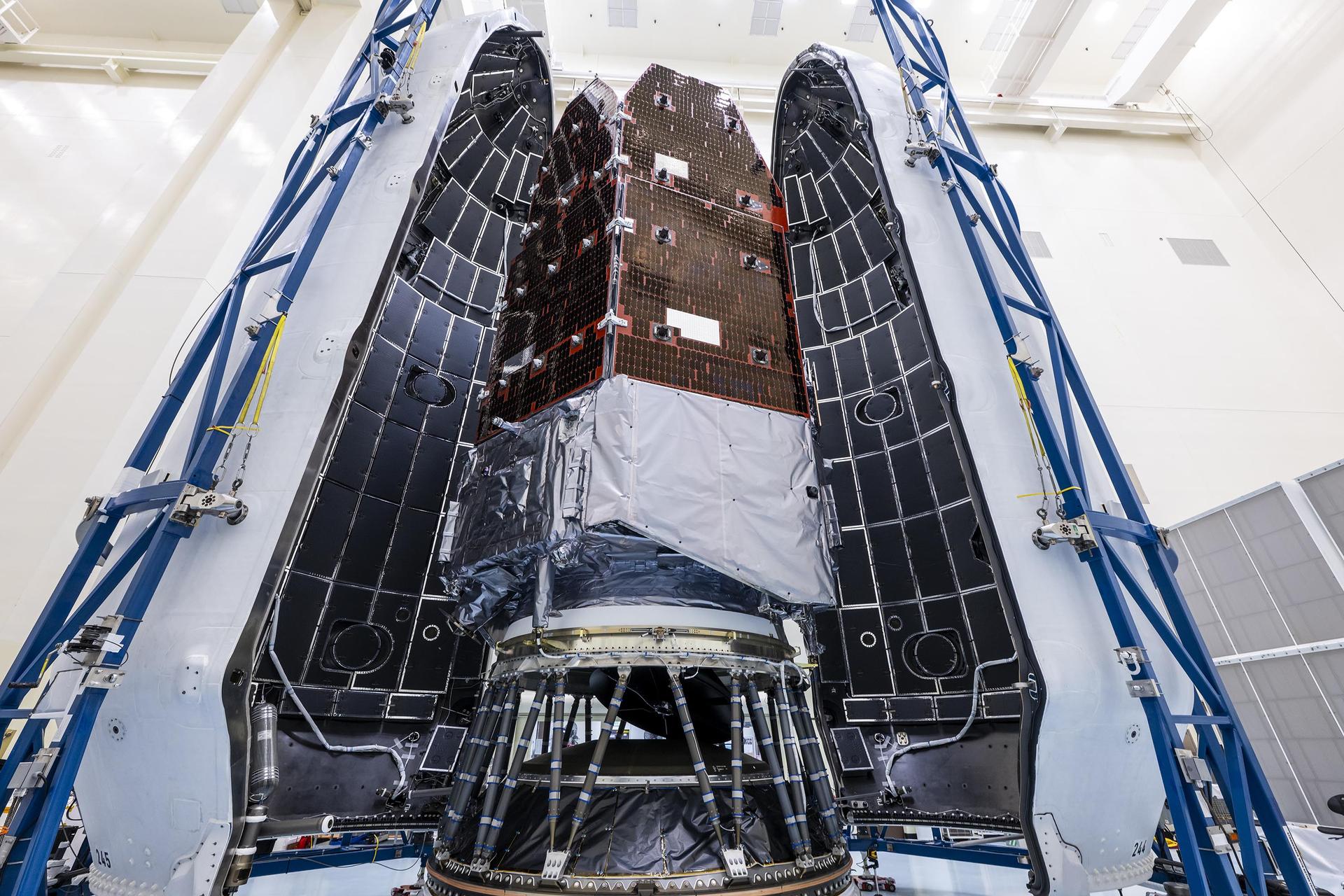
NASA now has a date for the Nancy Grace Roman Space Telescope's first images. In a media advisory issued Nov. 17 (M26-088), the agency said the images will be released at 3:30 p.m. EST (12:30 p.m. PST) on Monday, Dec. 7, 2026. The release will happen during a live stream from the American Geophysical Union's Annual Meeting in San Francisco.
To be clear about what this is: an announcement of a date, not the pictures themselves. Nobody outside the mission team has seen what Roman's cameras have recorded, and NASA isn't hinting. What the advisory does give is a full schedule for the day, along with a hint about what the agency hopes the reveal will mean to the public.
The schedule, hour by hour
First comes an embargoed session for the press, then a fireside chat and the public release, then a round of interviews.
- 12 p.m. EST, Dec. 7: An embargoed media preview. Media, whether attending remotely or in person, must be registered with AGU by 8 p.m. Sunday, Dec. 6.
- 2:45 p.m. EST: A fireside chat with NASA Administrator Jared Isaacman, moderated by journalist Alex Witze.
- 3:30 p.m. EST: The live broadcast of the release streams on NASA platforms and AGU channels, and the images post on NASA's website simultaneously.
- Dec. 8, 6 a.m. to 1 p.m.: Mission experts available for live, remote interviews with broadcast media.
According to Starlust's rundown of viewing options, the public can watch on NASA's X account, its YouTube channel and the NASA+ streaming service.
NASA is also asking the public to take part. The advisory invites people to claim a corner of the universe: a pixel of one of Roman's select first images, with a digital trading card to share once the image is revealed. It also encourages communities to hold their own watch events around the broadcast.
Where Roman is right now
Roman launched Aug. 30 from NASA's Kennedy Space Center on a SpaceX Falcon Heavy. Its destination is the Sun-Earth Lagrange point 2 (L2), about a million miles from Earth, a trip of roughly three months. As Space.com reported in September, L2 lets the observatory keep the Sun behind it. Space.com called it an optimal location for operating Roman's two primary instruments.
Engineers haven't waited for Roman to reach L2. According to the advisory, Roman has been undergoing commissioning during the journey, with its systems turned on, adjusted and calibrated. Starlust describes a weeks-long commissioning phase in which the instruments were switched on and calibrated. A three-month trip from an Aug. 30 launch ends around the start of December, so the Dec. 7 release falls close to the end of the cruise.
Roman carries two instruments:
- The Wide Field Instrument, a 300-megapixel infrared camera built from 18 detectors. It is designed to survey enormous swaths of the sky, and it is a likely source of the headline images, though NASA hasn't said.
- The Coronagraph Instrument, a technology demonstration meant to directly image planets around other stars.
Space.com's September coverage named BAE Systems and Teledyne among the industry teams on the mission and quoted Goddard's Josh Schlieder, the Wide Field Instrument scientist, on the instrument power-on milestone.
A little earlier than expected
The date stands out because it beats the timeline NASA had been describing. In September, Space.com reported that NASA said Roman remained on track to release its first science images in early 2027. Dec. 7 moves the reveal ahead of that window.
NASA's advisory doesn't explain why the date moved, and it would be a stretch to read too much into it. Still, Starlust reports that Roman has been declared fully functional, with the Wide Field Instrument exceeding image-quality expectations by nearly 30 percent. A fixed date with the Administrator on stage at a major scientific meeting is consistent with that, though NASA hasn't linked the two.
The venue is a little unusual for an astronomy milestone. The advisory describes Isaacman's fireside chat at the AGU meeting as a discussion of the connections between Earth and space science, and the media preview is also held there as part of the meeting.
Hubble's preview of what Roman will chase
NASA has already started connecting Roman to the existing observatory fleet. On Nov. 12, NASA Science published a Hubble collage of strong gravitational lenses. These are systems where a foreground galaxy's mass bends and magnifies light from objects behind it. Some of them are slated for follow-up by Roman. NASA says the lenses will be used to study galaxy evolution and dark matter (image credit: NASA, ESA, X. Huang, University of San Francisco).
The sampler shows how the two telescopes are meant to divide the work. NASA says Hubble gets a better view of individual lenses, while Roman's wider field of view will let it capture more of them. Lens science benefits from both. If Roman finds a particularly interesting lens, researchers may use Hubble for follow-up observations of individual objects.
Why It Matters
First-light images from a flagship observatory serve two purposes. Scientifically, they are a first public look at instrument performance, such as image quality across a wide field. They are not survey results. Roman's major science programs depend on accumulating huge datasets over years, and one striking image says little about the questions those programs were built to answer.
The second purpose is institutional. NASA has made the release a high-profile event: the Administrator on stage, a named moderator, an embargoed preview, a day of expert interviews and a pixel-adoption campaign. The agency clearly wants Roman to make a public splash. That is worth keeping in mind on Dec. 7: the first images are described as select ones that showcase Roman's capabilities. The more telling information will probably come in the technical details mission scientists offer in the interviews afterward.
Either way, the date is set. In under three weeks, the telescope that launched on a Falcon Heavy in August is due to show what it can do.
Sources
- NASA Invites Media, Public to View Roman Telescope's First Images (NASA Media Advisory M26-088)
- NASA to unveil first images by Nancy Grace Roman Telescope on December 7 (Starlust)
- Roman Space Telescope starts waking up as NASA powers on instruments for the 1st time (Space.com)
- NASA's Hubble Offers Cosmic Sampler of Targets for Roman (NASA Science)
