
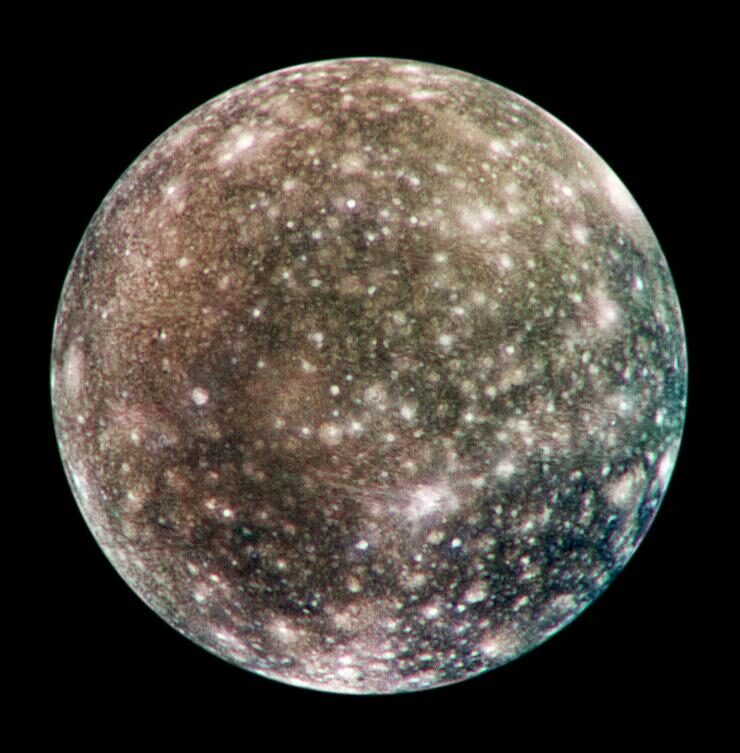
China's next deep-space mission now has a public instrument list and a deadline. On November 13, 2026, the China National Space Administration (CNSA) published an opportunity announcement for scientific payloads on Tianwen-4. The mission pairs a Jupiter orbiter with a lander meant to set down on Callisto, the outermost of Jupiter's large moons. The notice says what the agency wants to measure, which instruments it plans to carry, and who is allowed to propose them. That list includes institutions outside mainland China.
The notice is not a launch announcement and does not give a schedule. It is the formal step that turns a mission concept into a set of instruments, and it shows how China expects the science to work.
What CNSA is asking for
The announcement gives the mission's objectives as Jovian orbiting, plus orbiting and landing exploration of Callisto. It then lists 12 planned payloads, 10 on the orbiter and 2 on the lander.
The orbiter's planned instruments are:
- Soft X-ray Spectrometer
- Magnetometer and Wave Instrument
- Jovian And Solar-wind Magnetospheric Investigation
- Medium and High Energy Particle Detector
- Far-Ultraviolet Imager
- Wide Angle Camera
- Medium Angle Camera
- Callisto Laser Altimeter
- Visible and Infrared Imaging Spectrometer
- Callisto Gamma-Ray Spectrometer
The lander's two planned instruments are a Callisto Surface Composition Analyzer and a Callisto Lander Magnetometer.
The orbiter's payload covers two kinds of science. About half of it studies Jupiter's environment. The magnetometer and wave instrument, the magnetospheric investigation, the particle detector, the soft X-ray spectrometer and the far-ultraviolet imager are aimed at the giant planet's magnetic environment, its charged particles and its interaction with the solar wind. The rest of the orbiter's instruments are aimed at Callisto. A laser altimeter measures surface shape, a gamma-ray spectrometer measures elemental composition, an imaging spectrometer covers visible and infrared light, and two cameras provide images at different scales.
Daily Galaxy, citing China Daily, reports that the Lunar Exploration and Space Engineering Center is collecting the proposals for the 12 payloads split between the two spacecraft.
The terms for foreign partners
The terms for international partners are the most notable part of the notice. CNSA says institutions outside mainland China can join Chinese-led proposals or lead proposals of their own. Those teams are expected to pay their own way: the notice says development funds shall, in principle, be self-funded.
The other requirements are practical. Applicant entities must have spacecraft-product development capability and qualifications including ISO 9001 quality-management certification. Proposals must be submitted to CNSA as PDFs in both Chinese and English by December 31, 2026. That leaves about seven weeks from publication to the deadline, which is short for a team that does not already have a flight-ready concept.
Under the self-funding rule, foreign teams can put instruments on the mission, but their own funders have to pay for building them. For many groups, the question will be whether a national agency or research council is willing to do that.
Why Callisto, and why a lander
Callisto is a hard target for a landing because scientists are still unsure what lies beneath its surface. Universe Today, which covered the announcement on November 17, notes that Callisto appears to be only partially differentiated, and that magnetometer readings are ambiguous about an ocean. The same report says it is far from certain whether Callisto has a saltwater ocean.
The two lander instruments are designed to address that question from the surface. According to Universe Today, the lander's surface composition analyzer will be a Raman spectrometer, which could determine whether some of the surface material is aqueously altered, meaning changed by contact with liquid water. Universe Today says that would be evidence in favour of an ocean.
The second lander instrument is a magnetometer, and it is meant to work together with the orbiter. Universe Today explains that combining the lander magnetometer's data with the orbiter magnetometer's data lets scientists separate ionospheric signals from signals from the moon's surface, which would reveal more about its interior. Daily Galaxy adds that the instruments would not directly observe an underground ocean, but their measurements could provide evidence relevant to its existence and properties.
This is why the mission has two spacecraft. The orbiter maps Callisto and measures the Jovian environment, and the lander provides measurements from the surface at one site. The lander and orbiter magnetometers are meant to be used together.
What the notice leaves out
The CNSA announcement does not give a launch date, a launch vehicle or a planned arrival time. Daily Galaxy reports that earlier planning pointed to a launch around 2029 on a Long March 5 from the Wenchang launch site. Universe Today likewise notes that a timeline outlined in 2020 had a September 2029 launch and says that plan will likely change. That information does not appear in the CNSA notice, so it should be treated as a previous target, not a confirmed schedule.
The notice also does not say how many proposals CNSA expects to accept, whether any of the 12 slots are already reserved for particular Chinese institutions, or how foreign-led instruments would be selected against domestic ones. It says only that the timeline for proposal selection will be informed separately.
Why It Matters
Tianwen-4 is planned to include a landing on a moon of Jupiter, and the CNSA notice makes that intention explicit. Putting a spacecraft on the surface of a Galilean moon is more ambitious than orbiting, and pairing the lander with an orbiter allows coordinated measurements that neither spacecraft could make alone.
The science goal is a practical one. Daily Galaxy notes that measurements of Jupiter's magnetic environment and Callisto's surface and interior could contribute to understanding how icy worlds formed, evolved and possibly preserved liquid water far from the Sun. A partially differentiated moon that may or may not have an ocean is a good test case, and the lander's composition and magnetic measurements, combined with orbital data, are aimed at that question.
The open call also matters for scientists outside China. CNSA is inviting foreign-led instruments as well as foreign co-investigators on Chinese teams. Funding, certification and a tight deadline will limit who can take part. Still, the call gives research groups a route onto an outer-planet mission, and the year-end deadline means they need to decide quickly.
