
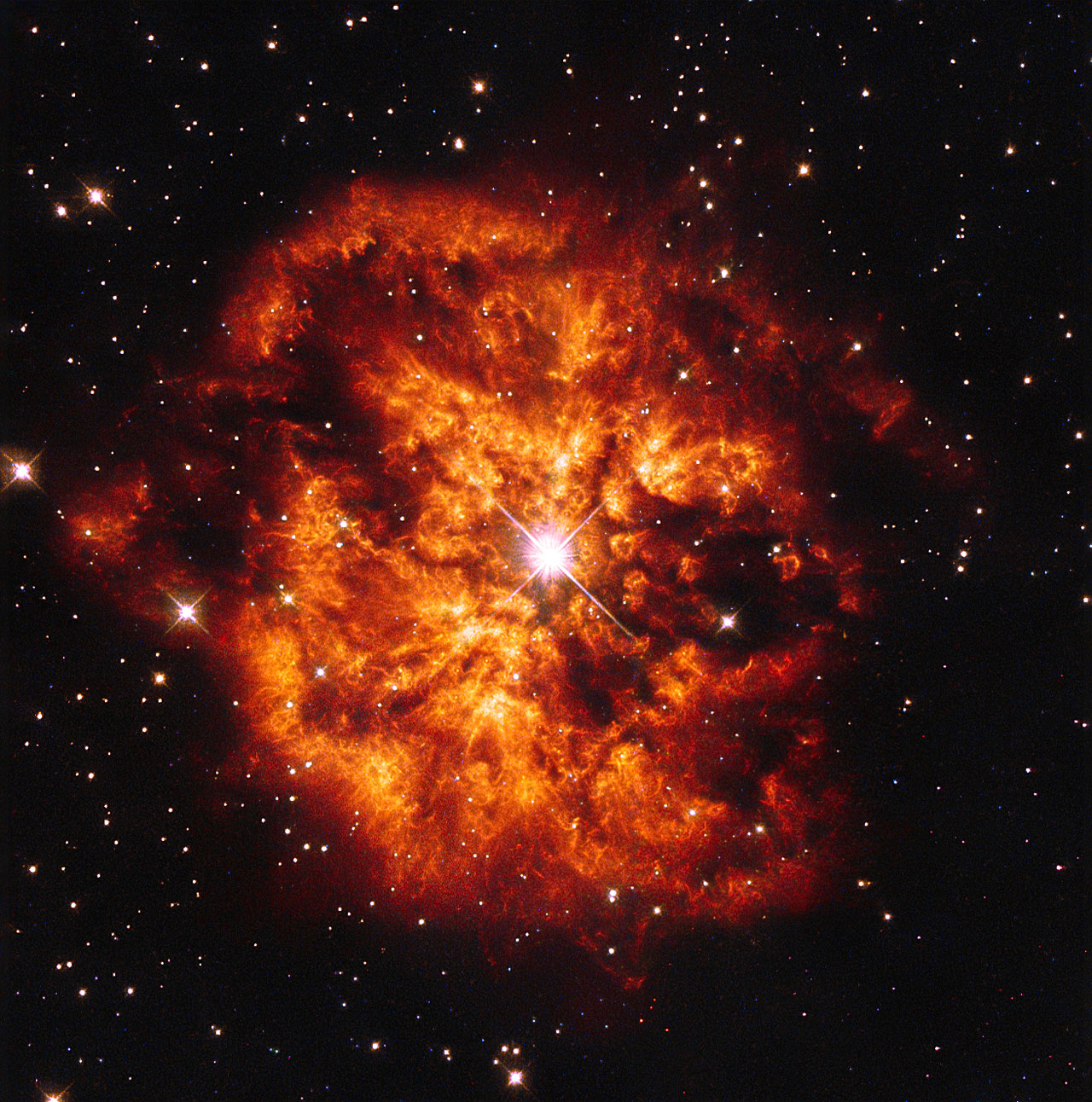
Most stars change on timescales that dwarf a human life. Sakurai's Object has not been that polite. In the roughly three decades since it erupted in 1996, this star in Sagittarius has heated up by a factor of about six, according to the University of Manchester. That is one of the fastest temperature increases ever seen for a star. Thirty years ago it was similar in temperature to the Sun. Now a new set of spectra shows what it has become.
A team led by W. Marcolino of the Observatorio do Valongo used the European Southern Observatory's Very Large Telescope in Chile to take fresh spectra of the star. Their Letter, "The emergence of a [WC] star in Sakurai's object," was submitted to arXiv on 16 September 2026. Manchester says the result appears in Monthly Notices of the Royal Astronomical Society. The Letter's conclusion is that the central star now has the spectrum of a [WR] object, and the Manchester team says the star is reheating more gradually than some earlier models predicted.
What is Sakurai's Object?
The star is named for Yukio Sakurai, the amateur astronomer who spotted its eruption in 1996, according to Universe Today. It is a roughly 0.6-solar-mass star that had already ended nuclear burning and was heading for a quiet life as a white dwarf. Then it flared back to life in what astronomers call a very late thermal pulse, and became a "born-again" star.
Only two stars have ever been watched going through this rebirth. One is Sakurai's Object. The other is V605 Aquilae. Because such events are so rare, each one is a chance to test stellar-evolution models against a real star instead of a simulation.
Since 1996 the star itself has been hidden. Thick gas and dust ejected in the outburst cloak it. The Manchester release notes that an ALMA image shows the ejected material stretching to about the size of the solar system. Measuring the star underneath means looking through, or around, that shroud.
Reading the spectrum
The new VLT/FORS2 observations were compared with NLTE expanding-atmosphere models. That comparison gives what the authors describe as a secure spectroscopic identification of the central star as a [WR] object. The strongest features in the spectrum are lines of ionized carbon (C II and C III) and neutral helium (He I). Universe Today reports that the fits support a [WCL] classification, the late-type, cooler subclass of these stars.
A note on the name, because it invites confusion. The brackets matter. A [WR] or [WC] star is a low-mass look-alike of the massive Wolf-Rayet stars. It shows a similar emission-line spectrum but is a different kind of object. Sakurai's Object is not a true, massive Wolf-Rayet star.
The temperature comes out at about 30.5 kK, or roughly 30,500 K. The fits rule out anything above 36 kK or below 27 kK. Manchester gives the surface temperature as currently between roughly 27,000 and 36,000 K, and describes it as the reheating that followed the eruption nearly three decades ago.
Cooler than its only sibling
The natural comparison is V605 Aquilae, the only other star caught in the act. According to the arXiv abstract, V605 Aql is far hotter, at about 95 kK. It erupted about 80 years before Sakurai's Object. So the two stars are snapshots at very different points after their outbursts. Sakurai's Object, at 30.5 kK, is much earlier on its climb.
Why the slow reheating matters
The interesting result is how fast the star has heated, not just how hot it is. Some earlier models of the very late thermal pulse predicted more rapid reheating. The paper says the inferred temperature is lower than models that suppress the efficiency of convective mixing during the pulse would predict. It is instead consistent with higher time-resolution calculations for remnants of slightly lower mass, at or below about 0.6 solar masses.
Put plainly, the measurement gives theorists a way to test their assumptions. The Manchester release frames it as more gradual reheating than some theories predicted, and Zijlstra says that gives "an important way of testing which theories best describe what happens when a dying star briefly springs back to life." In practice, calculations that can reproduce a 30.5 kK star at this stage of its evolution stay in play, and those that cannot are candidates for revision.
Why It Matters
Stellar evolution is usually a science of inference. Astronomers observe many stars at different ages and stitch the results into a life story, because most stars change too slowly to watch. Prof. Albert Zijlstra of the Jodrell Bank Centre for Astrophysics, a member of the team, put it this way in the Manchester release: "Most stars evolve so slowly that major changes take place over timescales far longer than a human lifetime." He added that "Sakurai's Object offers something far rarer."
With only two known examples, every measurement of a born-again star carries weight. A single temperature at a single epoch is useful, but the real prize is the curve: how quickly the star heats over time. The authors say continued monitoring is needed to trace that reheating curve. Each new spectrum adds a point that models must pass through.
What comes next
According to Universe Today, the star will keep contracting and heating for decades and should eventually settle back into life as a white dwarf. For observers, that means a slow, steady change to watch. For theorists, it means the result is not final. One temperature measurement narrows the field of models. More measurements over the coming years will narrow it further.
One caution for readers comparing coverage: a caption in the Universe Today piece says "six times brighter," while its body text and the Manchester release both say "six times hotter." We follow the Manchester wording, since it is the statement about temperature that the spectroscopy supports.
