
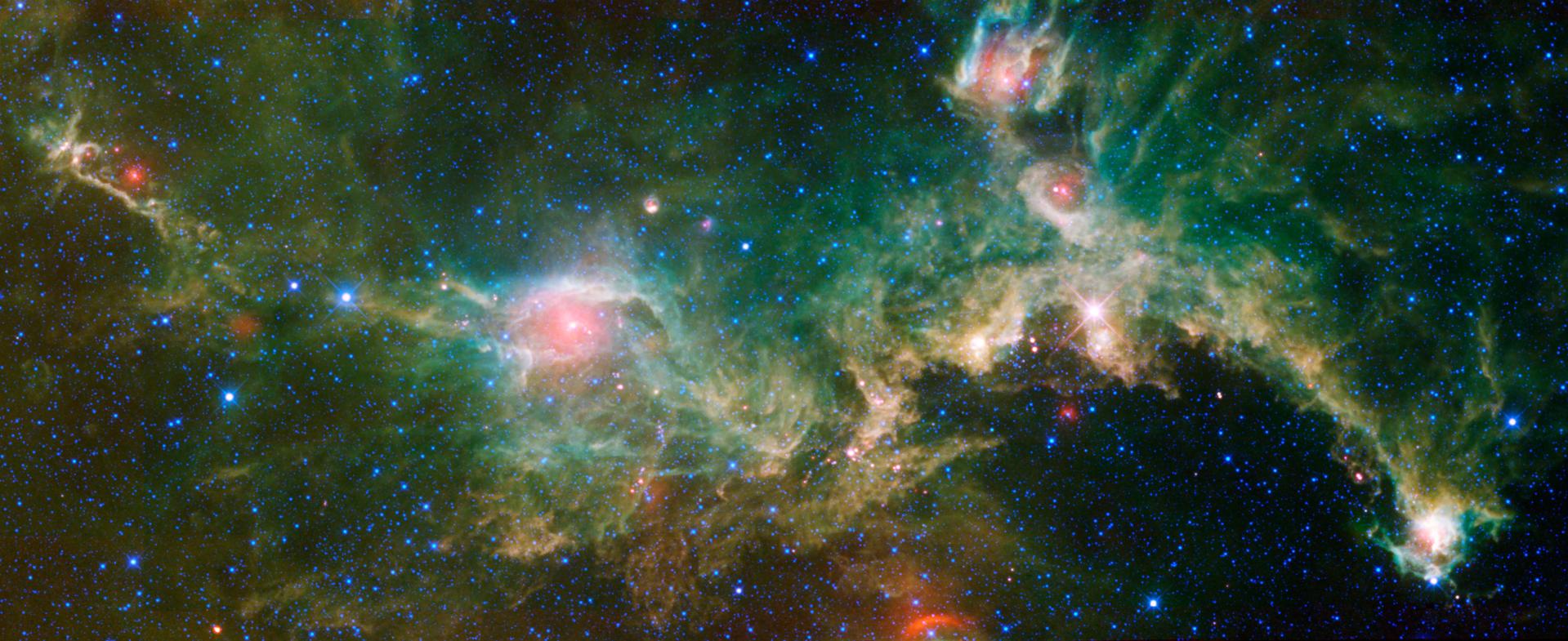
Most observatories put out their test data quietly and move on. The NSF-DOE Vera C. Rubin Observatory has instead gone back into its commissioning archive and pulled out a nebula. On October 22, Rubin and NOIRLab released an image of the Seagull Nebula. It was taken in fall 2024 with the Commissioning Camera, or ComCam, the smaller instrument that stood in for Rubin's main camera while engineers got the system working.
The timing marks two years since ComCam started engineering tests. It also makes a point: a camera that was only ever meant to be a rehearsal still produced what the release calls the deepest and sharpest view of this part of the sky, a title it will hold until the Legacy Survey of Space and Time (LSST) collects more data.
A stand-in with 144 megapixels
ComCam is small only next to the camera it was standing in for. Its focal plane has nine CCDs adding up to 144 megapixels, and each frame covers about twice the area of the full Moon. Between October 24 and December 11, 2024, the camera took about 16,000 exposures over seven weeks of observing.
According to Universe Today's coverage, ComCam was mounted on the Simonyi Survey Telescope, observed for seven weeks in late 2024, and was removed in December 2024. That is the instrument's real job: a rehearsal that runs the telescope, the data handling and the image processing before the far more expensive main camera takes over. The release says the data gave Rubin's team a chance to test hardware, software and the image processing pipelines later used with the much larger LSST Camera images, so the Seagull picture is a test of the software as much as of the optics.
ComCam is no longer imaging the sky, but it has not retired. According to the release, it now serves as a test stand in the summit clean room, supporting LSST Camera software testing and the regular cycling of spare vacuum pumps and refrigeration compressors to keep them in good working order.
What the image actually shows
The Seagull Nebula lies about 3,700 light-years away, between the constellations Monoceros and Canis Major. It is not one object. It is three clouds of gas catalogued as Sharpless 2-292, 2-296 and 2-297, which together form a shape that looks like a seagull in flight.
The ComCam frame shows the head of the bird, Sharpless 2-292. That cloud is an H II region, a cloud of ionized hydrogen gas, inside the larger IC 2177. The source of Sharpless 2-292 is HD 53367, a triple system of massive young stars that sits at the top of a dark, jagged ridge in the image, where it represents the Seagull's blue eye.
The colors carry physical meaning rather than being decoration:
- Pink marks hydrogen gas ionized by the ultraviolet radiation of newly born stars, which makes it glow.
- Blue is a haze of dust particles reflecting the light of other young stars in the area.
The release also notes that the radiation pressure sweeps away light-obscuring material such as dust, making the glowing hydrogen visible. The release describes the image as populated by active star formation.
The Seagull image also gave Rubin's image processing team early experience with the complex structures found in star-forming regions. That experience, the release says, helped the team identify and solve processing challenges that would also arise with the much larger LSST Camera images, including the Trifid and Lagoon Nebulae, one of the Rubin First Look images released in June 2025.
Why It Matters
The obvious question is why anyone should care about a test camera's pictures now that the real survey is underway. The Brookhaven National Laboratory repost of the release notes that LSST began earlier this year, and that the Seagull image was one of many ComCam images that led to the success of Rubin First Look, the observatory's public debut, and helped document the observatory's excellent performance. Put plainly, the commissioning work helped the survey start in good shape.
That matters because of scale. The LSST Camera has 3,200 megapixels, more than twenty times ComCam's pixel count of 144 megapixels, and a field of view 21 times larger. That lets it capture images of the entire southern hemisphere sky every three to four nights, according to the release. A survey at that rate makes an enormous amount of data, which is why it helps to work out processing problems beforehand. Seven weeks and about 16,000 exposures with a smaller camera running through the same kind of pipeline gave the team that chance.
The release also says that, until LSST collects more data, the ComCam image remains the deepest and sharpest view of this region. In other words, the survey that is now underway is expected to supersede it, and the stand-in camera's portrait holds the record only until then.
A rehearsal worth keeping
Engineering-camera images are not usually what an observatory is remembered for. Still, the Seagull release is a good reminder of what commissioning involves: a working scientific instrument, a production-grade pipeline and enough sky time to produce real results before the main event. Two years on, the stand-in camera has one more release to its name, and as Universe Today puts it, an engineering camera producing images this good is a marker of how far astronomical imaging has come.
Sources
- Seagull Nebula Through the Eyes of NSF-DOE Vera C. Rubin Observatory Commissioning Camera (NOIRLab, noirlab2625)
- Seagull Nebula Through the Eyes of NSF-DOE Vera C. Rubin Observatory Commissioning Camera (Brookhaven National Laboratory)
- Even the Rubin's Test Camera Produces Stunning Images (Universe Today)
