
Supermassive black holes are hard to catch in the act. The gas falling into them and the jets they launch play out over scales and timescales that rarely fit into a single observing campaign. A new analysis of archival data from NASA's Swift observatory suggests that one of the best-known black holes in the nearby universe may have done exactly that. It flared in X-rays, and its radio jets seem to have answered almost a year later.
The object is NGC 1275, the giant galaxy at the center of the Perseus Cluster. In a paper accepted to The Astrophysical Journal Letters and posted to arXiv on August 13, 2026, a team led by Sarah Ketchum of the University of Michigan reports the strongest X-ray flare yet recorded from the galaxy's core. They also report a radio flare at 43 GHz that shows up roughly 300 days after it. The authors call the evidence for the link tentative. If it holds up, it would be a rare case of watching cause and effect travel from a black hole's accretion flow out to its jets.
A noisy neighborhood
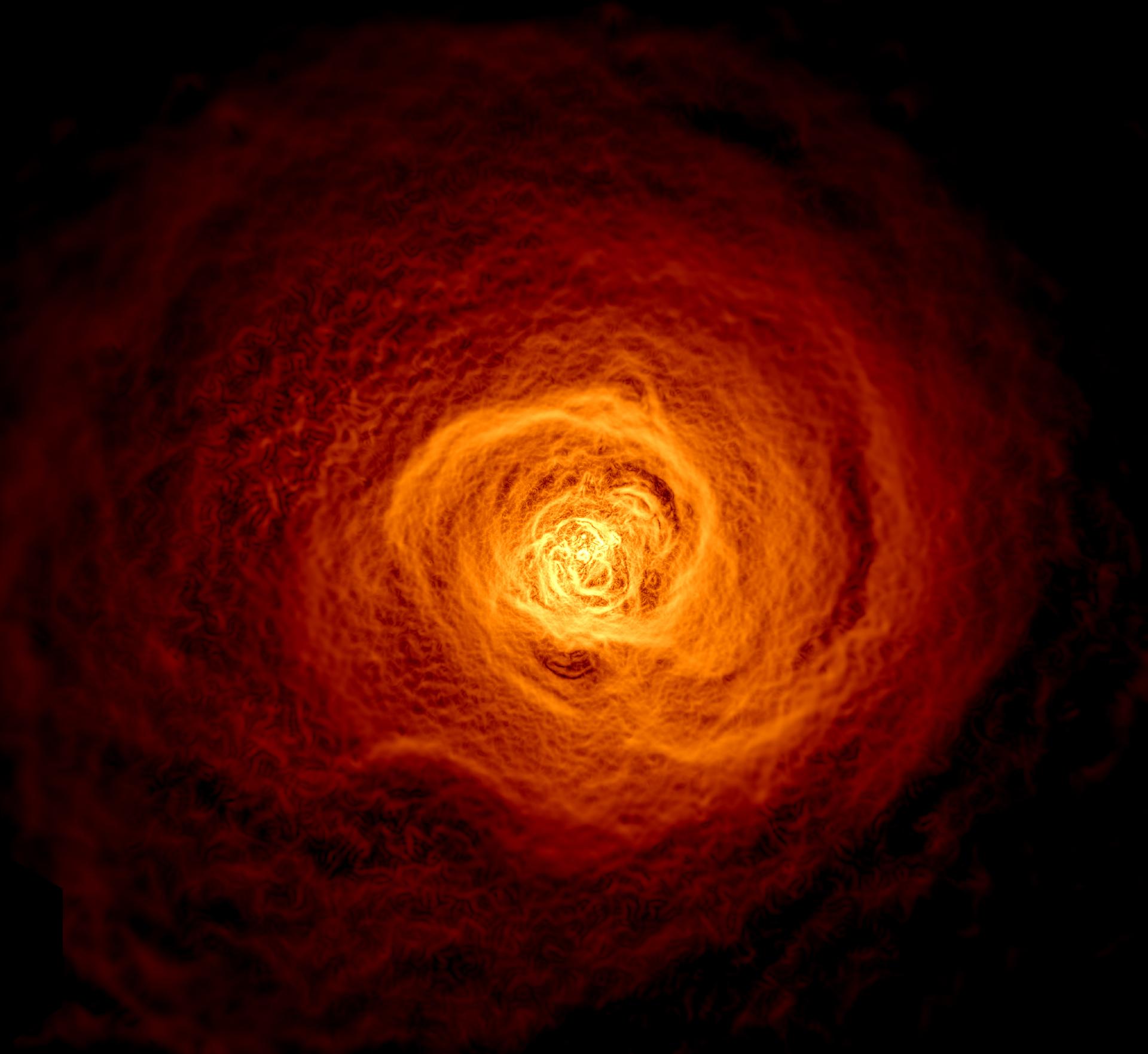
NGC 1275 is not a quiet target. NASA describes it as both a radio source, known as Perseus A, and a strong X-ray emitter sitting at the center of the Perseus Cluster. Composite images that combine Chandra X-ray, VLA radio and Hubble optical data show its radio jets filling cavities carved into the cluster's hot gas.
That hot gas, the intracluster medium (ICM), is the main problem for anyone trying to study the black hole itself. The cluster glows brightly in X-rays, and the light from the active nucleus sits on top of that glow. To isolate the black hole, the Michigan team modeled the ICM emission and removed it from Swift's archival observations. Space.com reports the archive covers 2007 to 2025, which the paper describes as about 20 years of monitoring.
Swift's strength here is cadence rather than sharpness. It came back to the target often enough to build a long, fairly dense light curve. Science News Today notes that Chandra, despite its greater power, cannot observe often enough to track this kind of variability.
The flare
With the cluster removed, the nucleus turned out to be highly variable. The standout event came in early 2023: X-ray flaring that roughly doubled the source's brightness over a span of days. According to Space.com's account of the work, the strongest flare came in February 2023, lasted under 60 days and consisted of two separate blasts of about five days each.
Flares that fast set a ceiling on how big the emitting region can be, since a region can't brighten coherently faster than light can cross it. The paper puts that limit at r ≤ 870 GM/c², scaled for a black hole of 100 million solar masses. Here GM/c² is the gravitational radius, the natural length scale set by the black hole's mass.
Space.com reports that the analysis also constrains the black hole's mass to between 100 million and 1 billion solar masses. That range matters because, as Science News Today points out, published mass estimates for NGC 1275 differ by nearly two orders of magnitude.
Not a shredded star
When a galactic nucleus suddenly brightens, one natural suspect is a tidal disruption event (TDE), in which a star wanders too close and is torn apart, and part of its debris falls into the black hole. The authors considered this and rejected it. The paper says the flare profile is inconsistent with simple TDE predictions, and Space.com reports the team ruled a TDE out.
That leaves a less dramatic but arguably more interesting explanation. Ketchum told Space.com the flaring was likely caused by a spike in the rate at which matter accreted onto the black hole, with no star destroyed. Science News Today adds that other processes, such as downstream shocks in the jet, remain possible, and that the researchers could not establish that all of the X-ray emission came from the region close to the black hole.
The echo
The more provocative result came from comparing the X-ray record with radio monitoring. In 43 GHz radio data, a flare appears roughly 300 days after the X-ray event. Science News Today reports the lag as 296 days. The paper itself says "roughly 300 days."
The physical picture is easy to sketch. X-rays trace emission from gas accreting onto the black hole. Radio emission traces the jets. Science News Today says the delay could represent the time needed for a disturbance to travel from the X-ray-emitting region near the black hole to a radio-emitting region farther out in the jet, and Space.com describes a similar picture of plasma traveling from the base of the jet to a knot or shock. Science News Today also notes another possibility, that the delay reflects movement between two locations farther downstream in the jet, and calls that interpretation uncertain.
The authors are careful not to overclaim. Space.com reports that Ketchum and her colleagues found tentative evidence for the delay. She said the X-ray data only sparsely sample the changes in NGC 1275, which makes it difficult to determine an exact relationship between the X-ray and radio emission for large portions of the light curve. One X-ray flare followed by one radio flare is suggestive. It is not proof, because an active galaxy like this one varies on its own and two unrelated flares can line up by chance. That caution is our own reading of the evidence, not a statement from the paper.
Why It Matters
How black holes turn infalling matter into outflowing jets is one of the central open questions in high-energy astrophysics. Science News Today and Space.com both frame the disk-jet connection as important for understanding how black holes limit the growth of their host galaxies. In clusters like Perseus, jets from the central galaxy inflate large bubbles in the hot intracluster medium, as the paper's abstract describes. Connecting a specific change in the accretion flow to a specific response in the jet would give theorists a measurable timescale to test their models against. Ketchum told Space.com that NGC 1275 reveals the impact of black hole jets on large spatial scales better than any other system.
The study also shows what long-running, frequent monitoring can do. The flare and its possible echo were found by going back through about two decades of archival Swift data. The authors had to model and remove the cluster's constant X-ray glow to get there, which left typical flux errors of about 3 percent, according to the paper.
What comes next
According to Space.com, Ketchum says the delay should be tested further, and that confirming the connection would require more X-ray data. She also said that if the flares are produced close to the black hole, an echo should show up in the accretion disk. A neutral iron emission line is seen in the data and may be that echo, but establishing it will likely take many observations with XMM-Newton and XRISM, the X-ray Imaging and Spectroscopy Mission.
The paper's conclusion points the same way: coordinated, moderate-resolution X-ray imaging and radio monitoring could potentially trace disk-jet connections in this galaxy and be extended to other sources. More frequent X-ray coverage paired with continued high-frequency radio monitoring would show whether the next big X-ray flare is also followed by a radio flare on a similar schedule. A repeat would strengthen the case for the disk-jet link. If no echo follows, the 2023 pairing may turn out to be a coincidence.
Either way, NGC 1275 is now a better-defined test case. Its flaring region has a size limit, its black hole mass has a tighter range, and astronomers have a specific delay to look for.
Sources
- X-ray Flaring and Variability in NGC 1275, the Heart of the Perseus Cluster (arXiv:2608.13281)
- Astronomers witness supermassive black hole gorge on a cosmic meal before 'burping' radio jets 300 days later (Space.com)
- NGC 1275 (Perseus A) Multi-wavelength Composite (NASA Science)
- Brightest X-ray flare from Perseus Cluster black hole followed 296 days later by radio flare (Science News Today)
