
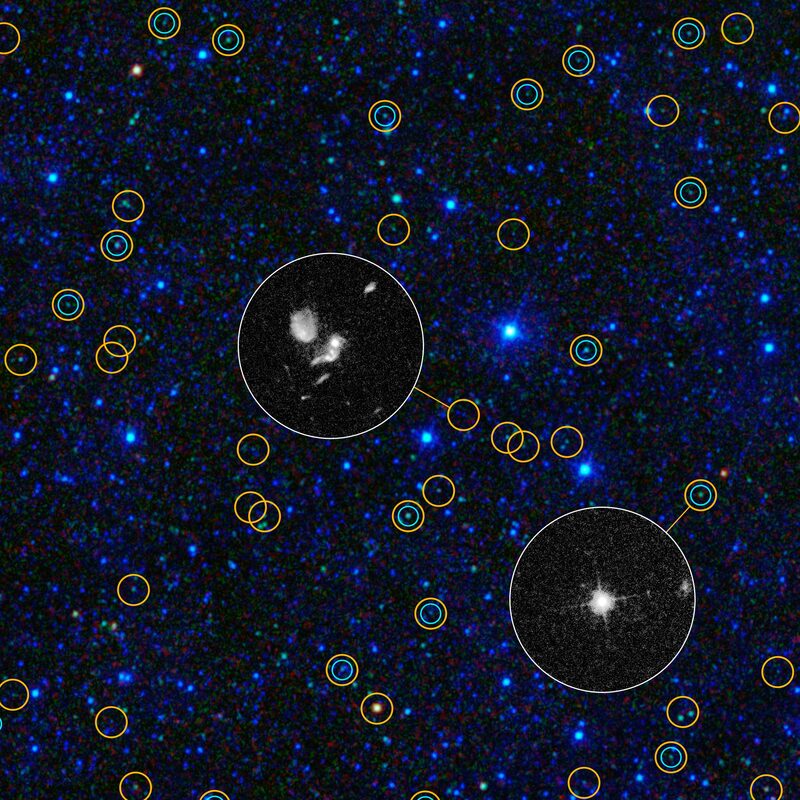
Black hole recoil has been predicted for a long time and is hard to catch. When two supermassive black holes merge, the gravitational waves they give off may not be released evenly in every direction. Any imbalance can push the merged black hole in one direction and send it moving through its host galaxy. Finding one clear case of this is difficult. So a team led by Bence Bécsy of the University of Birmingham took a different approach. Instead of hunting for one convincing example, they looked at about 100,000 quasars together to see whether the population carries a recoil signature.
They found a weak but statistically strong pattern, published in Monthly Notices of the Royal Astronomical Society. Quasars whose broad emission lines are more offset in velocity also tend to be redder from dust. The authors are careful to say this is not proof. But the trend points the way recoil would predict.
The logic of the search
The study uses quasars from the Sloan Digital Sky Survey's 16th data release (SDSS DR16). A quasar's spectrum has broad emission lines and narrow emission lines. The idea behind the test is that a black hole moving relative to its galaxy would carry its broad-line region with it. The narrow lines would stay closer to the host's rest frame. A recoiling black hole would then show a velocity offset between the two sets of lines. The team calls this offset |Δv|.
On its own, a velocity offset isn't strong evidence. The team added a second observable to test it. A black hole kicked out of the centre should swing through the dense, dusty core of its galaxy, and that dust would redden the light reaching us. The researchers measured reddening as a change in the quasar's g−i colour, written Δ(g−i). If recoils are common, quasars with larger offsets should be more dust-reddened on average.
Universe Today, reporting on the paper, gave the recoil speeds in question as roughly 360,000 to 3.6 million kilometres per hour. That works out to about 100 to 1,000 kilometres per second. The remnant black hole is expected to keep feeding and shining as a quasar for 10 to 100 million years after the kick. That gives it time to move through its galaxy's centre while it is still bright enough to see.
What the numbers say
The correlation is real but small. Between |Δv| and Δ(g−i), the team found a Spearman rank coefficient of about 0.12 and a Pearson coefficient of about 0.13. Taken alone, those numbers are modest. Across a sample of around 105 objects, though, the chance of getting this by accident is tiny. The reported p-value is far below 10−10.
The pattern is clearer at the extremes. The share of heavily obscured quasars goes up as the velocity offset grows. According to Universe Today, the group with the fastest offsets has about three times the share of obscured quasars found in the slowest group.
The authors also ran a control. When velocity offsets were computed between narrow emission lines instead, the correlation was largely absent. That matters. A signal that shows up in the broad-line offsets but not in the narrow-line ones fits better with the black hole itself moving than with a general bias tying line shifts to dust.
Bécsy said in a press release quoted by Universe Today that it is very difficult to prove the black hole in a single quasar has been ejected, because other phenomena can produce similar signatures. What is new, he said, is searching statistically for traces of an entire population. Co-author Zsolt Frei said that if the signal is caused by ejected black holes, two supermassive black holes merged relatively recently in a significant proportion of quasars, meaning such events are common.
The caveats are not boilerplate
The paper says plainly that recoil is not the only possible explanation. Winds, inflows, orientation-dependent obscuration and asymmetric broad-line regions are among the effects the authors list as possible contributors. The authors also report systematic differences between redshifted and blueshifted subsamples, which may point to residual velocity biases or additional physical effects. A correlation coefficient of 0.12 leaves plenty of room for several effects mixed together. The authors say recoiling black holes provide a natural explanation for the correlation, but that alternative scenarios should be explored. It is statistical evidence that fits recoil, not a detection.
That framing is right. Population statistics can show that a trend exists. They can't easily show what causes it, and the alternatives the authors list are well-known processes in active galactic nuclei. Separating them will probably take independent evidence that a given system really did go through a merger.
Why It Matters
If the recoil reading holds up, the result would be more than a curiosity. The authors write that, if confirmed, it would enable population-level constraints on massive black hole merger rates, recoil dynamics and the properties of active galactic nuclei discs. Merger rates are central to how galaxies and their central black holes grow together over cosmic time, and they are hard to measure directly.
The study also points to a way to check the idea. The Laser Interferometer Space Antenna (LISA), which Universe Today reports has a planned launch in 2035, is expected to observe gravitational waves from merging supermassive black hole binaries. Frei noted that the frequency of such mergers directly determines how many LISA may be able to detect. Gravitational-wave detections would therefore offer an independent check on the merger rate implied by the electromagnetic hint seen in 100,000 quasars. If the two agree, recoil would become a much stronger explanation for the dusty, offset quasars. If not, the winds, inflows and viewing angles would move to the front.
For now, the finding is a small correlation in a very large dataset. It is weak enough to stay cautious about, and strong enough to justify follow-up.
The full citation is Bécsy B., Raffai P., Haiman Z., Budai A. and Frei Z. (2026), MNRAS 550(4), stag1367.
