
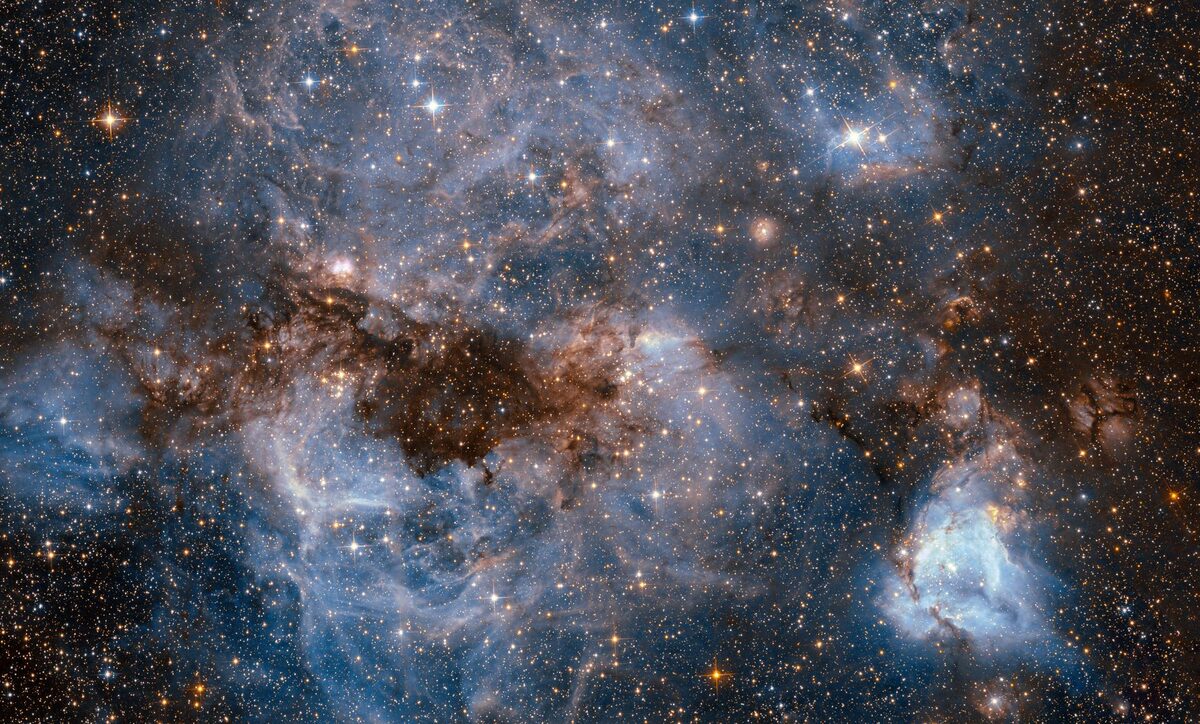
Most pictures of star-forming regions show one moment in time. The newest ESA/Webb Picture of the Month shows more than that. In the October 22 image of N159, a stellar nursery in the Large Magellanic Cloud (LMC), the region's different parts sit at different stages of star formation. A research paper released alongside it puts numbers on that sequence, with a catalog of more than 300,000 individual point sources.
N159, formally catalogued as LHA 120-N 159, lies about 161,000 light-years away. The new view comes from Webb's Near-Infrared Camera (NIRCam) and covers a patch of sky roughly 230 light-years across. ESA's release title is "Stars brewing in a nebulous cauldron." The region is under three million years old, which makes it one of the youngest star-forming regions in the LMC, and it holds thousands of stars at the earliest stages of their lives.
Reading the colors
Webb sees in infrared, so the colors in the image are assigned to tell different materials apart. ESA's guide to the image is simple.
- Orange clouds show polycyclic aromatic hydrocarbons (PAHs), an important carbon-based molecule.
- Pale blue regions are ionised H II gas, hydrogen ionised by the intense ultraviolet light from massive stars.
- Dark red filaments are cool molecular hydrogen. ESA calls them the densest part of the nebula.
The texture tells you something too. According to the ESA/Webb release, the fierce stellar winds from the region's massive, hot stars sculpt dense ridges and carve open cavities in the gas. The dark red filaments currently shield new stars from harsh radiation and stellar winds. By zooming in, you can see stars as points of light embedded in those filaments and in the small pillars of orange gas reaching into the blue bubbles. ESA says these structures will eventually melt away, leaving their completed stars behind.
Astronomers have looked at N159 before. The brightly glowing spot on the left side of the image is the Papillon Nebula, an exceptionally compact blob of ionised hydrogen that Hubble resolved for the first time in 1999. What Webb adds is depth: the new data reveal much dimmer stars than earlier views of the region could.
300,000 stars and a timeline
The image is the public face of a larger science program. The data come from Webb program #5114, and the first results appear in a paper on arXiv by Habel et al., "Sequential Star-Formation and the Near-Infrared Stellar Populations within N159", submitted September 22.
The authors call N159 one of the richest H II complexes in the LMC. It stretches about 130 parsecs and, in their words, exemplifies large-scale sequential star formation. To study it, the team measured more than 300,000 point sources in ten NIRCam filters from 1 to 4.7 microns. The faintest objects are around 27th magnitude in the F115W filter, which corresponds to stellar masses reaching below about 0.1 solar masses. ESA puts it as stars less than a tenth as massive as the Sun. For a region this far away, that reaches the dimmest kinds of stars.
Detecting faint stars is only half the job. A deep field of a star-forming region also contains main-sequence stars and older stars alongside the young ones. To separate them, the team built several colour-magnitude and colour-colour diagrams, which plot each source's brightness and its colors across several filters. Young stellar objects, still wrapped in dust and gas, show an infrared excess, and the paper identifies candidate young stellar objects from that signature. The authors report evidence for stellar populations younger than 0.5 million years, and the infrared-excess sources correlate spatially with dust filaments and molecular gas, which demonstrates their embedded state. That lets the researchers sort the population by evolutionary stage instead of treating every point of light the same way.
Once the young stellar objects were mapped, a pattern appeared. ESA reports that N159's western region has more young stellar objects packed into a more concentrated area, which shows that it is at an earlier stage of collapsing to form stars. The paper's abstract describes more evolved star-forming populations in the N159E region and newer star formation in the N159W region, supporting the sequential star formation scenario. In ESA's words, with the whole sequence of star formation taking place at once, N159 is a unique place to see the evolution of a collapsing molecular cloud up close.
Why It Matters
N159 is a nearby stand-in for the early Universe. ESA notes that the LMC's metallicity, its proportion of elements heavier than hydrogen and helium, is significantly lower than in the Milky Way. That gives researchers an opportunity to study H II regions in conditions more similar to those found in the early Universe, helping us learn about star formation in that time. The ESA/Webb release names N159 alongside the larger N79 region and the Tarantula Nebula as H II regions conveniently located for study in the LMC.
Webb can see the early Universe directly, but it can't resolve individual stars forming in galaxies billions of light-years away. Here, at 161,000 light-years, it can. The new paper counts stars down to below a tenth of a solar mass, distinguishes young objects from evolved ones, and shows where the youngest are concentrated. That level of detail is the kind you need to test ideas about how star formation spreads through a cloud and whether low metallicity changes the process.
The sequential pattern is useful on its own, too. Because the western region is at an earlier stage than the eastern part of N159, astronomers get several stages of one process in a single field of view, at the same distance and in the same galactic environment. That is a cleaner comparison than one built from separate regions observed with different instruments.
What comes next
The Habel et al. paper presents the first results from the NIRCam study, so further analysis of the 300,000-source catalog is a natural follow-up. The open questions are clear enough: how the populations of young stars differ from one part of the complex to the next, and what the sequence across N159 says about how star formation spreads through a low-metallicity cloud. For now, the image shows a region where massive stars have carved cavities into their surroundings while dense filaments of cool molecular hydrogen still shield stars at their earliest stages, with the western region caught at an earlier stage of collapse.
