
At first glance, the latest image from the Hubble Space Telescope looks like a standard galaxy portrait. A barred spiral about the size of the Milky Way fills the frame, its arms wrapped around a central bar of stars. A tiny spiral off to its left may be a satellite galaxy. The more important part of the picture is down in the lower-right corner, and it is easy to miss.
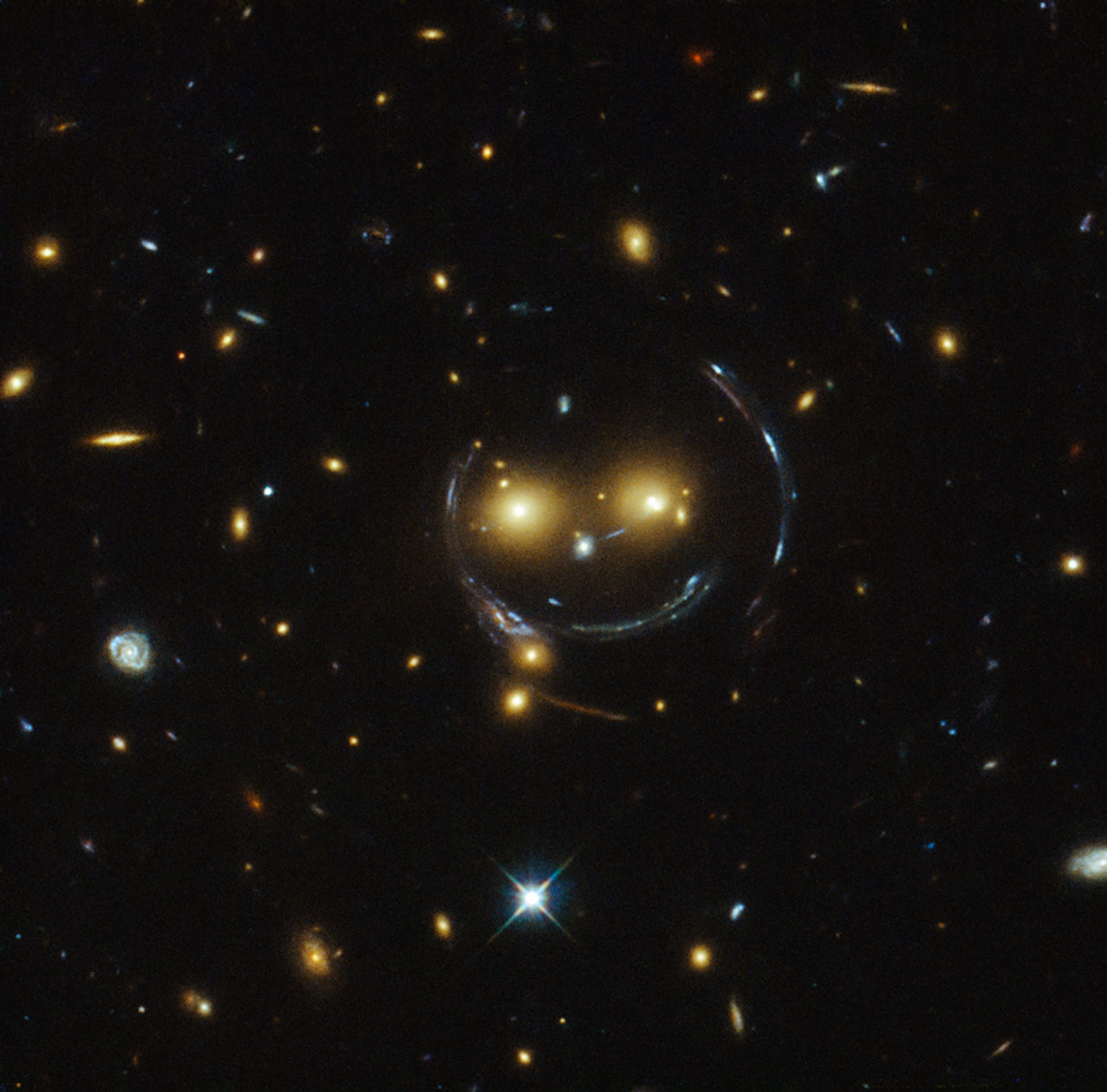
There, a foreground elliptical galaxy about 4.5 billion light-years away is bending the light of a much more distant galaxy, one about eight billion light-years from us, into a distorted pair of images. The background galaxy shows up as a large arc and, across from it, a smaller counter-arc that is flipped relative to the first. Astronomers call this an "arc-counterarc pair," and it is one of the cleaner signatures of strong gravitational lensing.
NASA released the image on Oct. 22, 2026, with credit to NASA, ESA and X. Huang of the University of San Francisco, and image processing by Gladys Kober. The agency did not present it as a one-off pretty picture. It belongs to a Hubble campaign whose job is to get ready for a much larger lens survey that NASA's Nancy Grace Roman Space Telescope is expected to carry out.
How a galaxy becomes a lens
The basic idea is that mass bends the path of light. When a massive galaxy sits almost exactly in front of a more distant one, as seen from Earth, the foreground galaxy acts like a lens. It magnifies the background source and smears it into arcs. In this case it also produces more than one image, which is where the counter-arc comes from.
The strength of that effect is the useful part. According to NASA, a more massive foreground galaxy makes a stronger lens. Because the amount of distortion depends on how much mass is doing the bending, researchers can work backward from the shape of the arcs to calculate the foreground galaxy's mass, including the dark matter it contains. Dark matter gives off no light, but it still bends light, so lensing is one of the few ways to weigh it directly.
The arc-counterarc configuration likely helps here. Two images of the same background galaxy, seen through different parts of the lens, should give modelers more to work with than a single smeared arc would.
The problem with doing this one lens at a time
Hubble is very good at this kind of observation, but it has a basic throughput problem. As NASA puts it, Hubble can view lenses one at a time. According to a 2025 release from the Space Telescope Science Institute (STScI), Hubble has studied hundreds of lenses to date. That is a real body of work, but it is small if the goal is to test dark-matter theories statistically and not galaxy by galaxy.
Roman is designed to change the scale. A study in The Astrophysical Journal, led by Bryce Wedig of Washington University in St. Louis, estimated that Roman will identify more than 160,000 gravitational lenses. STScI's summary of that work says hundreds of them should be suitable for detailed dark-matter study. Each Roman image will cover an area 200 times larger than Hubble's infrared snapshots.
The paper behind those numbers, "The Roman View of Strong Gravitational Lenses" (arXiv:2506.03390, submitted June 3, 2025), is a yield simulation. It estimates how many galaxy-galaxy strong lenses should be detectable in Roman's High Latitude Wide Area Survey. The authors model Roman with a field of view of 0.281 square degrees and diffraction-limited resolution of about 0.1 arcsecond. That combination of a wide field and sharp images is what makes a survey of this size realistic.
What Hubble is actually rehearsing
The new image is part of an effort to make sure the analysis tools are ready before Roman's data arrives. According to NASA, astronomers are using Hubble images to build a computer model that analyzes distortions in lensed images caused by dark matter. That model is meant to help analyze Roman's images later.
The work also goes the other way. NASA says Hubble will follow up on interesting lenses that Roman finds. In practice that is a sensible division of labor. Roman's survey turns up a large population of lenses, most of which will be handled statistically. The unusual ones, such as lenses with odd geometry or hints of small-scale structure, get closer study with Hubble.
The Wedig team's simulation fits into the same plan. The researchers released their simulation products specifically to train neural networks and to validate pipelines that look for dark-matter substructure. With more than 160,000 candidates, nobody is going to inspect each lens by hand. Automated tools have to find the lenses and flag the useful ones, and those tools need realistic training data before real data shows up. Hubble's real lenses and Roman's simulated ones cover different parts of the same problem.
Why It Matters
The point of the exercise is dark matter, and in particular how it behaves on scales smaller than a galaxy. The Wedig paper notes that strong lenses can constrain dark matter models and the standard cosmological model, Lambda-CDM (LCDM), at sub-galactic scales. According to STScI, less massive clumps of dark matter cause smaller distortions, so measuring tinier amounts of bending lets researchers detect and characterize smaller dark matter structures. Because models differ in how they distribute dark matter on small scales, those measurements are a way to tell them apart.
A handful of well-studied lenses can suggest an answer, but they cannot settle it. A sample in the hundreds of high-quality systems, drawn from a pool of more than 160,000, is the kind of dataset that could produce a statistically meaningful test. Getting there depends on having analysis tools that already work by the time the survey data comes in. The 2025 STScI release anticipated Roman science operations in 2027, and calibrating those tools on Hubble images now fits that timeline.
There is also a simpler lesson in the image itself. The lens sits in a corner of a frame that is nominally about something else, a big, bright barred spiral. Roman's wide field is meant to capture many such systems at once, and this Hubble image shows the kind of object the survey will be looking for.
