
For most of its life on the ground, the Nancy Grace Roman Space Telescope has been lying down. On June 25, 2026, that changed. Inside the Payload Hazardous Servicing Facility at NASA's Kennedy Space Center, technicians used precision handling hardware to rotate the observatory from horizontal to vertical — the orientation it will hold, more or less, for the rest of its working life in space. NASA detailed the milestone in a July 6 blog post, and the mission is now counting down toward a launch targeted for no earlier than August 30, 2026.
It's a mundane-sounding procedure — turning a spacecraft on its end — but it marks a hard boundary between two phases of Roman's life. Everything before this rotation was about building and shipping. Everything after it is about proving, piece by piece, that the telescope will actually work once it's 1.5 million kilometers from Earth with no one around to fix it.
The Trip to the Cape
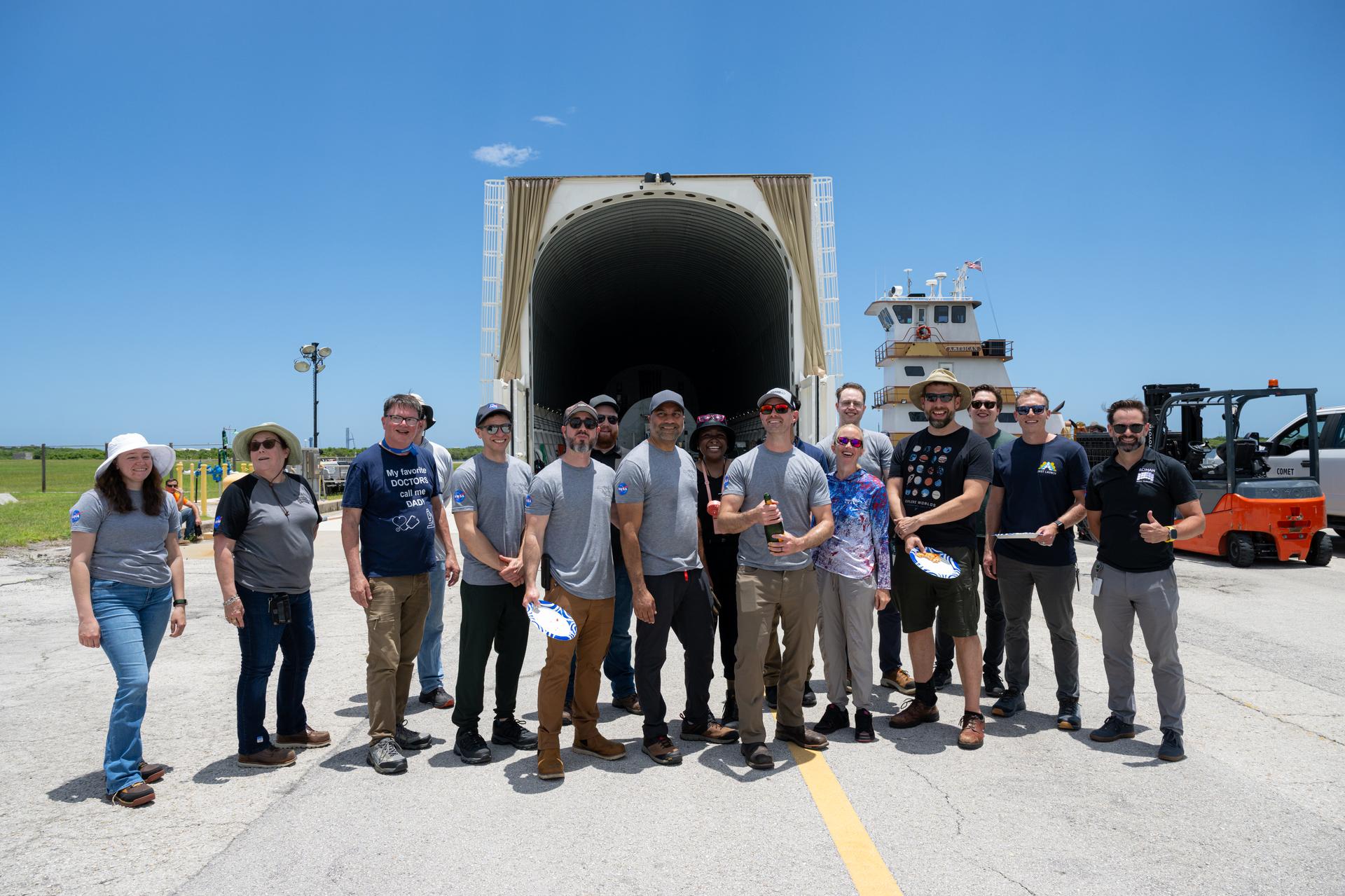
Roman arrived at Kennedy Space Center aboard NASA's Pegasus barge late in the morning on June 22, 2026, according to Spaceflight Now's coverage of the move. The spacecraft traveled inside a protective transport case nicknamed "the Chariot," and the trip wasn't entirely smooth: Neil Patel, the Roman mechanical engineer who accompanied the observatory, said the mission has a tight temperature tolerance — the telescope must stay below 74 degrees Fahrenheit — and the primary and backup cooling units on the transport case struggled to keep up after the spacecraft left Massachusetts. An emergency team added rental cooling units en route to keep the temperature in range. That kind of environmental babysitting isn't optional for a spacecraft built around sensitive optics and detectors; even small swings in temperature during transit can introduce stresses that show up later as calibration headaches or worse. The barge disembarked shortly after 7 p.m. EDT, delayed about an hour by thunderstorms. Once inside the Payload Hazardous Servicing Facility, the telescope was lifted and rotated to vertical, the configuration engineers need for the roughly 70-day prelaunch campaign of checkouts, fueling and encapsulation that precedes integration with its launch vehicle. In this posture, Roman is oriented the way it will sit atop the rocket that carries it to space — a SpaceX Falcon Heavy lifting off from Launch Complex 39A at Kennedy.
Nine Months Ahead — and Still on the Clock
The number that stands out in NASA's announcement isn't the rotation itself, it's the schedule. An August 30 launch date would put Roman nine months ahead of its original timeline — Spaceflight Now reports the date was moved up from an original September launch target. For a flagship-class NASA astrophysics mission, arriving early rather than late is unusual enough to be newsworthy on its own.
Being ahead of schedule doesn't mean the pressure is off, though. The weeks between now and launch are exactly when problems tend to surface: functional tests exercise systems that have sat dormant since final assembly, and integration with the rocket introduces new physical and electrical interfaces that haven't been checked together before. NASA's post frames the vertical move as a step toward inspections and functional testing, not the end of them — Roman still has to prove itself system by system before anyone straps it to a Falcon Heavy.
What Roman Is Built to Do
Once operating, Roman's headline feature is scale. Space.com's July 8 coverage — timed to imagery of the telescope standing vertical at Kennedy — reiterates the figure that has defined public understanding of the mission for years: a field of view at least 100 times larger than Hubble's. Roman program executive Lucas Paganini put it this way in comments to Spaceflight Now: Roman offers "the same resolution" as Hubble "but a wider area" — about 1,000 times faster in terms of sky coverage. That's not a resolution upgrade; it's a wide-angle upgrade, letting Roman capture in a single exposure what would take Hubble many, many pointings to cover — work Paganini said would take Hubble thousands of years to match what Roman can do in one. That difference in field of view is the whole point of the mission's science case. Roman is designed to survey — not to stare at one object for a long time, but to sweep large swaths of sky repeatedly, building the kind of statistical datasets that answer questions Hubble and even Webb aren't built to tackle efficiently: mapping the large-scale distribution of dark matter, tracking the expansion history of the universe to constrain dark energy, and finding exoplanets via gravitational microlensing across huge stretches of the galaxy.
The telescope's name honors Nancy Grace Roman, NASA's first Chief of Astronomy and the figure Paganini called the "Mother of Hubble" for the role she played in making the Hubble Space Telescope program possible — a lineage that makes Roman less a successor to Hubble in raw capability and more a complement to it, built to do the wide, statistical astronomy that Hubble's narrower view was never meant for.
Why It Matters
Dark matter and dark energy together dominate the universe's mass-energy content, and both remain almost entirely mysterious in their physical nature. Progress on either problem depends less on staring harder at individual objects and more on gathering enormous, uniform datasets — mapping how galaxies cluster across billions of light-years, or tracking how the universe's expansion rate has changed over cosmic time. That's a data-volume problem, and it's exactly the kind of problem Roman's 100-times-Hubble field of view is designed to solve. As Paganini put it, scientists know the universe's expansion is accelerating — a discovery that led to a Nobel Prize a quarter-century ago — but don't yet know whether that acceleration is changing over time, or whether the physics driving it is dark energy at all rather than a gap in our understanding of gravity itself.
The exoplanet side of the mission matters for a related reason: most of what's known about planets beyond our solar system comes from methods that favor planets close to their stars. Roman's microlensing survey, paired with a coronagraph instrument developed by NASA's Jet Propulsion Laboratory for observing faint light near host stars, is built to help fill in a part of the exoplanet census that current methods systematically undersample.
None of that science happens until the telescope survives launch, deployment, and months of on-orbit commissioning. The vertical rotation at Kennedy is a small physical event, but it's a visible marker that Roman has moved out of the assembly-and-transport phase and into the final, unforgiving stretch of pre-launch testing — the phase where a nine-month schedule cushion can evaporate quickly if something doesn't check out.
