
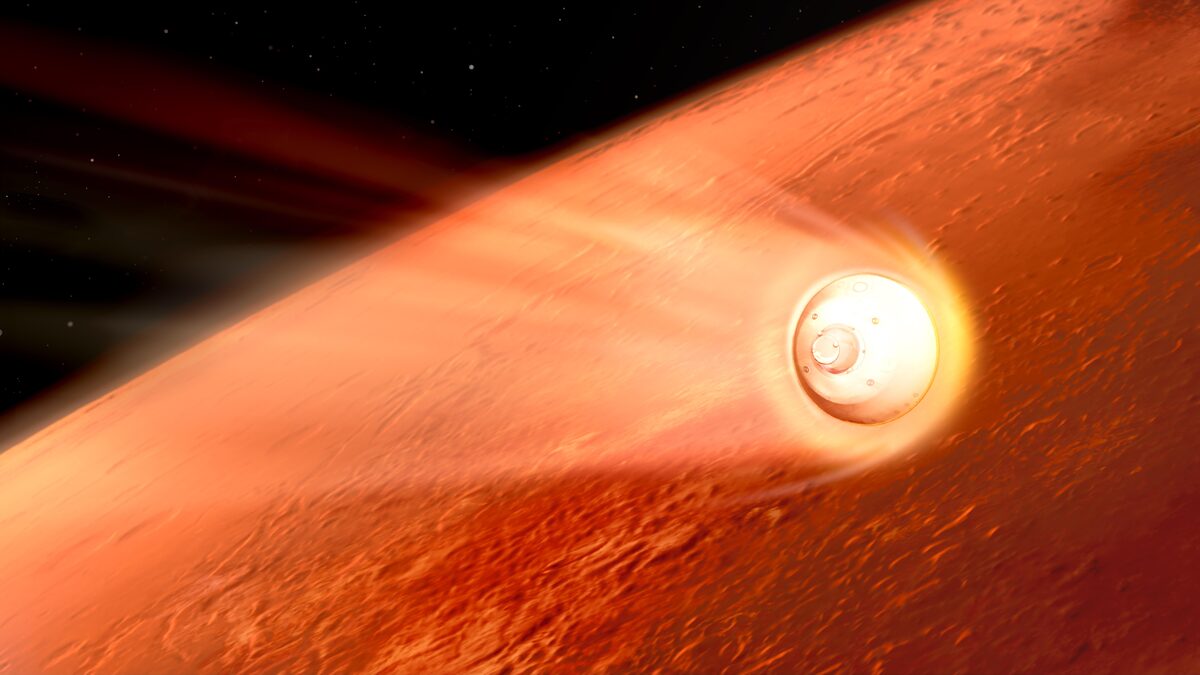
Getting a spacecraft to Mars is hard. Landing one is harder. NASA's newest helicopter mission is betting it can skip the second problem entirely — and Firefly Aerospace just got the job of building the shield that keeps the whole thing alive long enough to try.
On July 7, 2026, Firefly announced it had received a $13 million subcontract from NASA's Jet Propulsion Laboratory to design, manufacture, and test the aeroshell for SkyFall, JPL's follow-on to the Ingenuity helicopter that made the first powered, controlled flight on another planet. The award — Firefly's first out of its newly formed Gloworks innovation lab — covers the capsule-like shell that will protect the mission's payload through launch, the cruise to Mars, and the violent heat of atmospheric entry.
A Landing Without a Landing
SkyFall was unveiled publicly at NASA's "Ignition" event on March 24, 2026, and its core idea is a fairly radical departure from how NASA has historically put things on Mars. Rather than building a lander or rover platform to touch down and then release a helicopter, SkyFall dispenses with the landing platform altogether.
Instead, the mission will use what JPL calls the "SkyFall Maneuver": a mid-air release during descent that lets three heritage-derived helicopters fly free and disperse across the Martian surface on their own, without ever needing a wheeled or legged platform to land first. According to JPL, the goal is to distribute multiple next-generation rotorcraft to scout candidate landing sites for future human missions and to map subsurface water ice — a resource that would be critical for any astronauts who eventually set foot on Mars.
Firefly's materials describe a similar mandate: three helicopters conducting science and airborne subsurface mapping and resource prospecting ahead of eventual crewed Mars missions. It's Ingenuity's mission profile, scaled up and multiplied.
What Firefly Is Actually Building
An aeroshell is not the helicopter itself — it's the protective capsule, typically a heat shield and backshell pair, that encases a payload during the trip from Earth and shields it from the extreme heat generated by slamming into the Martian atmosphere at hypersonic speed. Get the aeroshell wrong and nothing inside survives to matter.
Under the new subcontract, Firefly will run structural qualification and flight-acceptance testing on the aeroshell at its Rocket Ranch facility before shipping the hardware to JPL. From there, JPL will put it through further environmental testing and integrate it with the agency's SkyFall helicopters and deployment system — the mechanism that actually executes the SkyFall Maneuver and releases the helicopters during descent.
It's a comparatively modest dollar figure for a Mars mission component — $13 million is a fraction of what a full spacecraft costs — but it's a meaningful entry point for Firefly, which has built its reputation primarily on launch vehicles and lunar landers. This is the first contract awarded through Gloworks, a new arm of the company apparently set up to chase exactly this kind of specialized subsystem work.
The Ride There Is Just as Strange
The aeroshell isn't the only unconventional piece of this mission. According to reporting from Space.com, NASA intends to launch SkyFall toward Mars in 2028 aboard what the agency is calling its first nuclear-powered interplanetary spacecraft, using nuclear electric propulsion (NEP) to make the cruise from Earth to Mars ahead of the helicopters' mid-air deployment. NEP systems generate electricity from an onboard nuclear reactor to power electric thrusters — a propulsion approach that can offer greater efficiency than conventional chemical rockets over long interplanetary distances, though it has never carried a NASA payload to another planet before.
That means SkyFall, if it flies as currently envisioned, would be notable on two fronts simultaneously: a new nuclear-powered cruise stage, and a landing-free helicopter deployment method that has no real precedent beyond Ingenuity's own brief demonstration flights, which depended on a separate rover mission for support. Firefly's aeroshell has to be built to survive both — the unfamiliar thermal and vibration environment of an NEP-propelled cruise, and then the atmospheric entry immediately preceding a maneuver JPL has not yet performed.
Why It Matters
Ingenuity proved that powered flight works in the thin Martian atmosphere — a genuine engineering surprise when it first demonstrated the feat. But Ingenuity was a technology demonstration that depended on a separate rover mission's landing infrastructure to reach the surface. SkyFall is different: it's an attempt to make aerial deployment a standalone strategy for putting instruments on Mars, without the cost and complexity of a dedicated landing platform for each destination.
If the SkyFall Maneuver works, it could open a cheaper, more flexible way to scatter science payloads across a wide area of Mars in a single mission — useful not just for subsurface water-ice mapping, but for scouting terrain ahead of the astronauts NASA still says it wants to send there. It also means more of the mission's fate rides on pieces like Firefly's aeroshell: with no landing platform as a backup or buffer, the capsule protecting the helicopters through entry has less margin for error, not more. A contract this specific — one company, one component, built to a hard 2028 target — is a small but telling sign of how seriously JPL is treating that engineering challenge.
Sources
- NASA's SkyFall Mars Helicopters — NASA JPL
- Firefly Aerospace Receives $13 Million NASA JPL Subcontract to Build Aeroshell for SkyFall Mars Mission — Firefly Aerospace
- Firefly Aerospace Receives $13 Million NASA JPL Subcontract to Build Aeroshell for SkyFall Mars Mission — GlobeNewswire
- NASA's '1st nuclear powered interplanetary spacecraft' will send Skyfall helicopters to Mars in 2028 — Space.com
