
China's Tianwen-2 spacecraft has caught up with one of the strangest objects in Earth's neighborhood. According to the China National Space Administration, the probe closed to within about 20 kilometers of near-Earth asteroid 469219 Kamoʻoalewa in early July 2026, capping a journey of roughly a billion kilometers and 13 months since launch. That rendezvous distance — down from the 2,000-kilometer flyby range it held just weeks earlier — marks the start of nine months of close-up surveying before the spacecraft attempts something no mission has done at this particular kind of target: grabbing a sample from Earth's smallest and most elusive class of companion, a quasi-satellite.
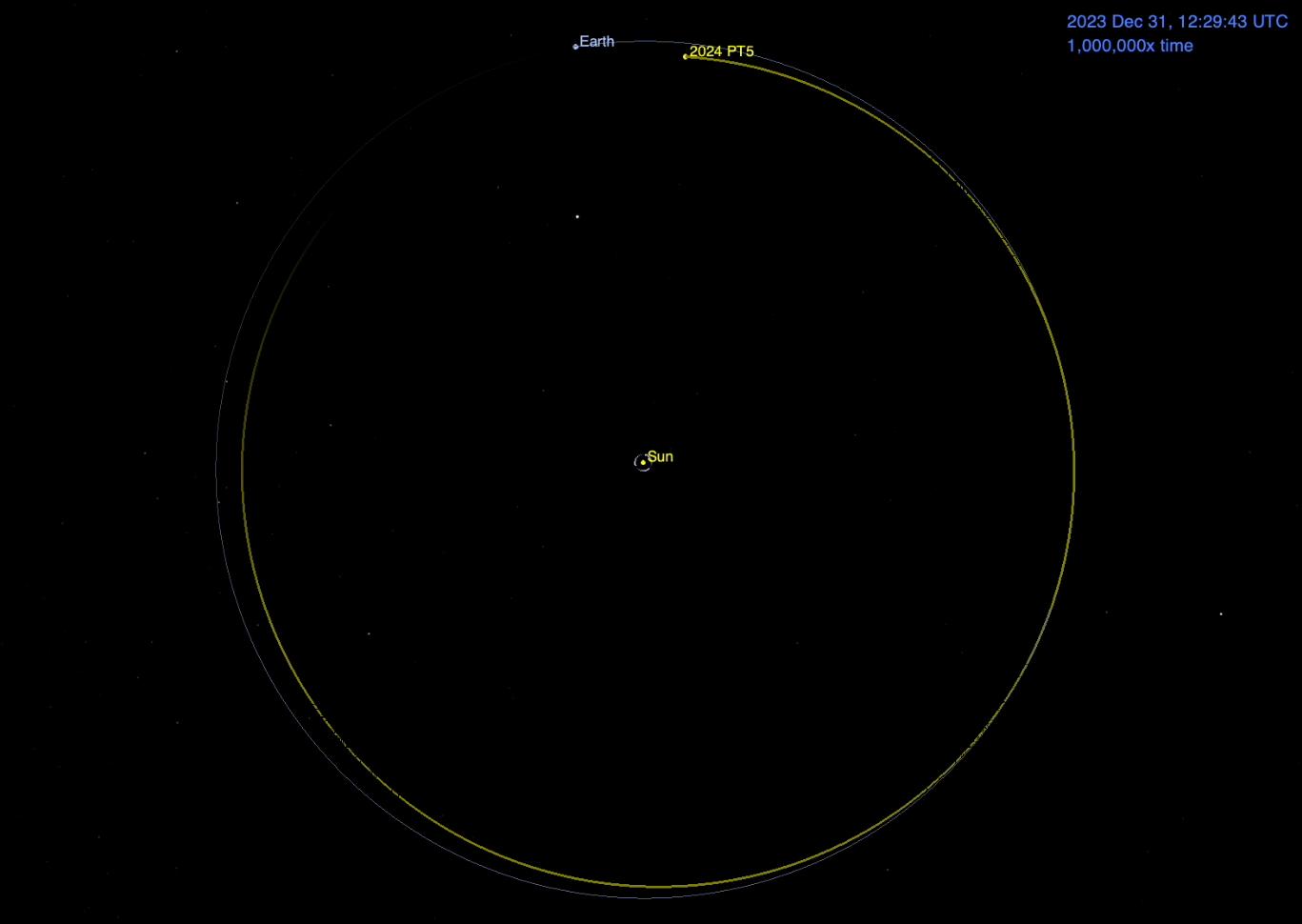
Kamoʻoalewa is not a moon in any conventional sense. It does not orbit Earth the way the Moon does; instead it loops around the Sun on a path that, thanks to a gravitational quirk, stays loosely tethered near Earth before eventually wandering off. Objects that do this are called quasi-satellites, and Kamoʻoalewa is one of only seven known to exist. It's also tiny — somewhere between 40 and 100 meters across, according to Forbes' reporting on the arrival.
How Tianwen-2 found its target
Chasing down a 40-to-100-meter rock across interplanetary distances is not a simple matter of pointing and flying. Per China's Global Times, the mission's ground team first re-detected Kamoʻoalewa on June 6, 2026, then executed a capture maneuver the very next day, June 7, while still roughly 30,000 kilometers out. From there, Tianwen-2 tightened its approach steadily: a closest pass within 2,000 kilometers on June 19, followed by imaging from about 20 kilometers on July 2 and the formal start of close-range scientific exploration at that same distance, announced by CNSA on July 6.
That progressive approach did more than just get the spacecraft close — it also fixed the asteroid's position with far greater precision than existed before. Global Times reports the mission team refined Kamoʻoalewa's positional uncertainty from over 100 kilometers down to the kilometer level, and released updated ephemeris data through China's Lunar and Planetary Data Release System. For an object this small and faint, that kind of precision is itself a scientific product — future observers, whether ground-based telescopes or other spacecraft, now have a far better fix on exactly where it will be.
A possible piece of the Moon — or not
Part of what makes Kamoʻoalewa worth a billion-kilometer trip is a lingering question about where it came from. A peer-reviewed study published in Nature Communications, timed to the encounter, concludes that Kamoʻoalewa's surface probably shares its composition with the asteroid Itokawa — a body sampled by Japan's Hayabusa mission — but shows signs of more advanced space weathering, matching a heavily weathered LL-chondrite-type surface in laboratory tests. That finding pushes back against a competing idea floated by earlier research: that Kamoʻoalewa could be a fragment of the Moon itself, blasted into space by an ancient impact and later nudged into its current quasi-satellite orbit. Instead, the study's authors argue the asteroid most likely originated from the Flora family of main-belt asteroids, reaching Earth's neighborhood via the ν6 secular resonance — an asteroidal origin story, not a lunar one. That gives Tianwen-2's instrument team a specific hypothesis to test once the spacecraft's cameras and spectrometers get a proper look, and it raises the scientific stakes for whatever sample eventually comes home.
What happens next
Tianwen-2 launched May 28, 2025, from the Xichang Satellite Launch Center, according to Forbes' account of the mission. Now that it has arrived, the spacecraft is expected to spend the coming months mapping Kamoʻoalewa's surface, measuring its composition, and scouting for a safe site to attempt sample collection — the mission aims to bring back at least 100 grams of material. Current plans call for Tianwen-2 to depart the asteroid in April 2027 and deliver its samples to Earth by November 2027.
That's not the end of the mission's road, though. After dropping off its Kamoʻoalewa samples, Tianwen-2 is slated to continue on to a second, far more distant target: comet 311P/PANSTARRS, with arrival not expected until 2035 — turning this single spacecraft into a two-act mission spanning more than a decade.
Why It Matters
Kamoʻoalewa sits at the intersection of several open questions in planetary science. Some earlier researchers have suspected it could be lunar debris, and if that turned out to be true, a returned sample would offer a rare, uncontaminated look at material blasted off the Moon by an impact whose age and location are still unknown — effectively a delivery of lunar history that never had to be dug up on the Moon itself. But the new Nature Communications study argues against that scenario, concluding that Kamoʻoalewa's Itokawa-like, heavily space-weathered surface is better explained by an asteroidal origin in the Flora family. If that conclusion holds up, the comparison against Japan's Hayabusa sample data from Itokawa becomes valuable in its own right, sharpening scientists' understanding of how small bodies near Earth weather and evolve over time — and a returned sample would let Tianwen-2's own data settle the debate directly, one way or the other.
There's also a practical dimension. Quasi-satellites like Kamoʻoalewa are notoriously hard to track and characterize precisely because they're small, dim, and orbitally unusual — only six others like it are even known to exist. The kilometer-level ephemeris refinement CNSA achieved during approach isn't just a navigation footnote; it's a template for how future missions, or ground-based planetary-defense surveys, might pin down similarly elusive objects. And with Tianwen-2 already plotted to press on to a comet after this encounter, China is positioning a single spacecraft to return data on two very different classes of small bodies — rocky, Earth-adjacent debris and icy, more distant material — within one extended mission.
Sources
- Tianwen-2 mission target asteroid (469219) Kamoʻoalewa probably develops an Itokawa-compositional but more space-weathered surface — Nature Communications
- A Chinese Spacecraft Just Arrived At Earth's 'Quasi Moon' — Forbes
- China's Tianwen-2 reaches asteroid Kamoʻoalewa, starting scientific exploration after 1 bln kilometers journey — Global Times
